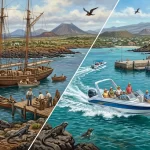
Every inter island journey in Galápagos includes a short boat ride most travellers never budget for. Because the inhabited ports have shallow, exposed bays, speedboats and yachts anchor offshore instead of docking. The link to land is the taxi acuático, a licensed municipal lancha working a fixed tariff.
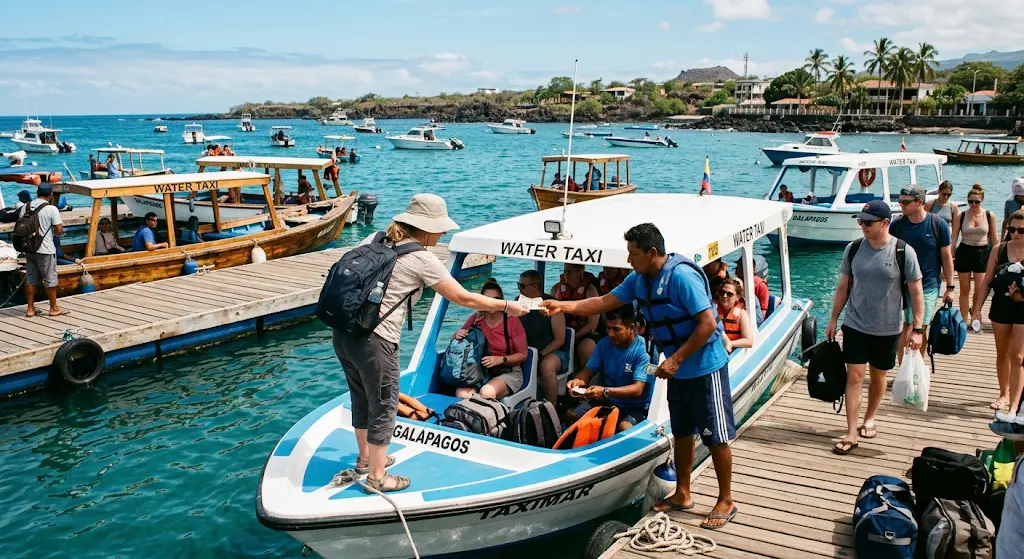
For 2026 and 2027 that tariff is no longer uniform. Puerto Ayora now charges $1.50 per person in daylight, up from the dollar that held for years, and $2 after 19:00. The other ports still sit around $1 to $1.50, though operators across the archipelago now advise holding $2 per crossing because drivers seldom carry change. A traveller circulating between three islands pays for six to ten separate crossings.
| Charge / Service | Rate 2026-2027 |
|---|---|
| Puerto Ayora, daytime | $1.50 per person, recently increased from $1 |
| Puerto Ayora, after 19:00 | $2 per person |
| San Cristóbal | $1, up to $2 at night |
| Isabela and Floreana | $1 to $1.50 per person |
| Cash to carry per crossing | $2, since drivers rarely give change |
| Oversized luggage | Possible $1 to $2 surcharge |
| Crossing time | 2 to 6 minutes |
| Payment method | Cash only, small bills |
| Separate charges | Itabaca barge $1 public or $2 private, Isabela entry fee $10 |
Why the Tariff Held for Decades and Then Moved
The service was formalised in the 1990s, replacing informal fishermen with registered cooperatives under municipal tariff control. Because residents, crew and fishermen use the same boats as tourists, local authorities held the rate flat for years while park fees and airfares climbed. Fuel costs and maintenance on ageing lanchas eventually pushed the Santa Cruz cooperatives to revise the daytime rate upward, the first meaningful change in a generation. The smaller ports have so far absorbed the same pressure without adjusting.
Rates Port by Port After the Increase
Puerto Ayora runs the busiest service, 24 hours, reachable on VHF channel 14, and is the port where the rise has already taken effect. Puerto Baquerizo Moreno holds at roughly $1, with a higher charge on late crossings, and many ferry passengers there walk straight onto the pier without any transfer at all. Puerto Villamil requires a crossing for every arrival and departure, paid immediately before the separate $10 municipal entrance fee. Floreana uses the same panga transfer on a reduced schedule. Arrival sequences are detailed in the Galápagos port check in guide.
Where It Fits Into Ferry Day
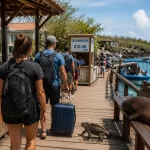
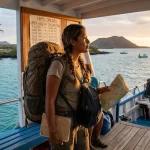
Passengers reach the pier 40 minutes before departure, clear agricultural biosecurity inspection, then board a lancha in groups to reach the anchored speedboat. Large bags are stacked on the bow, so fragile items belong in hand luggage. The fare is never included in the ticket, as the breakdown of ferry prices for 2026 and 2027 makes clear. Boards, tanks and bicycles may add a surcharge, a point covered alongside gear rules on Galápagos ferries.
Practical Rules Before the Dock
Carry at least $10 in small bills, since ATMs exist only on Santa Cruz and San Cristóbal and empty out in high season. Pay on boarding, and call a boat the night before any pre dawn tour. Keep the fare mentally separate from the mandatory payments listed among the ten entry requirements and fees. The Port Captaincy can also suspend crossings during heavy swell, most often between July and December.
A Closing Read on the One Dollar Crossing
For nearly thirty years the harbour crossing in Galápagos cost the same dollar it did before mass tourism arrived, in a destination where almost every other price has multiplied. That stability was a policy decision rather than a market outcome, since the lanchas function as genuine public transport for residents as much as a tourist service. The modest rise in Puerto Ayora marks the first point at which operating costs outran that arrangement.
The system also reveals a deliberate infrastructure choice. Galápagos has avoided building deep water passenger terminals at its inhabited ports, because dredging and heavy dock construction would disturb shorelines used by sea lions, marine iguanas and shorebirds. The water taxi absorbs a logistical problem that engineering would otherwise solve at environmental cost, and the fare reflects that trade off.
For visitors the sum remains trivial, perhaps $15 to $25 across a full itinerary, yet it causes outsized friction because it demands exact cash at precise moments when none is available. Anticipating it, rather than discovering it on a crowded pier at dawn, is what separates a smooth transfer from a delayed one. Wider planning context appears in this overview of how to travel between Galápagos islands.
FAQ – Galápagos Water Taxi Fees
How much is a water taxi at Puerto Ayora pier in 2026?
One dollar fifty per person during daylight, following a recent increase from the long standing dollar rate, and two dollars after 19:00. Other ports still charge around one dollar. The Puerto Ayora service runs 24 hours and can be called by radio on VHF channel 14.
Is the water taxi included in my ferry ticket?
No. It is a separate municipal service excluded from every inter island fare, paid in cash directly to the driver, once when boarding at departure and again on arrival.
Do I pay extra for luggage?
Standard bags travel free. Surfboards, bicycles and dive tanks may attract a $1 to $2 surcharge, since bulk affects balance on small open boats. Large items are loaded onto the bow rather than carried on your lap.
Can I pay by card?
No. Cash only, in US dollars, and drivers rarely have change for notes above $5. Carry two dollars per crossing in small bills, since the rate now varies by port and by hour, and ATMs exist only on Santa Cruz and San Cristóbal.
Is the Itabaca Channel crossing a water taxi?
No. That is a larger shuttle barge between Baltra and Santa Cruz, charging $1 per person on the public service and $2 on private boats, and it forms part of the airport transfer chain rather than the harbour taxi system.
Can the service be suspended?
Yes. The Port Captaincy can restrict operations during heavy swell, most often between July and December, which occasionally compresses ferry boarding times and delays departures.