Bicycles, Surfboards and Dive Equipment on Galápagos Ferries: What Boats Accept and What They Refuse
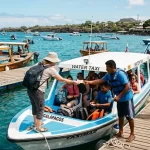
The vessels that connect Santa Cruz, San Cristóbal, Isabela and Floreana are not ferries in the conventional sense. They are enclosed-hull fiberglass speedboats, typically carrying around 30 passengers, powered by outboard engines and crossing open Pacific water in roughly two to two and a half hours. That design shapes every rule about what luggage can travel. There is no vehicle deck, no cargo hold and no forklift. Every item is lifted by hand, twice, because passengers and bags transfer between the dock and the boat aboard small water taxis.
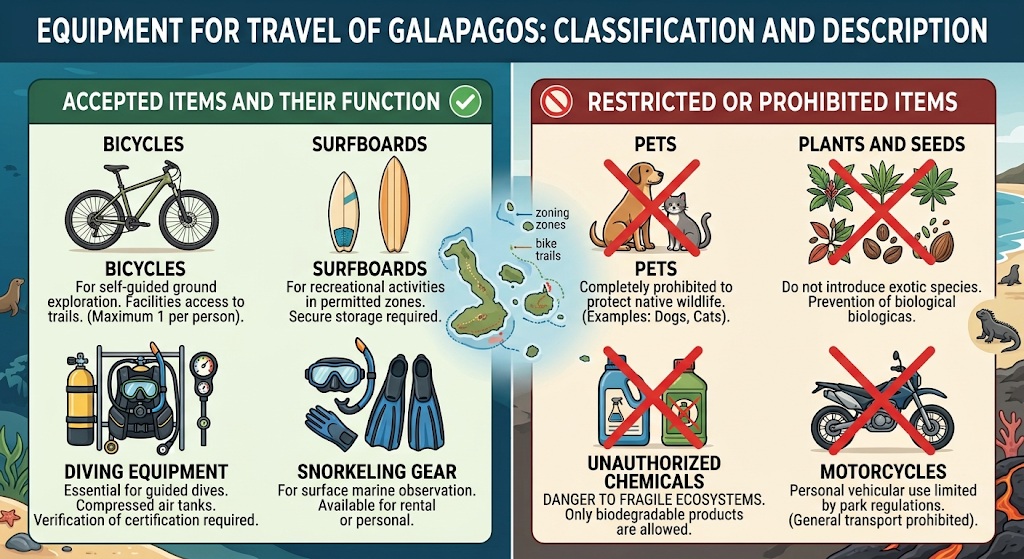
Sports equipment therefore sits in a separate category from ordinary suitcases. A bicycle, a surfboard or a full set of dive gear is not necessarily heavier than a packed duffel, but it is longer, more rigid and harder to stow. Operators manage it as oversize cargo, subject to a surcharge, to advance notice and ultimately to the captain’s discretion on the day of sailing.
The short answer is yes: bicycles, boards and personal diving equipment are routinely carried between the inhabited islands. The practical answer involves fees, packing standards and a biosecurity inspection that specifically targets wet, sandy and organic material. Understanding those three filters before arriving at the pier prevents the most common outcome travelers complain about, which is gear being left behind while the boat departs on schedule.
| Specification / Metric | Detail / Value |
|---|---|
| Standard baggage allowance | One large bag plus one carry-on per passenger; reference weight around 23 kg |
| Oversize sports item surcharge | Approximately $10 per bicycle or surfboard, paid at the pier |
| Items accepted | Bicycles (boxed or bagged), surfboards and SUPs in board bags, masks, fins, snorkels, wetsuits, regulators, BCDs |
| Items usually refused | Charged scuba cylinders, loose dive weights in quantity, large lithium e-bike batteries, unbagged boards |
| Inspection authority | Galápagos Biosecurity Agency (ABG), formerly SICGAL, at every port of departure |
| Check-in window | Arrive 45 to 60 minutes early; baggage screening closes about 30 minutes before departure |
| Stowage location | Bow locker, stern deck or roof rack under tarpaulin, exposed to salt spray |
| Additional port charges | Water taxi $1 to $1.50 per crossing, cash; Isabela municipal entry fee $10 |
| Advance notice recommended | At least 48 hours before departure, at the time of booking where possible |
How the hull and the water taxi transfer set the real size limit
Space on these boats is finite and awkwardly shaped. Luggage goes into a sealed bow locker, onto the open stern deck, or up on the roof under a tarpaulin secured with straps. None of those compartments was designed around a two metre surfboard or a boxed mountain bike, so a single oversize item can displace several suitcases.
The bottleneck that travelers underestimate is the transfer. At Puerto Ayora, Puerto Villamil and Puerto Baquerizo Moreno, passengers reach the anchored speedboat aboard a water taxi that seats around a dozen people. Long items must be balanced across the gunwales of a small open launch in a moving swell. Crews accept that work routinely, but it explains why boards and bikes are loaded last, why crews want notice, and why an item arriving unannounced on a full sailing may be deferred to the next departure. Declaring equipment when you book, rather than at the counter, is the single most effective step you can take. The broader baggage framework is set out in our guide to Galápagos ferry luggage policy and fees.
The oversize surcharge and where it is actually collected
Ordinary luggage travels without extra cost. Most operators allow one large bag plus one carry-on, and in practice a second suitcase or a bag slightly over the nominal 23 kg reference weight passes without comment. Sports equipment is treated differently. A bicycle or a surfboard normally attracts a surcharge of about $10 per item, collected in cash at the pier during check-in rather than through the online booking.
Two points cause friction. First, the surcharge is per item and per leg, so a return trip with a board doubles it. Second, it is separate from the municipal and dock charges that apply regardless of what you carry, including the $1 water taxi fee at each end and the $10 Isabela entry fee on arrival at Puerto Villamil. Budgeting for all three avoids scrambling for cash on a crowded pier. Current fare levels are tracked in our breakdown of Galápagos ferry prices for 2026 and 2027.
Why the biosecurity inspection targets wet and sandy equipment
Every bag boarding an inter-island vessel is screened by the Galápagos Biosecurity Agency (ABG) and tagged before it can be loaded. The mandate is not security in the airport sense. It is the prevention of species movement between islands, each of which holds distinct endemic populations that evolved in isolation.
Water sports gear is scrutinised precisely because it is an efficient vector. Sand trapped in a board bag, seawater standing in a wetsuit, algae on fin straps, seeds and soil wedged into bicycle tyre treads and drivetrains: all of it can carry organisms from one island to another. Equipment that is visibly clean and dry clears screening quickly. Equipment packed straight off the beach invites a manual inspection, and inspections take time that the 30 minute screening cutoff does not forgive. Rinse boards, fins and bike tyres in fresh water the night before and let everything dry fully. The full sequence at the pier is covered in our Galápagos port check-in guide.
Bicycles: boxing, batteries and where riding is worth the effort
Bicycles travel best disassembled to some degree. Removing the front wheel, dropping the saddle and turning the handlebars in line with the frame reduces the footprint substantially, and a bike bag or the original cardboard box protects both your components and the fiberglass around them. Unpackaged bicycles are sometimes accepted, though they are the first item refused when a boat is full.
Electric bicycles raise a separate issue. Large lithium-ion batteries are restricted cargo on Ecuadorian domestic flights and are frequently declined by boat crews as well, given the confined cabin and the absence of any fire suppression capability at sea. Confirm before travelling rather than at the counter.
Whether the effort pays off depends on your route. Isabela rewards cyclists most: the flat coastal track from Puerto Villamil to the Muro de las Lágrimas runs about six kilometres each way past lagoons and tortoise habitat. San Cristóbal offers a longer climb toward El Junco and Puerto Chino, while Santa Cruz links Puerto Ayora with the highland zones around Bellavista and Santa Rosa. All three islands rent decent bicycles by the hour or the day at prices well below the cost of shipping your own across an ocean.
Surfboards: the San Cristóbal factor
San Cristóbal is the archipelago’s surf island, with consistent reef and point breaks such as Tongo Reef, Carola and La Lobería within reach of Puerto Baquerizo Moreno, which is why boards move on the Santa Cruz to San Cristóbal crossing more than on any other route. Shortboards present no real problem. Longboards and stand-up paddleboards approach the practical ceiling of what a speedboat roof can carry safely.
A padded board bag is effectively mandatory, not for the operator’s benefit but for yours. Boards are strapped on deck or overhead where they take sustained salt spray and knock against luggage for two hours in open water. Fins should be removed, the nose and tail padded, and the whole package clearly labelled. Sea conditions matter too: swell is generally larger and the ride rougher between July and December, which is exactly when surfers want to travel. Passengers sensitive to motion should also read our notes on choosing the best seats on the ferry.
Dive equipment: what crosses easily and what stays on the island
Personal diving kit travels without difficulty in the categories that matter most. Masks, snorkels, fins, wetsuits, hoods, booties, computers, regulators and buoyancy compensators pack into a standard dive bag, count as regular luggage and rarely attract a surcharge. Protect regulators and computers in a hard case or padded compartment, since bags are stacked and shifted by hand.
Two items behave differently. Scuba cylinders are the clearest exception: charged tanks are compressed gas cylinders and operators generally decline to carry them. If a cylinder must move, it should be empty with the valve open and declared in advance, and even then acceptance is not guaranteed. In practice nobody needs to transport tanks, because dive centres on Santa Cruz, San Cristóbal and Isabela supply cylinders and weights with every guided dive. Lead weights are the second exception: a few kilograms distributed through your luggage is unremarkable, but a full weight belt adds dead mass to a boat that is already weight-managed, and weights are supplied locally at no meaningful cost. Divers planning their island sequence around specific sites will find the context in our Galápagos hammerhead shark guide and in our overview of how to travel between the Galápagos islands.
Final Thoughts
The rules governing oversize equipment on Galápagos speedboats are not arbitrary operator preferences. They are the visible edge of a transport system built to move people between four inhabited ports without also moving seeds, spores, insects and marine organisms across the ecological boundaries that made the archipelago scientifically significant in the first place. A sandy board bag is, in the language of conservation management, a pathway. Treating it as one costs a traveler ten minutes with a hose and saves an island system that cannot be repaired once a colonisation event succeeds.
The practical constraints reinforce the same conclusion. Small hulls, hand loading and water taxi transfers impose real physical limits that no amount of advance payment can expand. Operators respond with the tools available to them: a modest surcharge, a request for notice, and discretion on the day. That structure is reasonable, though it places the burden of planning squarely on the passenger.
For most visitors, the economics settle the question. Rental bicycles and boards are available on all three main islands at a fraction of the cumulative cost of surcharges, airline oversize fees and the risk of salt damage. The travelers who genuinely benefit from bringing their own equipment are those with specific technical requirements, particularly divers attached to a well-fitted wetsuit and a familiar regulator. For everyone else, the archipelago’s rental network is a simpler and lighter answer.
FAQ About Sports Equipment on Galápagos Ferries
How much does it cost to take a surfboard or bicycle on a Galápagos ferry?
The usual surcharge is around $10 per oversize item, per leg, paid in cash at the pier during check-in rather than online. Regular luggage carries no additional charge, so the fee applies specifically to large-volume sports equipment such as bicycles, surfboards and paddleboards. Budget separately for the $1 to $1.50 water taxi fee at each port and the $10 municipal entry fee charged on arrival at Isabela.
Can I bring a scuba tank between the Galápagos islands?
In practice, no. Charged cylinders are compressed gas containers and operators generally refuse them on passenger speedboats. If a cylinder must travel, it should be completely empty with the valve open, declared at the time of booking, and even then acceptance depends on the captain. There is no operational need to carry tanks, since dive centres on Santa Cruz, San Cristóbal and Isabela include cylinders and weights with all guided dives.
Does a surfboard count as my checked bag or as an extra item?
A surfboard is treated as an additional oversize item, not as your standard allowance. You may still bring one large bag plus a carry-on alongside it, with the board assessed separately. Boards must be in a padded bag, with fins removed and the nose and tail protected, because they are stowed on the stern deck or roof rack where they are exposed to salt spray and contact with other luggage for the full crossing.
Why does biosecurity inspect wet or sandy equipment more closely?
The Galápagos Biosecurity Agency screens all inter-island baggage to prevent the transfer of organisms between islands with distinct endemic species. Damp wetsuits, sandy board bags and soil packed into bicycle tyres and chainsets can carry seeds, invertebrates and algae. Equipment that is rinsed in fresh water and fully dried clears screening in seconds, while visibly contaminated gear triggers manual inspection that can exceed the 30 minute screening cutoff before departure.
Do I need to tell the operator in advance that I am bringing a bike or board?
Yes, and ideally at least 48 hours before departure or at the moment of booking. Crews plan stowage and weight distribution around the passenger manifest, and a single unannounced oversize item can displace several suitcases on a boat carrying roughly 30 people. Undeclared equipment arriving at a full sailing is the most common reason gear gets deferred to a later departure while the passenger travels as scheduled.
Is it worth bringing my own bicycle instead of renting in the Galápagos?
For most travelers, renting locally is the better decision. Puerto Villamil, Puerto Ayora and Puerto Baquerizo Moreno all have rental shops offering maintained bicycles by the hour or the day, at costs far below the combined airline oversize charges, ferry surcharges and salt exposure involved in shipping your own. Electric bicycles add a further complication, since large lithium-ion batteries are restricted on Ecuadorian domestic flights and frequently declined by boat crews.