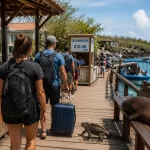
Every year, a predictable number of Galapagos travelers end up sleeping an extra night in Puerto Ayora they never planned for, missing a domestic flight they’d already paid for, or spending two hours hunched over a plastic bag on a speedboat that’s pitching hard enough to make even confident sailors nervous. None of this is bad luck. It’s the direct result of treating the inter-island ferry system like a formality instead of what it actually is: a public transport network with fixed schedules, hard capacity limits, and biosecurity rules that don’t bend for anyone’s itinerary.
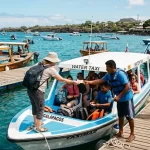
The ferry itself, sometimes called a “fibra” locally, is a fiberglass speedboat that seats between 20 and 40 people and connects Santa Cruz, San Cristobal, Isabela, and (less often) Floreana. It runs twice a day on the main routes, takes two to two and a half hours per crossing, and costs $35 to $40 one way. On paper, that’s straightforward. In practice, five recurring mistakes cause most of the problems travelers report, and all five are avoidable if you know they’re coming.
Mistake 1: Booking your last ferry the same day as your flight home
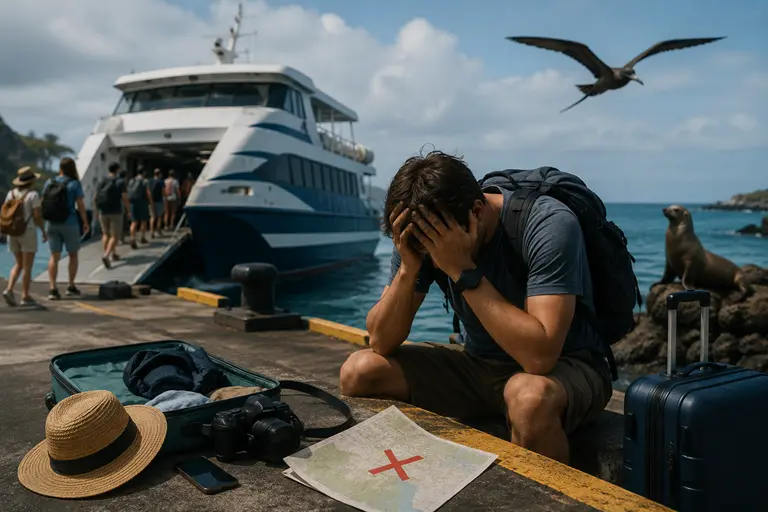
This is the single most common error, and it’s also the one with the highest cost when it goes wrong. Say you’re staying on Isabela and flying out of Baltra or San Cristobal tomorrow. The temptation is to take the morning speedboat from Isabela to Santa Cruz, then connect straight to the airport, landing with what feels like plenty of buffer.
The problem is that every step in that chain has its own points of failure, and none of them are under your control. Speedboats depart on schedule, but arrival times shift with sea conditions, engine trouble, or a slow biosecurity line at the dock. A crossing that normally takes two hours can stretch to three without anyone doing anything wrong. If your only Santa Cruz–Isabela ferry departs at 6 or 7 a.m., and your flight requires you at the airport counter two to three hours ahead of departure to complete Transit Control Card and biosecurity procedures, you’ve left yourself no room at all for delay. Our ferry booking and boarding guide walks through realistic timing for each leg if you want to map out a specific connection.
There’s a second layer to this specific to Isabela and San Cristobal: there is no direct boat between them. Getting from one to the other means riding to Santa Cruz first, then waiting for the afternoon departure to your final destination, which can turn a single transfer into most of a day. If your flight is the next morning and you’re starting from Isabela or San Cristobal, doing that full connection on flight-eve is asking for trouble. If you’re not sure which dock or pier applies to your route, our guide on where to board the Galapagos ferry covers each port by island.
How to avoid it
Build in a full buffer day. If your international or domestic flight leaves from Baltra or San Cristobal, plan to be in that same town the night before, not still traveling toward it. If you’re island-hopping through Santa Cruz on your way to the airport, take the earliest possible departure the day before your flight, not the same morning.
Mistake 2: Not budgeting time for biosecurity bag checks
Galapagos runs one of the strictest biosecurity systems of any tourist destination, administered by the ABG (Agencia de Regulación y Control de la Bioseguridad y Cuarentena para Galápagos). It exists to stop invasive plants, insects, and animals from moving between the mainland and the islands, and between the islands themselves, and it applies at every transfer point, not just your first arrival.
Travelers usually know about the mainland side: at Quito or Guayaquil airport, before you can check in for your flight to Galapagos, your luggage goes through an ABG counter, gets X-rayed, and is sealed with a tamper-evident tag. You’ll also have filed an online Biosafety Sworn Declaration in the 48 hours before your flight, since the paper version was phased out. What surprises people is that a version of this same process shows up again at the dock before boarding an inter-island ferry: bags get a physical inspection for organic material, and the line can be slow, especially during the morning rush before the 7 a.m. departure.
None of this takes long on its own; the inspection itself is a matter of minutes per person. The issue is stacking it against a tight schedule. If you arrive at the pier five minutes before departure assuming you’ll walk straight onto the boat, you may find forty other passengers already queued for the same inspection line, and the boat does not wait for stragglers. Our port check-in guide breaks down what happens at each stage of the process.
How to avoid it
Arrive at the dock at least 30 to 45 minutes before your scheduled departure, not right at departure time. Keep any snacks in sealed, commercial packaging rather than fresh fruit or homemade food, since that’s what tends to get flagged and slow the line down further. For a full rundown of what you can pack, weight limits, and extra fees, see our ferry luggage policy and fees page.
Mistake 3: Stacking island hops without any margin for delay
A common trip shape looks like this: Santa Cruz to Isabela in the morning, a full day of tours, then Isabela back to Santa Cruz the next afternoon, connecting same-day to San Cristobal. Each leg looks fine in isolation. Strung together with zero slack, one delayed boat cascades into a missed connection, and because there are only two departures a day per route, a missed connection doesn’t mean “wait an hour.” It means waiting until the next morning or afternoon window, sometimes the next calendar day.
This compounds badly around the San Cristobal–Isabela pairing specifically, since neither island has a direct boat to the other. Anyone doing that route in one day is already relying on two back-to-back crossings connecting perfectly through Santa Cruz, with time in between to clear the dock, find lunch, and get back to a different pier for the second leg. Add rough seas or an ABG line and that plan gets tight fast. For the full picture of how each route connects, see our overview of inter-island routes and practical info.
How to avoid it: treat each inter-island hop as its own day, not a leg you tack onto another activity. If your itinerary requires the San Cristobal–Santa Cruz–Isabela connection (or the reverse), don’t schedule anything else, like a tour, checkout, or another transfer, on that same day. Build one buffer day per multi-hop transition, particularly if the connection touches Isabela.
Mistake 4: Underestimating how rough the crossing gets from July to October
Galapagos has two broad seasons: a warmer, wetter period from roughly December through May, and a cooler, drier “garúa” season from June through November, driven by the Humboldt Current pushing up from the south. That current brings the nutrient-rich water that makes the diving and snorkeling so good in these months, but it also brings wind and swell, and the inter-island crossings feel it directly.
Seas start getting choppy in July, and August through October is consistently cited as the roughest stretch, with September frequently singled out as the worst of all, to the point that a number of tour boats deliberately schedule their annual maintenance in that month rather than run it. The calmest water, by contrast, tends to fall around February, inside the warmer season when the Panama Current dominates.
None of this makes the boats unsafe. It does mean that a two-hour crossing in September can feel considerably longer and rougher than the same crossing in March, and travelers who’ve never experienced ocean swell before are sometimes caught off guard by how physical it is: an open, fast-moving boat taking waves at an angle, with spray coming over the sides in the uncovered rear seats.
How to avoid it: if you’re traveling between July and October and know you’re prone to motion sickness, take medication before boarding, not after symptoms start. Ask for a seat in the covered section rather than at the very back, and avoid a heavy meal right before departure. Our seasickness tips for the Galapagos ferry go into more detail, and our guide to choosing the best seats on the ferry covers which spots ride smoothest. If your trip dates are flexible and seasickness is a real concern, note that February tends to offer the calmest water of the year.
Mistake 5: Not booking ferry tickets ahead of peak season
Because each speedboat only holds 20 to 40 passengers and there are only two sailings a day per route, capacity fills up fast during Easter week, Christmas, and New Year, three periods when both Ecuadorian domestic travelers and international tourists are moving through the islands at the same time. It’s common during these weeks for the first available seat on a given route to be a full day away, which is a serious problem if it collides with a flight connection you can’t move.
Outside those peak windows, showing up and buying a same-day ticket at the dock is often still possible, though never guaranteed. During Easter, Christmas, or New Year, it’s a genuine risk rather than a minor inconvenience. If you’re weighing whether to reserve ahead or take your chances at the pier, our comparison of booking online vs. buying at the port lays out the trade-offs.
How to avoid it: if any part of your trip falls within Easter week, the last two weeks of December, or the first week of January, book your inter-island tickets as far in advance as your dates allow, ideally as soon as your itinerary is fixed. Outside peak season, a day or two ahead is normally enough of a cushion. Current fares by route are listed on our 2026–2027 ferry prices page.
The routes, at a glance
| Route | Duration | Price (one way) | Direct? |
|---|---|---|---|
| Santa Cruz to San Cristobal | About 2 hours | $35 | Yes |
| Santa Cruz to Isabela | 2 to 2.5 hours | $35 | Yes |
| Santa Cruz to Floreana | About 2.5 hours | $40 | Yes, limited days |
| San Cristobal ↔ Isabela | Via Santa Cruz, same day | Two fares | No, must connect |
Departures generally run at 7:00 a.m. and 3:00 p.m. on the Santa Cruz–San Cristobal and Santa Cruz–Isabela routes. Floreana runs far less frequently, often just one morning departure a few days a week, so it needs to be planned around rather than treated as a flexible add-on.
A working checklist before you buy
- Is this the last ferry before a flight? If so, take it the day before departure, not the morning of.
- Have you added 30 to 45 minutes at the dock for the biosecurity bag check, on top of your normal arrival buffer?
- Does your itinerary connect through Santa Cruz on the same day as another activity? If so, clear that day of everything else.
- Are you traveling July through October? Pack motion sickness medication and expect a rougher, wetter ride.
- Does any part of your trip fall in Easter week, Christmas, or New Year? Book your ferry tickets as early as possible.
You can check current schedules and reserve inter-island speedboat tickets directly through galaferry.com, choosing your route and departure window in advance rather than relying on same-day availability at the pier. For a broader look at planning an independent Galapagos trip, see our essential ferry travel guide, and if a specific question isn’t covered here, check the Galapagos ferry FAQ. Killing time during a Santa Cruz layover or waiting on a connection? Our list of 40 best things to do in the Galapagos Islands is worth a look.