The Galápagos archipelago is often described as a destination reserved for cruise passengers, but independent travel here has been legally viable and logistically practical for more than a decade. Four inhabited islands, Santa Cruz, San Cristóbal, Isabela and Floreana, are connected by a scheduled public speedboat service and by a small fleet of light aircraft. The difference between an expensive trip and an affordable one rarely comes down to accommodation. It comes down to how transport is sequenced.
Independent visitors face two distinct cost layers. The first is fixed and non negotiable: mandatory entry fees, the mainland flight, and biosecurity procedures that apply to every arrival regardless of budget. The second is variable and highly responsive to planning: which airport you fly into, which island you start on, how many sea crossings your route requires, and whether you pay for speed or accept a two hour boat ride.
This guide focuses on the second layer, where informed decisions produce measurable savings. Understanding the Santa Cruz hub structure, the pricing gap between ferries and inter island flights, and the seasonal behaviour of the sea between islands allows travellers to build efficient routes without paying for a packaged itinerary.
| Transport Metric | Detail / Value |
|---|---|
| Mainland departure airports | Quito (UIO) and Guayaquil (GYE) |
| Island arrival airports | Baltra (GPS), serving Santa Cruz, and San Cristóbal (SCY) |
| Typical round trip mainland airfare | Approximately $320 to $500, season dependent |
| National Park entrance fee | $200 foreign adults, $100 children under 12, cash on arrival |
| Transit Control Card (TCT) | $20 per person, issued before mainland boarding |
| Standard ferry fare | $35 to $60 one way, route dependent |
| Crossing duration | 2 to 2.5 hours per leg |
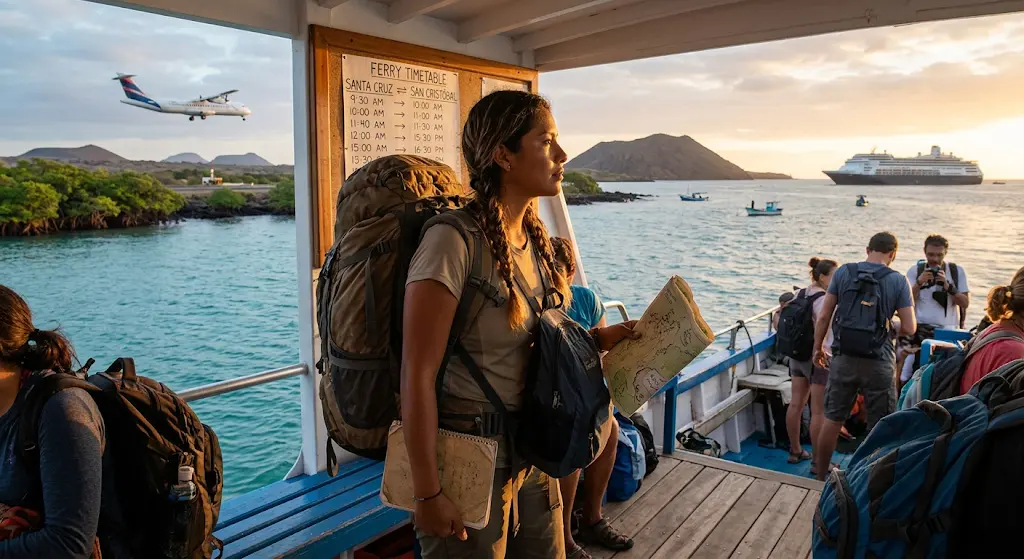
| Usual departure times | 07:00 and 15:00 daily |
| Ferry luggage allowance | Around 23 kg per passenger, subject to biosecurity inspection |
| Water taxi transfer | $1 to $2 per crossing, cash only |
| Isabela municipal entry fee | $10 foreign visitors, paid on arrival at the pier |
| Inter island flights | Roughly $180 to $270 round trip, luggage limit near 11 kg |
| Islands linked by public ferry | Santa Cruz, San Cristóbal, Isabela, Floreana |
| Calmest sea period | January to June |
Fixed Costs That Land Before Your First Crossing
Every visitor pays the same entry package. The National Park entrance fee rose to $200 for foreign adults, payable in cash at Baltra or San Cristóbal, and the Transit Control Card costs $20, purchased at the Governing Council counter in Quito or Guayaquil before check in. Neither can be avoided, discounted or bundled away, and both require clean, undamaged bills.
Airfare from the mainland is the single largest controllable expense. Guayaquil departures are consistently cheaper than Quito departures, since Quito flights usually stop in Guayaquil anyway. Booking six to ten weeks out, avoiding Ecuadorian school holidays, and travelling midweek typically shifts a return ticket toward the lower end of the range. A full checklist of the obligatory documents and payments appears in the ten requirements and mandatory fees to enter the Galápagos.
Baltra or San Cristóbal: The Arrival Airport Changes Everything
Baltra is not on Santa Cruz. Arrivals cross the Itabaca Channel by shuttle bus, then a small barge, then a road transfer to Puerto Ayora, a chain of three separate payments and roughly 90 minutes. San Cristóbal’s airport sits within walking distance of Puerto Baquerizo Moreno, which removes transfer costs entirely on that side.
The most efficient budget structure is an open jaw itinerary: fly into one island airport and out of the other. Ecuadorian carriers price these combinations at rates close to standard returns, and the arrangement eliminates a redundant two hour sea crossing plus its associated fees. Travellers comparing route order will find the practical sequencing options in this overview of how to travel between Galápagos islands.
The Speedboat Fleet and How the Public Network Works
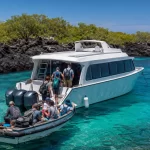
The inter island service uses fibras, fibreglass hulled boats of roughly 20 to 30 passengers powered by twin or triple outboard engines. They operate as a scheduled public transport system rather than a tour, with no guiding, no onboard catering and minimal shelter. Crossings run two to two and a half hours at open sea speed.
Two structural rules govern planning. First, Santa Cruz functions as the network hub: there is no direct public boat between Isabela and San Cristóbal, so that journey requires an overnight or a same day connection through Puerto Ayora. Second, departures cluster at 07:00 and 15:00, which means a missed morning boat usually costs a full day. Floreana runs on a reduced schedule with fewer operators and higher fares. Current route by route pricing is tracked in the guide to Galápagos ferry prices for 2026 and 2027.
When Paying for an Inter Island Flight Is Defensible
Light aircraft link the three main inhabited islands in 30 to 45 minutes, at roughly four to six times the ferry fare. For most backpackers the economics do not work. Two situations justify the expense: a tight departure window where a cancelled morning boat would mean a missed mainland flight, and travellers who cannot tolerate open water crossings. The trade off is a luggage allowance near 11 kg, well below the ferry standard, which frequently forces excess baggage charges. Ferry weight rules and their associated costs are detailed in the ferry luggage policy and fees.
Sea State, Seasonality and Route Risk
Conditions between islands are driven by the Humboldt Current and the southeast trade winds. From January to June the water is warmer and noticeably calmer. From July to December, the garúa season, swells build and crossings become physically demanding, with cancellations more likely during strong tidal phases.
Budget travellers absorb this differently than cruise passengers. A cancelled crossing means an unplanned night of accommodation plus a rebooked fare. Building one buffer day before any international departure is the cheapest insurance available. The seasonal pattern is examined in this analysis of the worst months for rough seas and tides.
Biosecurity Controls and Practical Boarding Discipline
All luggage passes agricultural biosecurity inspection at each pier, since transporting seeds, fresh produce or live material between islands is prohibited under park regulation. Inspection queues open around 40 minutes before departure, and passengers arriving late are simply not boarded.
Three recurring cash requirements catch independent travellers: the $1 to $2 water taxi at both ends of most crossings, the Santa Cruz dock fee, and the $10 municipal fee on arrival at Isabela. ATMs exist only on Santa Cruz and San Cristóbal, and they run empty during high season. Seats sell out on popular legs, which is why advance purchase matters more than travellers expect, as explained in this note on booking Galápagos ferries in advance.
Building an Efficient Ten Day Route
A cost efficient structure typically runs San Cristóbal, Santa Cruz, Isabela, Santa Cruz, Baltra, using four ferry legs rather than six. Placing Isabela in the middle avoids a dead end, since every Isabela departure must return through Puerto Ayora. Travellers who invert this order and finish on San Cristóbal often pay for two additional crossings.
Daily ground costs remain modest. Set lunches run $5 to $8, hostel beds in Puerto Ayora and Puerto Villamil sit in the $20 to $35 range, and several of the best known sites, including Tortuga Bay and the Wall of Tears, are reachable on foot or by rented bicycle at no guided cost.
A Wider Read on Independent Island Travel
The existence of a functioning public boat network in a strictly protected archipelago represents an unusual policy balance. Ecuador has maintained scheduled maritime links between inhabited islands while capping visitor numbers, enforcing biosecurity and steadily raising the conservation levy. The result is a destination that stays accessible to independent travellers without abandoning the protective framework that justifies its UNESCO status.
That balance is deliberate rather than accidental. Revenue from the doubled park fee is distributed among conservation programmes, municipal services and marine research, which means budget travellers still contribute substantially to the system they are using. The ferries themselves serve residents first, students, workers and families moving between islands, and tourism revenue subsidises a route network that would otherwise be difficult to sustain commercially.
For visitors, the practical conclusion is straightforward. Independent travel in Galápagos rewards planning over spending. Route order, arrival airport selection, seasonal timing and cash preparation determine whether the archipelago costs a moderate sum or an excessive one. The wildlife encounters that define the destination, from marine iguanas on volcanic shorelines to penguins at the western channels, remain identical whether reached by chartered yacht or by a $35 public speedboat seat.
FAQ – Backpacking Galápagos Transport
How much should I budget for transport alone on a ten day Galápagos trip?
Excluding the mainland flight, expect roughly $140 to $180 for four ferry legs, $220 in mandatory entry fees, $10 for the Isabela municipal charge, and $15 to $25 in water taxis and dock fees. Ground transfers from Baltra add another $12 to $15 per direction if you use the public shuttle and bus rather than a private taxi.
Can I fly into San Cristóbal and out of Baltra on one ticket?
Yes. Ecuadorian carriers sell multi city combinations covering both island airports, usually at a price close to a standard return. This open jaw structure removes one full sea crossing from your itinerary and is the single most effective route saving available to independent travellers.
Is there a direct boat between Isabela and San Cristóbal?
No public ferry connects these two islands directly. The journey requires transiting Santa Cruz, arriving in Puerto Ayora on a morning boat and connecting to the 15:00 departure, or overnighting there. Only the inter island aircraft offers a direct link, at considerably higher cost.
What happens if the ferry is cancelled due to sea conditions?
Operators generally rebook passengers on the next available departure rather than issuing refunds, which can mean waiting until the following morning. Since cancellations cluster between July and December, scheduling at least one spare day before any mainland flight prevents a cancelled crossing from becoming a missed international connection.
How strict are the ferry luggage limits in practice?
The standard allowance sits near 23 kg per passenger, and excess weight commonly triggers a surcharge of around $10. Bulky items such as surfboards or dive equipment are accepted on most services but may require advance notification. All bags pass agricultural inspection, and prohibited organic material is confiscated at the pier.
Do I need cash, or can I pay for transport by card?
Cash is essential. The $200 park fee, the $20 Transit Control Card, water taxis, dock charges and the Isabela municipal fee are all cash transactions, and torn or heavily worn dollar bills are frequently refused. ATMs exist only on Santa Cruz and San Cristóbal and are unreliable during peak periods, so withdraw on the mainland before departing.