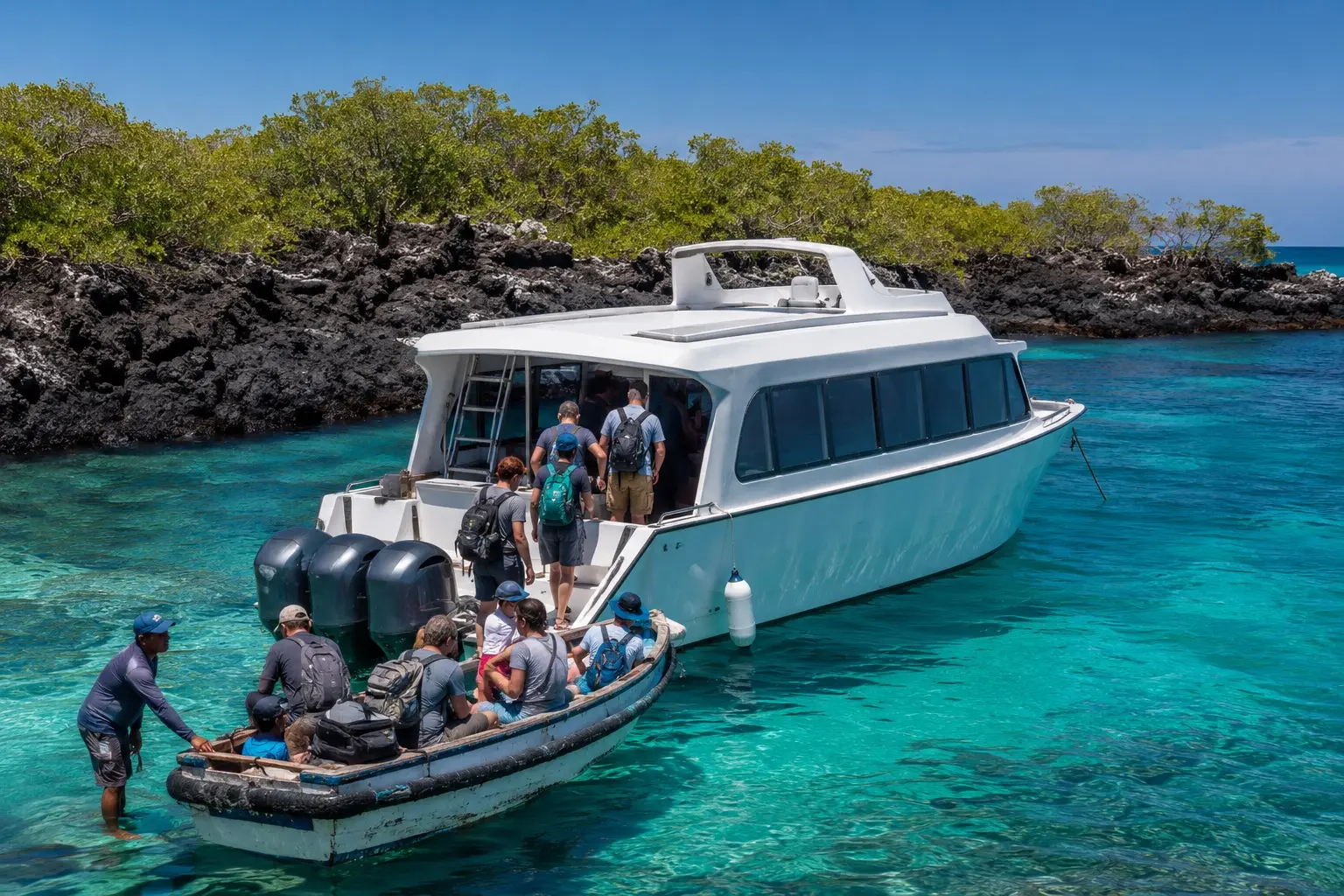
The short answer is yes for most itineraries, and emphatically yes for anything scheduled around a flight home. The inter-island “ferries” that connect Santa Cruz, San Cristóbal, Isabela and Floreana are not ferries in the conventional sense. They are privately owned fiberglass speedboats carrying roughly 24 to 32 passengers each, operating on two fixed departure windows per day. Total daily capacity on a given route is measured in the low hundreds of seats, not thousands, and that ceiling does not expand when demand rises.
This matters because island hopping has become the fastest-growing way to visit the archipelago. Travelers who once booked a cruise now assemble their own routes across the four inhabited ports, and every one of those routes depends on the same small fleet. A missed crossing is rarely a minor inconvenience: with only a morning and an afternoon option, and no direct link between Isabela and San Cristóbal, a single sold-out boat can cost a full day of a trip that was already tightly planned around domestic flights, park entry logistics and non-refundable hotel nights.
The question of advance booking, then, is really a question of risk management. How far ahead is far enough depends on the route, the month, the direction of travel and how much slack the rest of the itinerary can absorb. This guide sets out how the system works, where the pressure points are, what the realistic booking windows look like, and which parts of the process remain outside any operator’s control regardless of how early a seat is reserved.
| Specification / Metric | Detail / Value |
|---|---|
| Vessel type | Enclosed-hull fiberglass speedboat (locally: lancha or fibra), twin or triple outboard engines |
| Typical capacity | 24–32 passengers per boat; no assigned seating on most vessels |
| Direct routes | Santa Cruz ↔ San Cristóbal; Santa Cruz ↔ Isabela; Santa Cruz ↔ Floreana |
| Routes requiring a connection | Isabela ↔ San Cristóbal (same-day transit via Puerto Ayora, two separate tickets) |
| Standard departure windows | Morning approx. 06:00–07:00; afternoon approx. 14:00–15:00. Floreana operates on a reduced, non-daily pattern |
| Crossing time | 2–2.5 hours typical; up to 3 hours in heavy swell |
| Indicative one-way fare | Approx. USD 50–90 depending on route, operator and sales channel; Floreana usually priced above the standard routes |
| Standard luggage allowance | One checked bag (commonly 20–23 kg) plus one small carry-on; excess charged locally |
| Additional fees payable in cash | Water taxi approx. USD 1 per person per leg; municipal pier fee at Isabela approx. USD 10 |
| Recommended pier arrival | 45–60 minutes before departure for biosecurity inspection and manifest check-in |
| Practical advance-booking window | 72 hours minimum in low season; 1–3 weeks in high season and around national holidays |
| Regulatory oversight | Ecuadorian maritime authority, municipal port administrations, and biosecurity screening for organic material |
How the Inter-Island Network Developed
Nothing about this system was designed as public transport. It grew out of local necessity. The four inhabited islands of the archipelago sit between roughly 40 and 70 nautical miles apart, and for decades the only reliable links were cargo vessels, the occasional navy boat, and whatever private craft happened to be making the crossing. As resident populations grew and the provincial capital consolidated on San Cristóbal while the commercial center consolidated in Puerto Ayora on Santa Cruz, a daily passenger service became unavoidable.
What emerged was a decentralized network of independently owned speedboats, each licensed to operate a specific route and each running the same basic rhythm: out in the morning, back in the afternoon, crew home by evening. That rhythm is the reason the timetable looks the way it does. The two daily departure windows exist so that boats and crews finish the day at their home port, not because a transport planner determined that two crossings met demand.
Santa Cruz became the pivot by geography rather than by decree. Puerto Ayora sits near the center of the archipelago, and every other inhabited port is closer to it than to any of the others. The consequence is the single most important structural fact for anyone planning a route: there is no direct service between Isabela and San Cristóbal, and there is unlikely to be one, because the crossing is long, exposed and commercially thin. Travelers moving between those two islands must transit Puerto Ayora on the same day, arriving on the morning boat and continuing on the afternoon boat. For the full map of connections and transit timings, our overview of inter-island routes and practical information covers each pairing in detail.
Regulation tightened as tourism grew. Vessels carry mandatory safety equipment, captains are licensed for Galápagos waters, passenger manifests are filed before departure, and all luggage passes biosecurity screening designed to prevent the transfer of seeds, insects and organic material between islands. These controls improved safety and traceability. They did not add capacity, which is the constraint that drives everything discussed below.
Capacity, Fleet Structure and How Seats Are Actually Sold
A useful way to understand the booking question is to count. On a busy route such as Santa Cruz to Isabela, several boats may run in a single departure window during peak weeks, but each carries about 30 people. Even with multiple vessels dispatched, a morning window rarely offers more than a few hundred seats, and that pool is shared among independent travelers, tour operators holding blocks for their clients, residents, and workers moving between islands. Local demand is not seasonal in the way tourist demand is; it forms a baseline that never disappears.
Seats are sold through several parallel channels that do not share a single inventory system. Operators sell directly through their own offices at the piers and in town. Local agencies resell allocations. Land-tour companies pre-purchase blocks for packaged itineraries. Online platforms request and confirm space with individual boats. Because these channels overlap imperfectly, a route can appear sold out on one platform while a different operator still has space, and it can also appear available for a departure that is already effectively full. This is why confirmation, rather than checkout, is the step that matters. The comparison between booking online and buying at the port sets out the practical trade-offs of each channel.
One consequence of this fragmented structure surprises many first-time visitors: a confirmed ticket does not always specify the vessel. On high-demand days, captains consolidate passengers so that boats sail full, and the specific boat name may only be communicated the evening before departure or at check-in. A ticket guarantees a seat on the route at the stated time, not on a particular hull. Travelers who care about comfort should read the practical notes on choosing the best seats on a Galápagos ferry, since seating on most vessels is unassigned and claimed on arrival.
Pricing varies more than the standardized appearance of the service suggests. Fares differ by route, by operator, by sales channel and by whether the ticket includes assistance, transfers or flexible changes. Cash purchases made in person on the islands sometimes undercut online rates, though that saving comes with the obvious exposure of buying into whatever seats remain. Current figures by route are maintained in our breakdown of Galápagos ferry prices for 2026 and 2027.
What “Booking in Advance” Actually Means Here
Advance booking in the Galápagos does not resemble buying an airline ticket months ahead. Most operators open their sales windows a matter of weeks out, and some confirm space only a few days before departure. Requesting a seat six months in advance is rarely possible and rarely necessary. The realistic decision is between three broad approaches.
The first is same-day or day-before purchase at the pier or through a town agency. This works during genuinely quiet weeks, typically in the low-demand months of the year, and it offers maximum flexibility for travelers with open itineraries and no fixed departure date. It also carries the full risk of the system: if the boat is full, the next option is the following departure window, which may be the next morning.
The second is a 48 to 72 hour booking window, which is the minimum most platforms consider reliable given limited capacity. This is generally sufficient outside peak periods and on routes with multiple daily vessels. It leaves enough margin to switch to an alternative departure if the first choice is unavailable, without requiring the traveler to lock in the entire itinerary weeks ahead.
The third is booking one to three weeks ahead, which is the appropriate approach for high season, national holidays, and any crossing that feeds directly into a flight, a cruise embarkation or a non-refundable booking. The cost of early commitment is flexibility. The cost of late commitment, in these cases, is potentially the trip itself.
A fourth scenario deserves separate mention. Travelers attempting the Isabela to San Cristóbal transit, or the reverse, are effectively booking two crossings that must both succeed on the same day. The risk compounds: a delay or cancellation on the morning leg can strand a passenger in Puerto Ayora overnight, with the afternoon seat already paid for and unusable. That itinerary should always be reserved in advance, and where budget permits, the inter-island light aircraft alternative removes the problem entirely at roughly triple the cost.
Route-by-Route Demand and Geographic Context
Demand is not distributed evenly across the network, and the routes that sell out first are predictable.
Santa Cruz to Isabela is consistently the tightest route in the system. Isabela is the largest island in the archipelago, home to Sierra Negra, Los Túneles and Concha de Perla, and it draws a high proportion of independent travelers on multi-island itineraries. It also has fewer accommodation beds than Santa Cruz, which concentrates arrivals and departures into narrow windows. Morning departures on this route are the single most contested seats in the system, and the Santa Cruz to Isabela crossing should be booked as early as the itinerary allows during busy months.
Santa Cruz to San Cristóbal and the return leg carry the highest total volume, since San Cristóbal has its own airport and functions as an alternative gateway to the archipelago. This route usually has more vessels running, which cushions demand, but it also carries the greatest concentration of flight-critical passengers. Anyone using the afternoon boat to reach a next-morning departure from San Cristóbal airport is taking an unnecessary risk; the morning crossing leaves a full day of margin.
Santa Cruz to Floreana operates on a different logic altogether. Floreana has a resident population of roughly a hundred people, no significant hotel infrastructure, and a service pattern that is not daily. Departures cluster on specific days of the week, capacity is minimal, and cancellations for low passenger numbers or sea conditions are comparatively common. Advance booking is not merely advisable on this route; without it, a crossing may simply not be available on the intended date.
Departure points also differ in a way that affects timing. In Puerto Ayora, passengers board via a short water taxi ride from the municipal dock to the speedboat anchored in the bay. Puerto Villamil’s pier on Isabela sits outside the town center and requires a taxi. San Cristóbal’s dock is within walking distance of most of Puerto Baquerizo Moreno. Allowing for the transfer to the boarding point, rather than for the departure time alone, is what keeps the pre-departure hour from becoming a problem.
Seasonality, Holidays and Demand Cycles
Three overlapping calendars determine how full the boats are on any given date, and only one of them is obvious to international visitors.
The first is the international high season: mid-June through late August, and mid-December through mid-January. These periods align with northern hemisphere school holidays and produce the highest sustained pressure on every route. Booking windows of two to three weeks are reasonable here, and same-day purchase should not be part of the plan.
The second is the Ecuadorian and South American domestic calendar, which international travelers routinely overlook. Carnival, Semana Santa, the early-November holidays around Día de los Difuntos and the independence celebrations, and the New Year period all generate sharp mainland demand for the islands. During these windows, boats can fill weeks ahead, and the compression is often more severe than during international high season because the peak is concentrated into a few days.
The third is the sea itself. From roughly July through November, the Humboldt current brings cooler water, stronger southeast trade winds and choppier channel crossings. Boats still run, but crossings are rougher and cancellations for sea state are more likely. From December through May, seas are generally calmer and warmer. This does not change how many seats exist, but it changes how reliably a scheduled departure sails, which is a distinct planning consideration. Travelers sensitive to motion should read the practical measures in our guide to managing seasickness on Galápagos ferries before choosing between the morning and afternoon crossing.
Morning departures deserve a note of their own within the seasonality discussion. Trade winds typically strengthen through the day, so the 07:00 crossings are usually smoother than the afternoon ones. That comfort advantage is well known locally, which is precisely why morning seats sell out first. The demand pattern and the sea-state pattern reinforce each other.
Operational Realities Advance Booking Cannot Solve
A confirmed ticket protects against one specific failure mode — a full boat — and against nothing else. Understanding the remaining exposures prevents both false confidence and unnecessary alarm.
Port closures are decided by the maritime authority, not by operators. When sea conditions exceed safe thresholds, departures are suspended for all vessels simultaneously. In these cases tickets are typically rescheduled to the next available departure or refunded, but the traveler’s schedule absorbs the disruption. Refund processing under standard terms usually takes several business days, which is a meaningful consideration for travelers on tight budgets.
Mechanical issues affect individual boats. Because the fleet is composed of independent vessels, a breakdown usually results in passengers being redistributed to other boats in the same window when space allows. This is one of the few situations where the informality of the system works in the traveler’s favor.
Change and cancellation policies are generally restrictive by design. Modifications are commonly permitted up to about two days before departure, with no changes accepted inside 24 hours. This reflects the manifest and biosecurity requirements, which are filed in advance and cannot be adjusted at the pier. Travelers who anticipate needing flexibility should build it into the itinerary rather than expecting it from the ticket.
Finally, no-shows are absolute. Boats depart on schedule and do not wait. Passengers who arrive after the manifest closes forfeit the fare. The full sequence of arrival, inspection and boarding is set out in the Galápagos port check-in guide, and it is worth reviewing before the first crossing, because the process is unfamiliar to most visitors and the timing is genuinely unforgiving.
Regulation, Biosecurity and Costs Beyond the Fare
Every inter-island crossing passes through a biosecurity checkpoint. Bags are inspected for fresh produce, seeds, live plants, soil and animal material, all of which are restricted between islands to prevent the spread of invasive species. Inspected luggage is tagged before it is loaded. This is not a formality, and it is the main reason the recommended pier arrival is 45 to 60 minutes rather than the 15 minutes the crossing distance would suggest.
Luggage allowances are standardized in principle and applied with some local variation in practice: one checked bag in the 20 to 23 kilogram range plus one small carry-on is the common baseline, with excess weight charged at the pier in cash. Travelers on multi-island itineraries generally find that a soft duffel handles the loading process, deck storage and water taxi transfers considerably better than a rigid suitcase. Specific limits and surcharges are detailed in the ferry luggage policy and fees guide.
Several small costs sit outside the ticket price and are almost always cash-only in US dollars. Water taxis to and from anchored vessels run about one dollar per person per leg in Puerto Ayora. Isabela charges a municipal pier fee on arrival, generally around ten dollars. These amounts are minor individually, but card payment is not accepted at the dock, and ATMs on the smaller islands are unreliable. Carrying small denominations is a practical necessity, not a preference.
Practical Guidance for Planning Crossings
The following approach reflects how the system behaves rather than how it is marketed.
Fix the crossings that carry consequences first. Any ferry that connects to a domestic flight, a cruise embarkation or a prepaid hotel night should be booked as soon as the operator’s sales window opens, and should be a morning departure wherever possible. The morning boat provides a second chance on the same day; the afternoon boat does not.
Reserve the Isabela leg early regardless of season. Its combination of high demand and limited accommodation makes it the least forgiving link in most itineraries.
Structure the route to minimize backtracking. Because Santa Cruz is the hub, itineraries that run Santa Cruz to Isabela, back to Santa Cruz, then on to San Cristóbal generally require fewer contested seats than routes that bounce between the outer islands. Fewer crossings means fewer opportunities for the plan to fail.
Leave a buffer day before departure from the archipelago. This is the single most effective protection against sea-state cancellations, and it costs one hotel night. Travelers who return to their departure island the evening before their flight rather than the same morning eliminate almost all of the schedule risk in the system.
Keep documentation and cash accessible. Passport or identification is checked against the manifest at every crossing, and small bills are needed for water taxis and pier fees at multiple points along the way.
Verify the departure the day before. Times shift occasionally, boat assignments are confirmed late, and a five-minute confirmation message removes the most common source of avoidable disruption.
Final Thoughts
The advance-booking question exposes something broader about how the Galápagos manages visitation. The archipelago’s conservation model has always relied on constraint rather than expansion: park entry is capped and priced, visitor sites operate under guided quotas and rotation schedules, and the transport network between inhabited islands has never been scaled to eliminate friction. The two-departure timetable and the thirty-seat boat are not deficiencies awaiting correction. They function as a soft limit on internal movement, and they distribute pressure across the islands in a way that a high-frequency service would not.
For the independent traveler, this produces a specific planning discipline that has little in common with mass-market destinations. The relevant question is not whether a seat is available but whether the itinerary can survive the loss of one. Systems with narrow capacity and no redundancy reward preparation and punish improvisation, and the Galápagos ferry network is a clear example of both. Travelers who understand this build in margin; those who assume transport elasticity that does not exist tend to discover the constraint at the pier.
The pattern is also increasingly common. Small-island economies and protected areas worldwide are confronting the same arithmetic: access infrastructure sized for residents, meeting visitor volumes that grow faster than any local willingness to expand it. Whether the answer is more capacity or better distribution of existing capacity remains contested across the tourism sector. In the Galápagos, the answer has so far been the latter, and the modest speedboat crossing between Puerto Ayora and Puerto Villamil is where that policy meets the individual traveler’s calendar.
Frequently Asked Questions About Booking Galápagos Ferries in Advance
How many days in advance should I book a Galápagos ferry?
A minimum of 72 hours is realistic during quieter months, when multiple boats typically run each route and cancellations free up space. During international high season (mid-June to August, mid-December to mid-January) and Ecuadorian holiday periods such as Carnival and Semana Santa, one to three weeks is the appropriate window. Any crossing connected to a flight, cruise embarkation or non-refundable booking should be reserved as soon as the operator’s sales window opens, irrespective of the season.
Can I just buy a ferry ticket at the pier on the day of travel?
Sometimes, but it is not a strategy that should be relied upon. Same-day purchase is occasionally possible during low-demand weeks, when a boat has not filled and the operator sells remaining seats at the dock. It fails predictably in high season, on the Santa Cruz to Isabela route, and on morning departures generally. If the boat is full, the next option is the following departure window, which in practice often means the next morning and the loss of a day.
Do Galápagos ferries sell out completely?
Yes. Each vessel carries roughly 24 to 32 passengers, and although several boats may operate in a single departure window on busy routes, total capacity is finite and shared with residents, workers and pre-purchased tour blocks. Morning departures fill first because seas are calmer earlier in the day and arriving at mid-morning preserves a usable day at the destination. Floreana, with limited non-daily service, sells out furthest in advance relative to its capacity.
Is there a direct ferry between Isabela and San Cristóbal?
No. All inter-island crossings route through Puerto Ayora on Santa Cruz. Travelers moving between Isabela and San Cristóbal must take the morning boat to Santa Cruz, wait several hours in Puerto Ayora, and continue on the afternoon departure, purchasing two separate tickets for the same day. Total travel time can approach nine hours door to door. The inter-island light aircraft covers the same journey in about 40 minutes at a substantially higher fare.
What happens to my ticket if the ferry is cancelled due to weather?
Port closures are ordered by the maritime authority and apply to all vessels at once, so no operator can sail when conditions exceed the safety threshold. Standard practice is to reschedule passengers onto the next available departure or issue a refund, typically processed within a few business days. The fare is protected, but the schedule is not, which is why a buffer night before any outbound flight from the archipelago is the most effective safeguard.
What extra costs should I have in cash on ferry days?
Water taxi transfers to and from vessels anchored offshore cost approximately one US dollar per person for each leg, and Isabela charges a municipal pier fee of around ten dollars on arrival. Excess luggage above the standard allowance of one checked bag plus a carry-on is charged at the dock. None of these payments accept cards, and ATMs on the smaller islands are unreliable, so small-denomination US dollar bills should be carried separately from the main travel budget.