The Galápagos Hammerhead Shark: A Complete Guide to the Ocean’s Living Wall
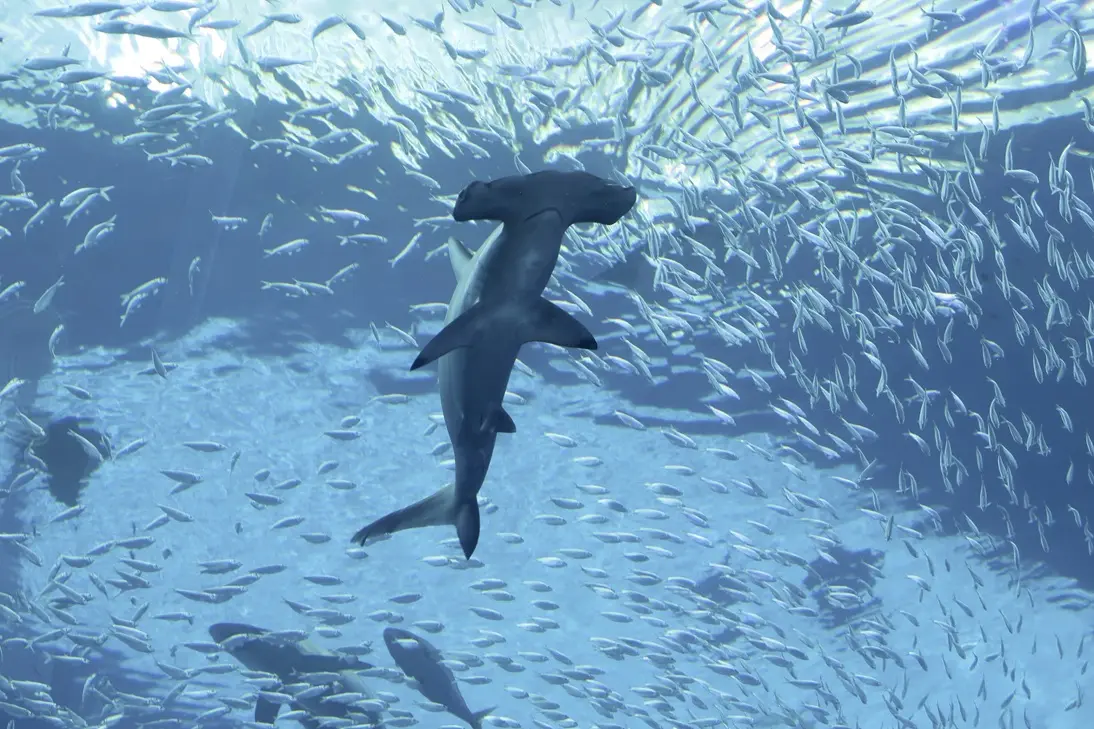
Drop into the water off Darwin Island in September and the first thing you notice isn’t a shark. It’s the shadow. A patch of ocean goes dark overhead, and then you realize the shadow is moving, breathing almost, hundreds of bodies stacked in loose formation against the current. Scalloped hammerheads don’t announce themselves the way a lone predator does. They arrive as weather. Sphyrna lewini has been swimming these waters for longer than the islands have had a name, drawn north to Darwin and Wolf by currents that stack nutrients the way a wind stacks snow. Divers travel from every continent for a few minutes inside that school, and marine biologists have built entire careers tracking where the sharks go once they leave it.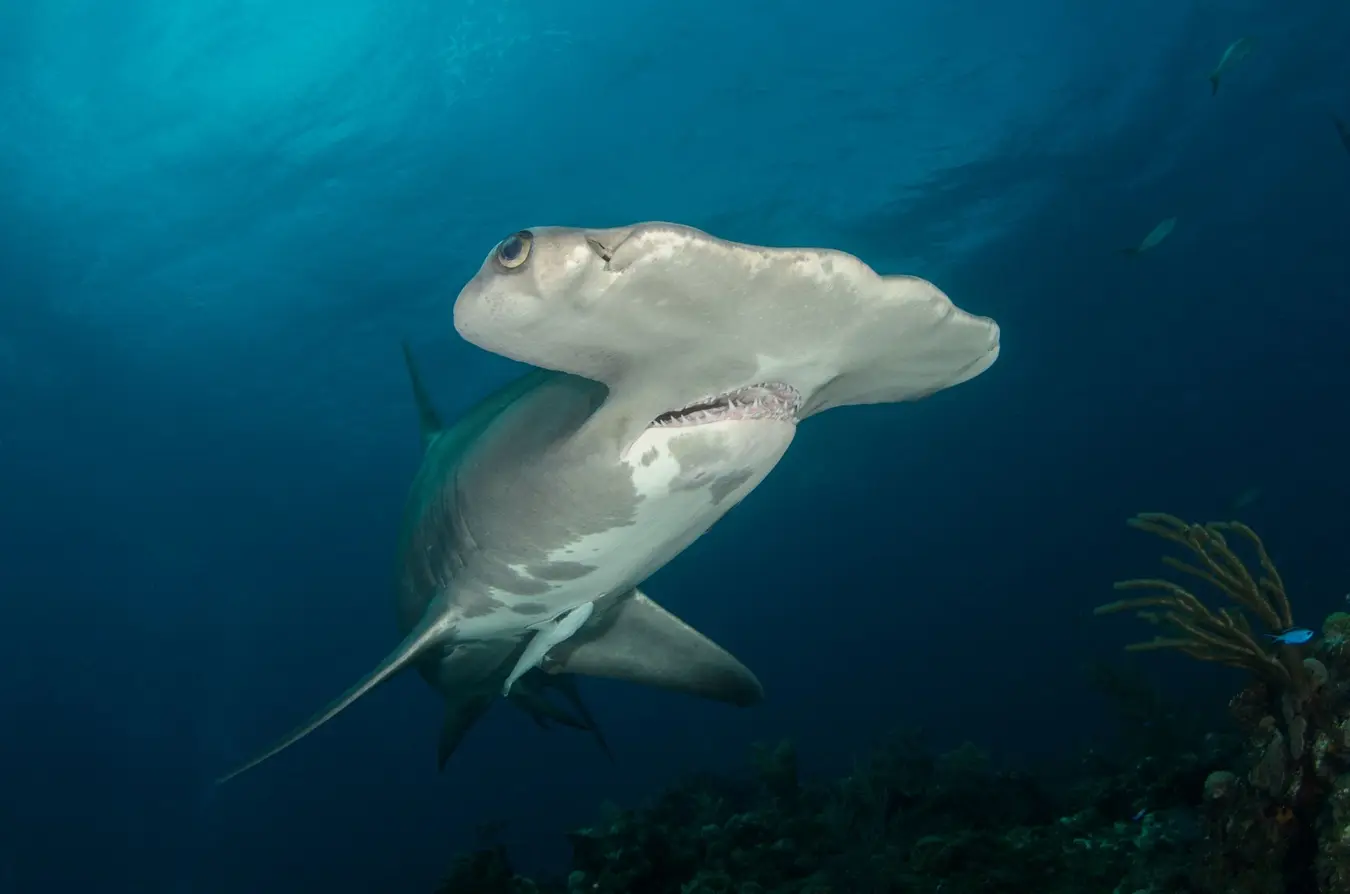
Quick Facts About The Galápagos Scalloped Hammerhead Shark
| Category | Detail |
|---|---|
| Scientific name | Sphyrna lewini |
| Average size | 2.5 – 3 metres (8 – 10 ft) |
| Maximum size | Up to 4.2 metres |
| Weight | 80 – 100 kg average, up to 152 kg |
| Lifespan | 20 – 30 years |
| Diet | Sardines, herring, mackerel, squid, stingrays, small sharks |
| Conservation status | Critically Endangered (IUCN) |
| Population estimate | Down at least 80% globally over three generations |
| Distribution | Warm temperate and tropical waters worldwide; Galápagos population migrates to Panama and beyond |
| Unique trait | Scalloped, hammer-shaped head (cephalofoil) that spreads sensory organs for near 360° vision |
Evolutionary Origins
Nobody has caught the exact moment in the fossil record when a shark’s head started to flatten and spread, but the payoff is obvious enough that it’s evolved more than once in the hammerhead family. Spreading the eyes wide apart gives a shark stereoscopic vision above and below its body at the same time — a blind spot directly ahead, but almost nothing missed anywhere else. Spreading the nostrils does something similar for smell, letting the shark essentially triangulate a scent trail the way we’d triangulate a sound. The cephalofoil is also loaded with electroreceptors, the ampullae of Lorenzini, and a wider head means more surface area for them. Bury a stingray under sand and a hammerhead can still find the faint electrical signal of its heartbeat. That single adaptation is probably why the family diversified into nine living species instead of staying as one generalized ancestor. How the species ended up concentrated at Darwin and Wolf has more to do with geography than biology. The Galápagos sits at the meeting point of the cold Humboldt Current and warmer equatorial water, a collision that keeps the surrounding sea unusually productive. For a migratory predator moving through thousands of miles of comparatively empty ocean, a reliable pocket of food and safety like that is worth returning to, generation after generation. Researchers increasingly suspect the sharks use the magnetic signature of underwater seamounts as a kind of chart, which would explain why the aggregation sites are so specific and so consistent year after year.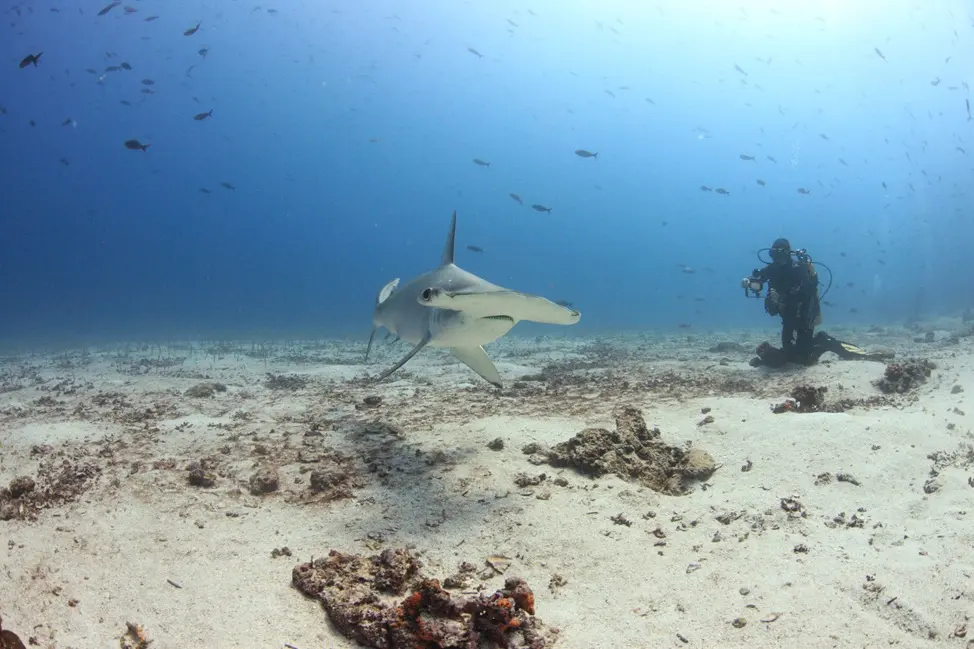
Physical Characteristics
Strip away the head and a scalloped hammerhead’s body plan is fairly ordinary shark: slender, bronze-brown on top, pale underneath, built for cruising rather than sprinting. The teeth are small, backward-curving triangles designed to grip and swallow rather than saw through flesh, which fits a diet built around schooling fish that get taken whole. The head is where all the interest lives. Unlike the great hammerhead’s nearly straight-edged cephalofoil, the scalloped hammerhead’s has a distinct central notch and rounded lobes — the “scalloped” in the name. That shape difference is one of the fastest ways to tell the species apart underwater, along with the taller, more sharply curved first dorsal fin. Pups are born around 40 to 50 centimetres long, already fully formed, and grow quickly through their first years in sheltered nurseries before heading into deeper water. Adult females tend to run larger than males, some pushing past 3.5 metres, and their bellies visibly swell in the final months of pregnancy — a detail researchers now use to identify which sharks in a school are close to giving birth.Extraordinary Adaptations
A head built for hunting blind. The cephalofoil isn’t just about vision — it functions as a metal detector for biology, letting the shark sweep the seafloor and pick up the electrical pulse of a buried ray without ever seeing it. Schooling for reasons nobody fully understands. Adult hammerheads are typically solitary hunters at night, yet during the day they gather into schools that can number in the hundreds. The leading theories point to social hierarchy, mate selection, and safer navigation, but no single explanation has been confirmed, which makes Darwin and Wolf one of the more genuinely mysterious wildlife spectacles left on Earth. Cleaning-station loyalty. Hammerheads return repeatedly to specific rocky outcrops where small fish pick parasites off their skin and gills — a routine so consistent that dive guides can predict, almost to the ledge, where a school will pass on a given morning. A body engineered for long-distance travel. The Galápagos population isn’t resident; it’s migratory. Satellite tags have followed individual sharks on journeys of well over a thousand miles, from the islands to the Panamanian coast and back out into open Pacific water, all powered by a lean, hydrodynamic frame that trades bulk for endurance. Extreme sensitivity to disturbance. Unlike the more confident Galápagos shark that often shares the same reef, scalloped hammerheads spook easily. Divers who exhale a burst of bubbles at the wrong moment can scatter an entire school in seconds, which is part of why respectful, low-impact diving practice matters so much here.Distribution
Within the reserve, the population is heavily concentrated around the far northern islands of Darwin and Wolf, remote enough that they’re reachable only by liveaboard. Smaller, less predictable numbers turn up around Wolf’s southern neighbors, at Gordon Rocks off Santa Cruz, and around Kicker Rock off San Cristóbal, giving land-based travelers at least a chance at an encounter without a multi-day boat trip. The most significant recent distribution discovery came in 2017, when researchers identified a hammerhead nursery in the mangroves along the coast of Santa Cruz — the first confirmed pupping ground found inside the archipelago itself. Before that, scientists assumed Galápagos hammerheads gave birth elsewhere entirely, most likely in the mangrove-lined shallows of Panama, since the islands themselves offer little of that sheltered nursery habitat. Numbers shift dramatically with the seasons. During the cool season, tracking studies have found that up to 90% of tagged sharks stay inside the marine reserve. During the warm season that figure drops to around 30%, as much of the population pushes north toward Panama, following the same corridor that pregnant females use to reach their nurseries.Comparison of Galápagos Hammerhead Shark Dive Sites
| Site | Typical School Size | Diver Level | Notable Trait |
|---|---|---|---|
| Darwin Island | Dozens to hundreds | Advanced | Deepest, most reliable aggregations; occasional whale sharks |
| Wolf Island | Dozens to hundreds | Advanced | Strong cleaning-station activity along sheltered reefs |
| Gordon Rocks (Santa Cruz) | Small to moderate groups | Advanced | Best land-based option; strong “washing machine” currents |
| Kicker Rock (San Cristóbal) | Individuals to small groups | Intermediate–Advanced | More accessible; sightings less predictable |
Behavior and Reproduction
By day, hammerheads school; by night, the group disperses and each shark hunts alone, tracking sardines, herring, mackerel, squid, and the occasional smaller shark through open water using that oversized sensory head. Come daylight, they regroup, often orbiting the same reef structure for hours before drifting off with the current. Reproduction runs on roughly a two-year cycle. Gestation lasts around nine to ten months, and a single female can give birth to litters of 15 to 30 pups. She then leaves them to fend for themselves in sheltered nursery habitat — mangroves, in most known cases — with zero further parental involvement. It’s a strategy that works only if enough pups survive the gauntlet of predators and, increasingly, fishing gear before reaching adulthood.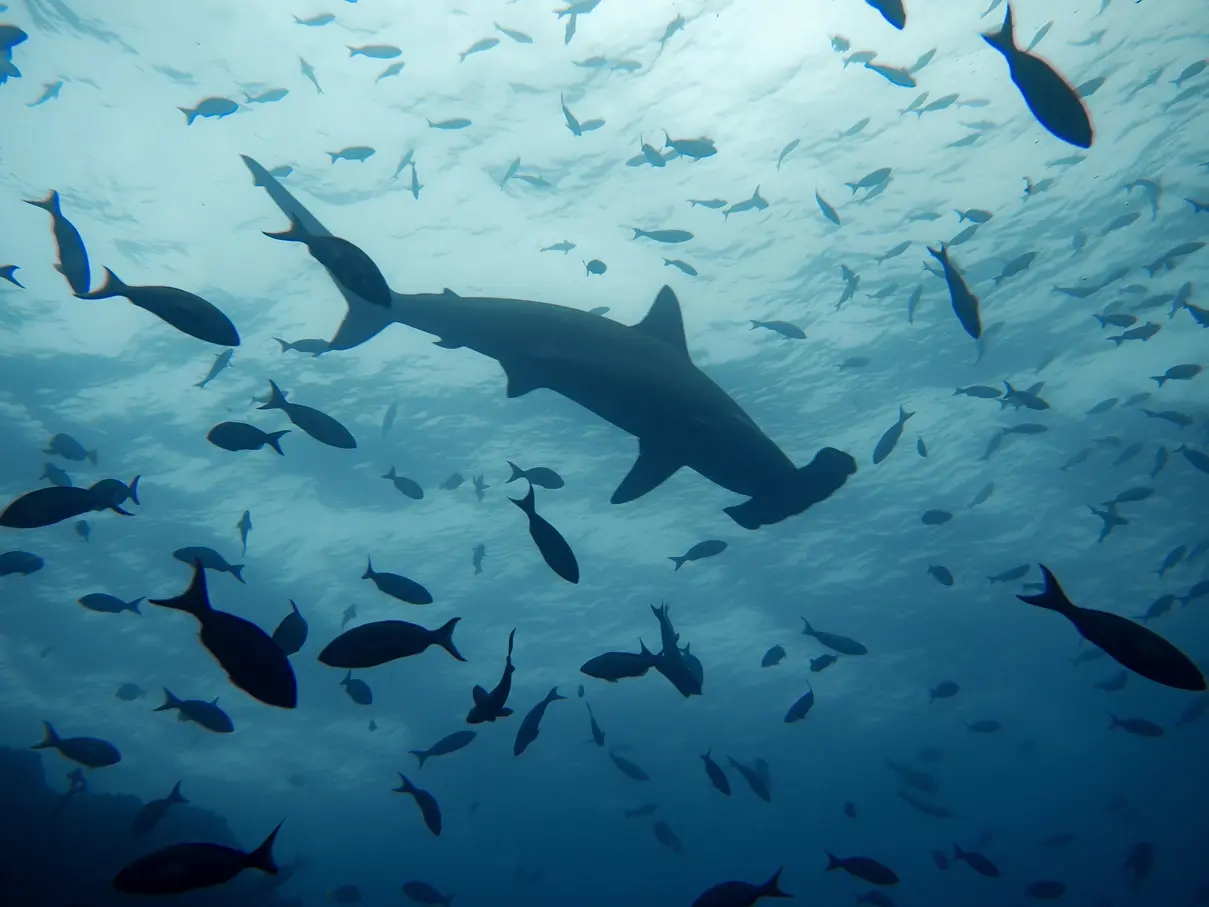
Conservation Status
The numbers behind the Critically Endangered listing are blunt: global populations of scalloped hammerheads have fallen by more than 80% over the past three generations, driven almost entirely by demand for shark fin and incidental bycatch in longline and gillnet fisheries. The species grows slowly, matures late, and reproduces in modest litters — biology that simply cannot outpace industrial-scale fishing pressure. Inside the marine reserve, protection is real but not absolute. Illegal longlines still turn up around Darwin and Wolf on a regular basis; researchers on recent expeditions have found lines tangled around their own boats and wrapped around the rock formation now known as the Pillars of Evolution. A hammerhead pulled from one of those lines inside the reserve isn’t a hypothetical — it’s happened. The bigger vulnerability sits outside Galápagos entirely. Satellite tagging has shown that a large share of tagged sharks, many of them pregnant females, swim roughly 800 miles to the coast of Panama to give birth, then continue west another 1,800 miles into open Pacific water before eventually returning. That route crosses multiple national jurisdictions and long stretches where industrial and semi-industrial fishing operates legally. Panama has banned the international shark trade, but artisanal fishing there still lands baby hammerheads and pregnant females bound for local ceviche markets — a detail that undercuts protection efforts back in the reserve. There has been real progress. In March 2026, Ecuador’s proposal to move scalloped hammerheads to Appendix I of the Convention on the Conservation of Migratory Species passed, obligating signatory nations to introduce stronger domestic protections. Combined with satellite-tracking data that’s steadily mapping the species’ migratory corridor, conservationists finally have the evidence needed to argue for protected corridors between Galápagos, Panama, and the high seas beyond — not just protection at the aggregation sites divers actually visit.Where To See Them In Galápagos
Darwin and Wolf remain the only reliable places to witness true mass aggregations, and both are accessible exclusively via liveaboard dive expeditions departing from Santa Cruz or Baltra — there’s no day-trip option and no land-based lodging anywhere near them. Expect multi-day itineraries, advanced certification requirements, and strong currents as the price of admission. Travelers based on the inhabited islands still have a realistic shot at Gordon Rocks, a short boat ride from Santa Cruz, or Kicker Rock off San Cristóbal, where hammerheads pass through less predictably but sightings are far from rare. Neither delivers the wall-of-sharks spectacle of the north, but both offer a genuine chance at an encounter without committing to a week aboard a dive boat. Seasonality matters as much as location. The cool season, roughly June through November, brings the strongest currents, the coolest water, and by far the highest odds of encountering a large school — a trade-off against choppier conditions and thicker wetsuit requirements. The warm season, December through May, offers calmer seas and better visibility in exchange for smaller, more scattered groups as much of the population migrates north. There is no dedicated hammerhead breeding center to visit in Galápagos; the mangrove nursery on Santa Cruz remains a restricted research site rather than a public attraction, protected specifically because of how sensitive newborn sharks are to disturbance.