Blue-Footed Boobies in the Galápagos and Their Famous Dance
No animal in the Galápagos breaks the ice quite like the blue-footed booby. Long before a visitor learns to pronounce Sula nebouxii, they’ve usually already stopped mid-trail, phone or camera raised, watching a bird with feet the color of a swimming pool march back and forth in front of a mate who seems entirely unimpressed. It is, by any measure, an odd way for a wild animal to behave. It is also one of the most reliable wildlife encounters anywhere on the islands.
Quick Facts About The Galápagos Blue Footed Booby
Category
Detail
Scientific name
Sula nebouxii
Average size
Around 81 cm (32 in) long, wingspan near 1.5 m (5 ft)
Least Concern (IUCN), though the Galápagos population has declined sharply since the 1960s
Population estimate
Roughly 6,000–6,400 individuals in Galápagos, down from an estimated 20,000 in the 1960s
Distribution
Pacific coast from the Gulf of California to Peru; over half the global population breeds in Galápagos
Unique trait
Bright blue, carotenoid-pigmented feet used as a signal of health during courtship
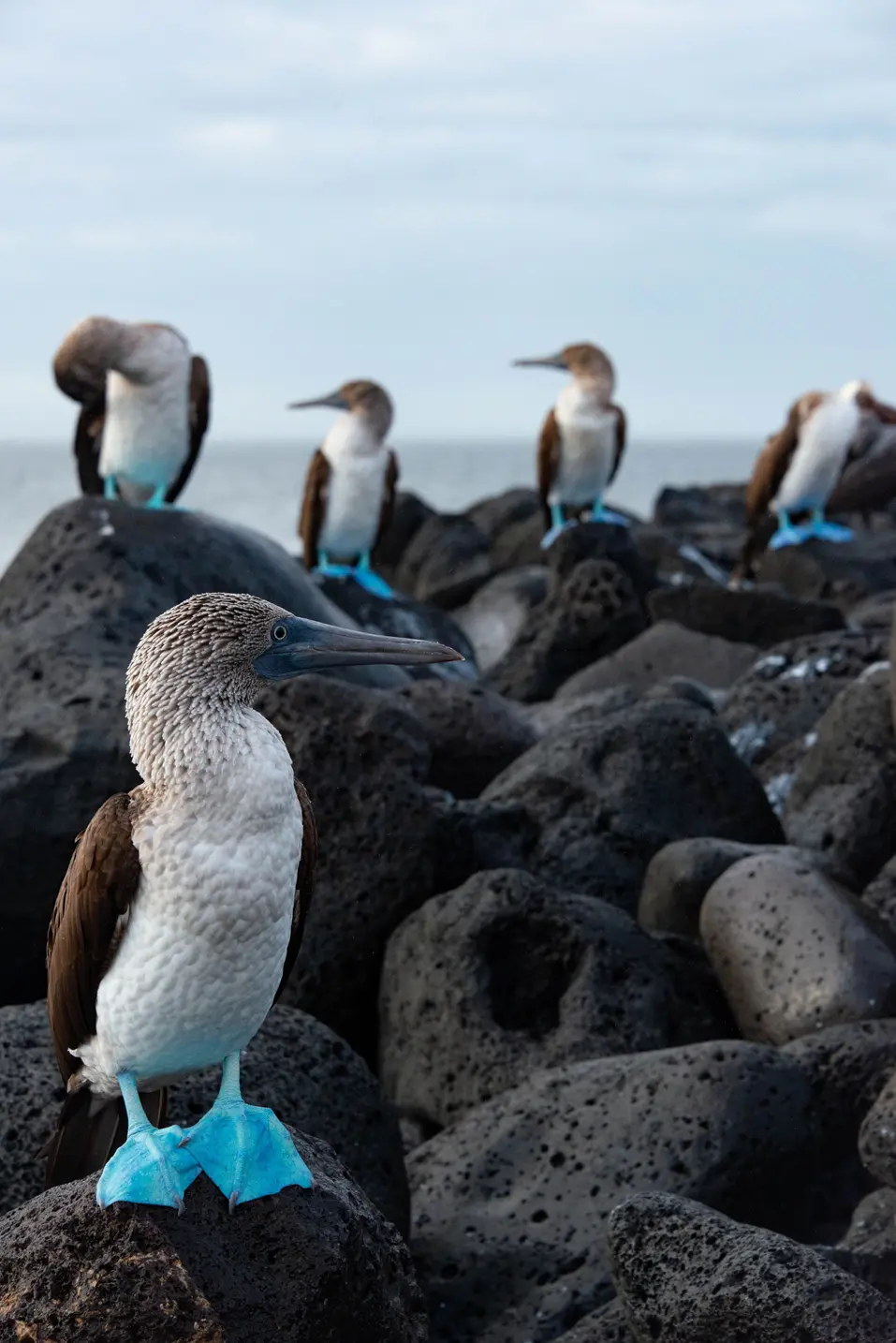
The blue feet themselves are not just a quirk of plumage. They are a running scorecard of the bird’s health, built from pigments lifted directly out of its last few meals, and read closely by every potential mate it meets. That single adaptation — equal parts biology and burlesque — has turned a mid-sized seabird into one of the most photographed animals on Earth.Image credit: Diego F. Parra / Pexels What makes the story bigger than one charismatic bird is where it plays out. More than half of the world’s blue-footed boobies nest in the Galápagos archipelago, on bare lava rock within arm’s reach of hiking trails, completely unbothered by the people walking past. Few places on the planet let you watch a courtship ritual this intimate, this close, and this often. And beneath the comedy is a seabird built for serious work: a torpedo-shaped diver capable of folding its wings and dropping into the Pacific at highway speed, sealed nostrils and all, to chase sardines that most birds could never catch. The blue-footed booby is, in other words, a far more accomplished animal than its slapstick reputation lets on.
Evolutionary Origins
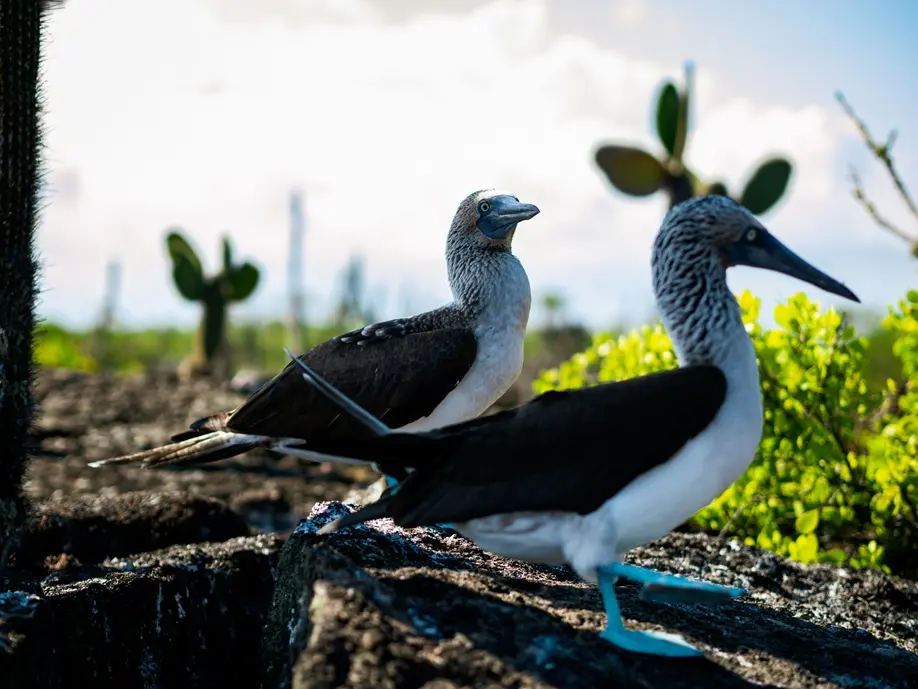
The blue-footed booby belongs to Sulidae, a small family of plunge-diving seabirds that also includes gannets. Boobies are thought to have split from their gannet relatives somewhere between the late Miocene and Pliocene, trading the gannets’ cooler, temperate waters for the warmer currents of the tropics. Unlike Galápagos’ famous land animals, which arrived by drifting or rafting across open ocean, boobies needed no luck with currents at all. They flew in, almost certainly tracking the rich upwellings of the Humboldt and Cromwell currents that still draw fish — and the birds that eat them — to the islands today. What happened after they arrived is the more interesting part of the story. Three booby species — blue-footed, red-footed, and Nazca — now share the Galápagos coastline, and in classic island fashion, they have carved up the available space rather than competing head-on for it. Blue-footed boobies forage close to shore in shallow water. Red-footed boobies range far out to sea and even perch in trees, something almost no other booby does.Image credit: Bjarn Bronsveld / Unsplash Nazca boobies sit between the two, nesting on open cliffs and hunting moderate distances offshore. It is a quieter, less famous version of the resource-partitioning story usually told about Darwin’s finches, playing out instead in the diving habits of three closely related seabirds. The evolutionary significance lies in that division of labor. By specializing in different hunting depths, ranges, and nest sites, all three boobies can occupy the same islands without driving each other out — a small, elegant demonstration of how isolation and competition shape Galápagos wildlife, seabirds included.
Physical Characteristics
A Body Built for Speed and Impact
Strip away the feet, and a blue-footed booby is a study in aerodynamic efficiency. The body is long, narrow, and tapered at both ends, built less like a typical bird and more like a dart, which is exactly the shape it needs for the high-speed dives that define its hunting style. The wings are long and pointed, giving the bird strong, gliding flight over open water, while a sharp, slightly hooked grey-blue bill is positioned for a fast, precise strike rather than for tearing or crushing.
Camouflage, Vision, and Impact Protection
Coloration is understated everywhere except the feet. The upperparts are a mottled grey-brown, the rump and tail show patches of white, and the belly and underwings are clean white, creating a counter-shaded pattern that breaks up the bird’s silhouette against both sky and water. The head and neck carry a streaky brown-and-white pattern, and pale eyes sit close together at the front of the skull, giving the bird strong binocular vision, essential for judging the exact moment to fold its wings and drop. Several of the booby’s organs are quietly remarkable. Its nostrils are sealed shut entirely, an adaptation against the impact of repeated high-speed water entry, which means the bird breathes instead through the corners of its bill. Air sacs beneath the skin cushion the shock of each dive, the same way a car’s crumple zone absorbs a collision.
Size and Sexual Differences
The feet — webbed across all four toes, unusual among birds — carry a dense network of blood vessels just beneath the surface, which both produces their saturated blue color and makes them an effective tool for keeping eggs and chicks warm. On size, a typical adult measures around 81 cm from bill to tail, with a wingspan close to 1.5 meters, and weighs about 1.5 kilograms. Females run slightly larger than males across nearly every measurement, a pattern common among seabirds and one that may let them dive deeper or carry larger prey back to the nest.
Extraordinary Adaptations
Blue Feet, Honest Signals
The blue-footed booby’s defining adaptation is, unsurprisingly, its feet. Their saturated blue comes from carotenoid pigments absorbed directly from fresh fish, and the intensity of that color tracks the bird’s nutritional state almost in real time, a duller blue can appear within days of a poor run of fishing. Because the color is so honest a signal, it has become central to courtship: birds in good condition advertise it, and prospective mates read it closely before committing to a partner who will need to help raise chicks for months.
High-Speed Hunting and Diving Skills
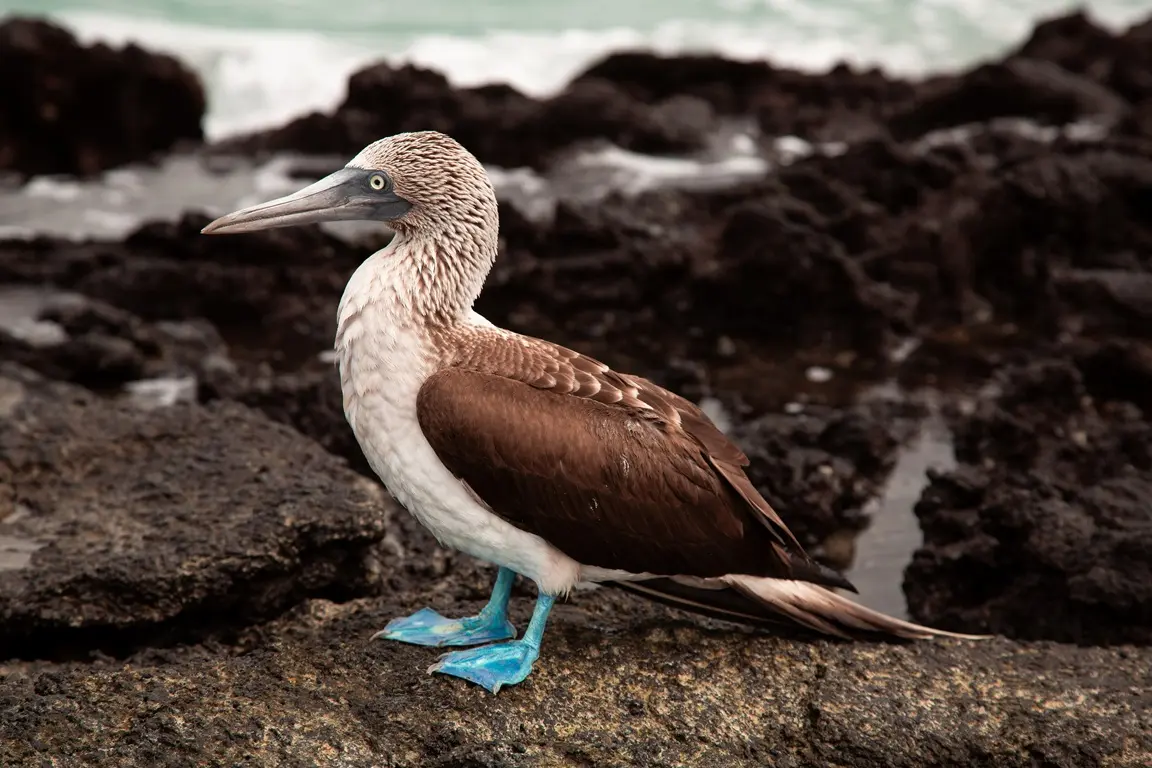
Image credit: Sofia / Unsplash Hunting ability is the second great adaptation, and it is considerable. Blue-footed boobies plunge-dive from heights of up to 80 feet (about 24 meters), folding their wings tight against the body in the instant before impact and hitting the water at speeds approaching 60 mph (97 km/h). Once underwater, they can chase prey to depths of around 25 meters before surfacing, sealed nostrils and reinforced air sacs absorbing the punishment that a dive at that speed would otherwise inflict. They hunt alone or in coordinated groups, sometimes working a school of sardines from multiple angles at once, and unlike most boobies they are also capable of diving directly from a sitting position on the water’s surface.
Nesting, Cooling, and Survival Tricks
Nesting comes with its own set of solutions. Blue-footed boobies build no nest at all, laying their eggs in a shallow scrape on bare ground and marking the site instead with a ring of guano that signals “occupied” to neighboring pairs. Lacking the bare brood patches many birds use to transfer body heat to their eggs, they incubate with their feet instead, wrapping those heavily vascularized webs around the eggs for roughly six weeks. Heat management on shadeless, equatorial lava is its own challenge, and boobies meet it with two unusual tricks. The first, gular fluttering, involves rapidly vibrating the throat muscles to promote evaporative cooling, similar to panting in a dog. The second, urohidrosis, is blunter: the bird defecates and urinates directly onto its own legs and feet, cooling itself as the liquid evaporates from the skin.
Fearless Behavior Around Humans
Finally, there is the matter of trust. With no native land predator ever having hunted adult boobies in Galápagos, the birds show little to no fear of humans — a trait that makes them remarkably easy to observe up close, and one that conservationists ask every visitor to handle responsibly by keeping a respectful distance regardless of how unbothered the bird appears.
Distribution
Range Across the Eastern Pacific
Blue-footed boobies range along the eastern Pacific coast of the Americas, from the Gulf of California in Mexico down through Central America to Peru. Yet it is the Galápagos Islands, sitting roughly 1,000 km offshore, that hold the species’ stronghold: over half of the world’s breeding population nests here, drawn by the same cold, nutrient-rich currents that sustain so much of the archipelago’s marine life, much as they sustain the diet of the islands’ marine iguanas just offshore.
Major Colonies Within the Galápagos
Within the archipelago, colonies are scattered across more than a dozen sites rather than concentrated in one place. The largest and most easily visited colonies are on North Seymour and Española, where well-worn trails pass close enough to active nests that visitors can watch a single pair raise chicks from egg to fledgling over multiple visits. Strong populations also nest at Punta Pitt on San Cristóbal, on Santa Fe, on Plaza Sur, along the cliffs of Rabida, and around the coastlines of Floreana, Isabela, Fernandina, and Pinzón.
Population Patterns and Environmental Signals
Numbers vary noticeably from island to island, generally tracking local fish abundance rather than any preference for one landscape over another. A colony that thrives in a year of strong upwelling may produce far fewer chicks the following season if sardine numbers drop, which is one reason researchers treat the species as something of a living barometer for the health of Galápagos’ coastal waters.
Comparing the Three Galápagos Boobies
Species
Size
Distinctive Trait
Nesting Style
Where To See (Galápagos)
Blue-footed booby
(Sula nebouxii)
~81 cm, 1.5 kg
Bright blue webbed feet; elaborate strutting dance
Ground scrape, no nest material
North Seymour, Española, Punta Pitt, Santa Fe
Red-footed booby
(Sula sula)
Smallest of the three, ~70 cm
Bright red feet; only booby that perches in trees
Stick nests in shrubs and trees
Genovesa, Punta Pitt (San Cristóbal)
Nazca booby
(Sula granti)
Largest of the three, ~90 cm
White plumage, orange bill, black wingtips
Open cliff-top ground nests
Genovesa, Española, Floreana
Behavior and Reproduction
Daily Habits and Seasonal Breeding
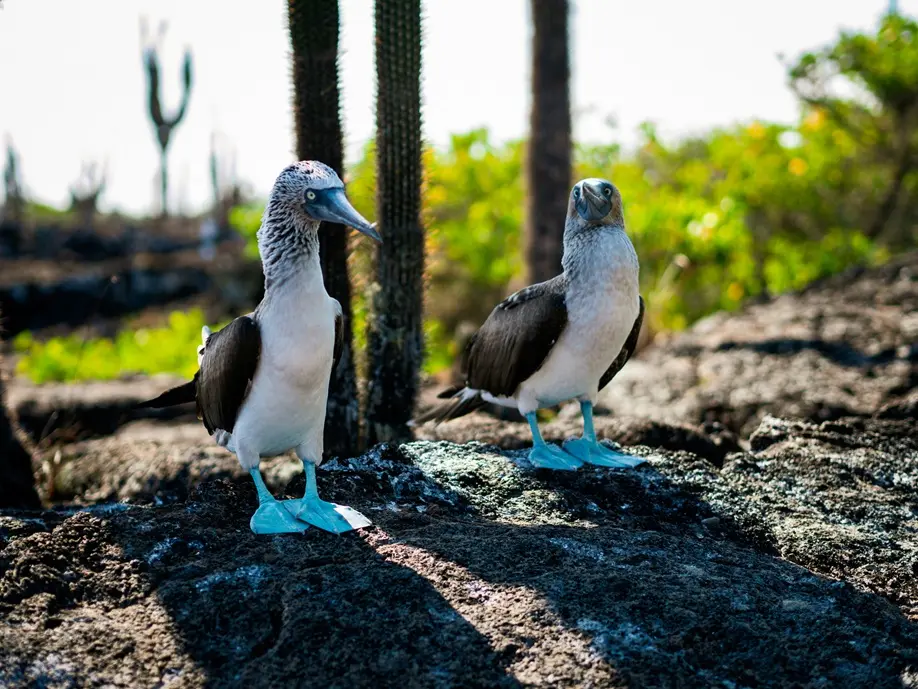
A blue-footed booby’s day runs on daylight. Birds leave their roosts on coastal cliffs and rocky points at dawn, spend the day hunting alone or in loose groups offshore, and return to land in the evening, a rhythm broken only during breeding season, when one parent must always stay behind to guard the nest.Image credit: Bjarn Bronsveld / Unsplash Breeding itself is opportunistic rather than fixed to a single season; pairs will nest whenever local fish stocks are abundant enough to support raising chicks, which is why activity can be found on some Galápagos island at almost any time of year. That said, courtship visibly peaks during the cooler, nutrient-rich months from June through August, and most chicks hatch from July onward. The birds are generally monogamous, often re-pairing with the same partner across seasons, though a poor breeding year can be enough to send a female looking elsewhere the next time around.
The Famous Courtship Dance
The courtship dance is the species’ signature behavior, and it unfolds in a fairly consistent script. The male approaches with a gift, typically a twig, stone, or feather, even though the eventual nest will use none of it, before lifting each blue foot high and stamping it down in an exaggerated, high-stepping march. He points his bill and tail skyward, spreads his wings, and lets out a thin whistle; the female, if interested, answers with a deeper honk and begins to mirror his steps. Successful pairs often finish by standing close together, bills raised in unison, before mating.
Incubation and Chick Survival
Once a pair commits, both parents share incubation duties for around 45 days, wrapping their warm, well-vascularized feet around two or three pale blue eggs laid several days apart. After hatching, chicks are fed by regurgitation for roughly two months while parents alternate between guarding the nest and foraging at sea. In years of plentiful fish, two or even three chicks can fledge from a single nest; in leaner years, the older, stronger chick typically receives the bulk of the food, and only one survives, a quietly brutal but effective filter that keeps each generation suited to the conditions it is born into.
Predators and Social Life
Nesting on open ground leaves eggs and small chicks exposed, and Galápagos hawks are the species’ main natural predator, along with occasional opportunistic losses to frigatebirds or mockingbirds when a nest is briefly left unattended. Outside of breeding season, blue-footed boobies are loosely social, tolerating close neighbors on cliff ledges and shorelines without forming the dense, packed colonies seen in some other seabirds.
Conservation Status
Globally, the blue-footed booby is classified as Least Concern by the IUCN, reflecting its wide range along the Pacific coast of the Americas. The picture inside Galápagos is more complicated. Surveys from the 1960s estimated around 20,000 individuals in the archipelago; more recent counts put the number closer to 6,000–6,400, a decline steep enough that researchers and conservation organizations have kept the species under close watch for more than a decade. The leading suspect behind the drop is food, not direct threats. Blue-footed boobies depend heavily on sardines and other small schooling fish, and their numbers appear closely tied to the availability of that prey, which fluctuates with ocean conditions including El Niño cycles and broader shifts in Pacific currents. Scientists have also flagged a breeding problem layered on top of the food issue: adult survival looks roughly normal, but fewer young birds appear to be successfully recruiting into the breeding population, suggesting that chicks are struggling to reach adulthood even when adults themselves are faring reasonably well. The knock-on effects reach further than the boobies themselves. Fewer chicks means less prey for the Galápagos hawks that rely on them, and a shift in adult boobies’ time toward bare cliffs and rocks, rather than the vegetated areas they once used more, has reduced the nutrient-rich guano deposits that historically helped fertilize island soils. The Galápagos National Park Directorate and partner organizations, including the Galápagos Conservation Trust, fund ongoing population monitoring, breeding-success studies, and research into the link between foot coloration, diet, and reproductive performance, work aimed at understanding exactly where in the life cycle the species is losing ground — and what, if anything, can be done about it.
Where To See Them In Galápagos
Best Islands for Watching Blue-Footed Boobies
Few Galápagos animals are easier to find than the blue-footed booby; the harder part is choosing where to watch them. For the courtship dance, North Seymour Island and Española are the most reliable stages, with trails that run directly past active nesting territory and a high concentration of displaying males during the peak season of June through August. Punta Pitt, on the eastern tip of San Cristóbal, offers a rare chance to see all three Galápagos booby species — blue-footed, red-footed, and Nazca — within a single short hike. Santa Fe and Plaza Sur add land iguanas to the scene, making for a doubly rewarding stop if you’re also tracking down the islands’ land iguanas, while Rabida’s red-sand cliffs are a favorite for watching boobies launch directly out over snorkelers’ heads. Floreana, Isabela, and the western island of Fernandina round out the list, and on Santa Cruz’s north coast, boobies can occasionally be spotted without leaving the main island at all — useful for travelers building a land-based itinerary alongside trips to see the islands’ giant tortoises.
When to Visit and How to Reach the Colonies
Because boobies breed opportunistically rather than on a fixed calendar, some island will almost always have active nests, but late June through early September remains the strongest window for witnessing the full courtship dance, with chicks typically visible from July onward. Many of these visitor sites sit on different islands, so getting between them usually means a combination of cruise itineraries and inter-island ferries; if you’re piecing together your own route, our essential ferry travel guide and current ferry prices are good starting points, while the Santa Cruz to San Cristóbal ferry route connects two of the easiest places to base yourself for booby-watching. First-time visitors often find it worth reading our port check-in guide and a few seasickness tips before booking, since several of the best booby colonies are only reachable by boat.
Final Thoughts
There is something disarming about an animal that earned its common name from sailors who thought it looked foolish, only to turn out to be one of the more sophisticated hunters in the bird world. The blue-footed booby’s dance, so often described as comic, is in fact a precise piece of communication — a living readout of diet, health, and fitness, delivered one exaggerated step at a time. Nothing about it is wasted. What the Galápagos offers this species, and offers visitors in turn, is proximity rarely available anywhere else. A bird that elsewhere keeps a wary distance from people will, on these islands, raise a family within a few meters of a hiking trail, entirely unconcerned by the audience. That trust was earned over thousands of years without ground predators, and it remains one of the most fragile and remarkable things about Galápagos wildlife as a whole. The decline recorded since the 1960s is a reminder that even an animal this visible, this photographed, and this beloved is not immune to changes happening far below the surface — in fish stocks, ocean currents, and the slow chemistry of a warming Pacific. Watching a blue-footed booby fold its wings and vanish into the sea is still one of the great small spectacles of the islands. Keeping that possible for the next generation of visitors will depend on paying closer attention to what happens beneath the waves than to what happens on the trail.
Frequently Asked Questions About the Blue-Footed Booby
Are blue-footed boobies dangerous to humans?
No. Blue-footed boobies show little fear of people and pose no threat to visitors. Galápagos National Park rules still require keeping a distance of at least 2 meters (roughly 6 feet) from all wildlife, both to protect the birds and to avoid disturbing nesting behavior.
Can blue-footed boobies swim underwater?
Yes. After plunge-diving from heights of up to 80 feet, they can actively pursue fish underwater to depths of around 25 meters before resurfacing, using their webbed feet and streamlined bodies to maneuver during the chase.
Do blue-footed boobies migrate?
Not in the traditional sense. Galápagos populations are largely resident year-round, though individual birds may travel between islands or shift foraging areas in response to local changes in fish abundance, particularly during El Niño events.
How long do blue-footed boobies live?
Wild blue-footed boobies typically live around 17 years, though survival depends heavily on consistent access to food during both adulthood and the vulnerable chick-rearing stage.
Can visitors touch or get close to blue-footed boobies in Galápagos?
Touching wildlife is prohibited throughout the Galápagos National Park. Because boobies nest directly beside many trails, visitors can usually get a close, unobstructed view simply by staying on the marked path and keeping the required minimum distance.
Why do some blue-footed boobies have bluer feet than others?
Foot color reflects diet. Carotenoid pigments from fresh fish accumulate in the feet, so well-fed, healthy birds display a more saturated blue, while birds going through a lean stretch of fishing show duller coloring within days.