GALAFERRY: Your bridge between islands +593 99 075 3119 sales@galaferry.com

Galápagos Land Iguana: Facts, Species & Where to See

  • Home
  • Wildlife
  • Galápagos Land Iguana: Facts, Species & Where to See

Galápagos Land Iguana: The Golden Giant of the Enchanted Islands

Charles Darwin was not impressed. He stepped ashore on Santiago Island in 1835 and found the ground riddled with burrows. Consequently, his crew struggled to find a clear patch for their tent. The creature responsible struck him as graceless and even ugly. However, history has been kinder than Darwin. The Galápagos land iguana represents one of the most improbable survival stories in the natural world. For instance, this sun-colored reptile drinks cactus instead of water. It also sleeps underground to stay warm in the tropics. Furthermore, it very nearly vanished from entire islands within living memory.

Quick Facts About The Galápagos Land Iguana

Category Detail
Scientific name Conolophus subcristatus
Average size ~1 m (3.3 ft)
Maximum size Up to 1.5 m (5 ft)
Weight 11–13.5 kg (25–30 lb); large males occasionally heavier
Lifespan 50–60 years (average around 55)
Diet Mostly herbivorous (Opuntia cactus pads, fruit, flowers); opportunistic carnivore (insects, centipedes, carrion)
Conservation status Vulnerable (IUCN Red List)
Population estimate 5,000–10,000 individuals
Distribution Fernandina, Isabela, Santa Cruz, South Plaza, Baltra, Santiago, North Seymour
Unique trait Survives without fresh water by metabolizing moisture from cactus; grooming mutualism with Darwin’s finches

What makes the species remarkable isn’t just its size. A five-foot adult basking on black lava rock is certainly an arresting sight. Instead, the true wonder is the sheer improbability of its presence here. Every land iguana in the archipelago descends from animals that rafted across hundreds of miles of open Pacific. These ancestors floated on tangles of vegetation before arriving on islands with no fresh water and no soil. In fact, they had almost nothing to eat except the spiny pads of a cactus. Most animals would avoid this plant entirely. From that improbable landing, evolution produced three unique species. Each one reflects the particular volcano, drought cycle, and food source of its home island.

Today, travelers who know where to look can watch this entire evolutionary story play out. You can easily see it in a single trip. The journey ranges from the common, golden-scaled iguana found on seven islands to a critically endangered pink population. Scientists discovered this pink iguana in 2009. Currently, it survives on the flank of an active volcano where tourists cannot visit. This guide brings together what we know about the Galápagos land iguana. Specifically, it details how they evolved, how they live, why they nearly disappeared, and where you can responsibly see them for yourself.

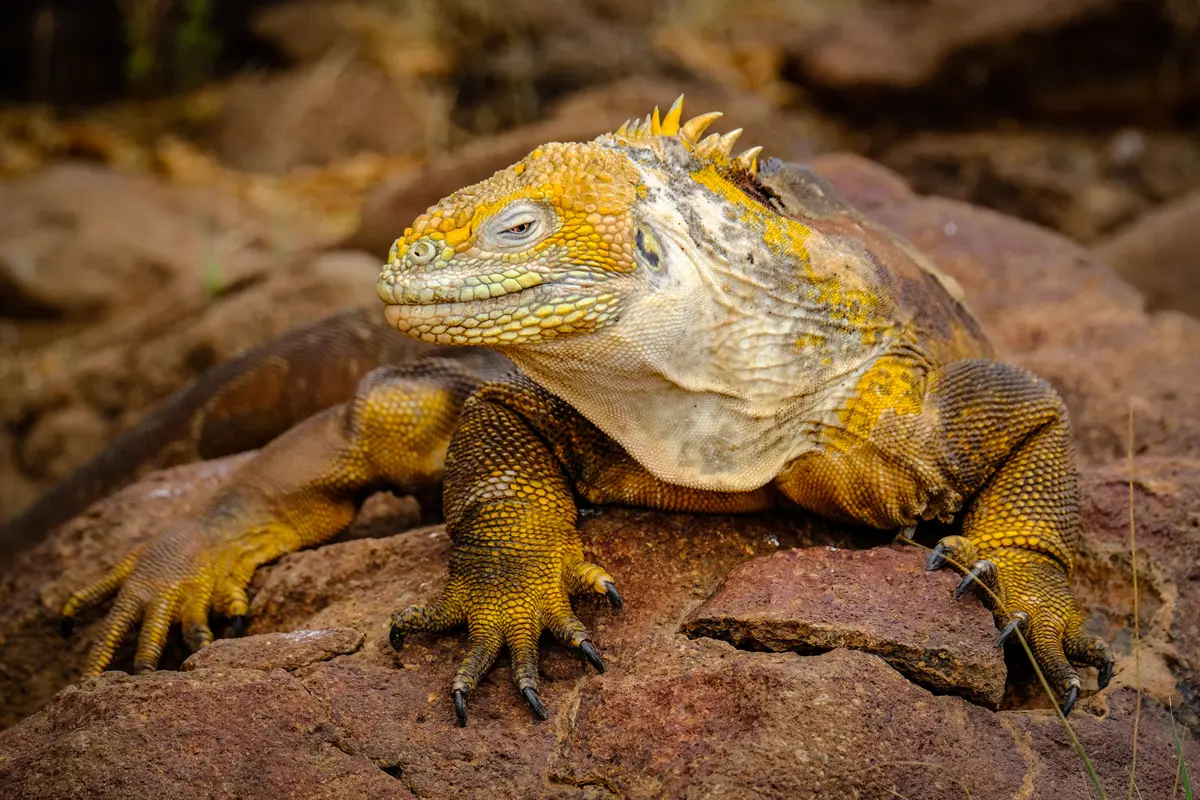
Land iguana standing on a rock, looking to the side
Image credit: Francesco Ungaro / Pexels

Evolutionary Origins

The Ancient Journey from the Mainland

The story of the Galápagos land iguana begins on the South American mainland millions of years ago. At that time, the islands looked nothing like they do today. Rivers and ocean currents swept ancestral iguanas out to sea on mats of floating vegetation. Eventually, the waves deposited them by chance on the volcanic shores of the emerging Galápagos archipelago. This accidental colonization repeated countless times across the islands’ history. As a result, most arrivals died within days. The ones that survived found themselves in a landscape with almost no competition and very little to eat.

The Great Evolutionary Split

From that single founding population, the land iguana lineage split in two dramatically different directions. One branch stayed on land and adapted to feed on cactus and ground vegetation. In contrast, the other took the extraordinary step of returning to the sea. It evolved into the marine iguana, which is the only lizard on Earth that forages underwater. Genetic evidence places this split between land and marine iguanas at roughly 8 to 10 million years ago. Therefore, it stands as one of the best-documented adaptive divergences in the islands’ evolutionary record.

On land, the iguana continued to diversify island by island. Ocean channels gradually cut off populations from one another. These isolated groups diverged in size, coloration, and snout shape as they adapted to local conditions. Consequently, we now recognize three distinct species. These include the widespread Conolophus subcristatus, the paler Santa Fe land iguana (Conolophus pallidus), and the pink land iguana (Conolophus marthae) of Wolf Volcano. Few places on Earth offer such a clear, compressed window into how isolation drives speciation. Indeed, it serves as a living illustration of the same process that fascinated Darwin when he studied the islands’ finches.

Physical Characteristics

Size, Armor, and Coloration

A fully grown Galápagos land iguana is a formidable-looking animal. Its appearance focuses entirely around survival in a harsh, arid landscape rather than speed or aggression. For example, adults typically reach about a meter in length. The largest individuals stretch to 1.5 meters and weigh as much as 13.5 kilograms. Powerful hind legs and long, curved claws help them dig burrows in compacted volcanic soil. However, they do not use these tools for combat.

Coloration ranges from dull yellow to burnt orange. Brown and black blotches often mottle their skin, breaking up their outline against lava rock and dry scrub. In the soft light of early morning, the iguanas emerge to bask. At this time, their skin can take on a striking golden sheen. This beautiful feature has made them one of the most photographed reptiles in the archipelago. Additionally, a row of low, soft spines runs along the back from neck to tail. This crest is far less pronounced than the dramatic dorsal crest of the marine iguana. Finally, their head is short and blunt, often giving the impression of a faint, enigmatic smile.

Built for the Dry Season

Inside that smile is one of the iguana’s more distinctive features: a pink tongue. You can frequently see it as the animal forages among cactus pads. Furthermore, the skin itself is thick and leathery. This adaptation reduces water loss in an environment where rainfall can be scarce for months at a time. They also move with a slow, deliberate gait. This strategy carefully conserves energy rather than signaling sluggishness. Ultimately, every visible feature of the land iguana points to the same evolutionary pressure: survive the dry season at any cost.
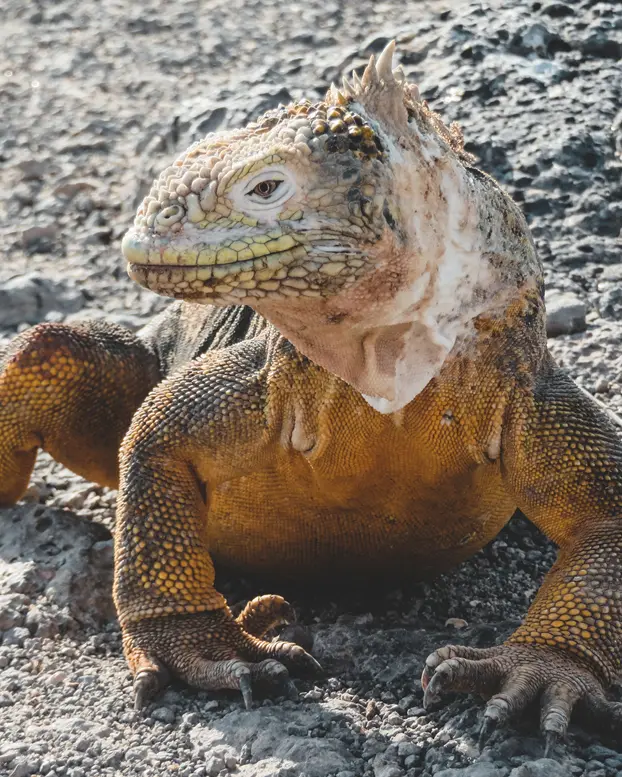
Front view close-up of a land iguana showing its head and facial texture
Image credit: Colin Fearing / Pexels

Extraordinary Adaptations

Cactus as Food and Water

Fresh water is one of the scarcest resources in the Galápagos. Therefore, the land iguana built its entire physiology around that fact. In the driest parts of its range, the spiny pads, fruit, and flowers of the Opuntia cactus make up roughly 80 percent of its diet. They eat them spines and all. To achieve this, the iguana swallows the pads whole to extract both nutrients and vital moisture. This allows them to survive months without rainfall. When the rainy season arrives, individuals gladly drink from temporary pools. They also supplement their diet with the bright yellow flowers of Portulaca. However, for most of the year, cactus provides both food and water.

Mastering Temperature Control

Thermoregulation is the second pillar of its survival strategy. As a cold-blooded reptile, the land iguana cannot generate its own body heat. Therefore, its entire daily rhythm revolves around managing temperature. Mornings involve basking in direct sun to warm sluggish muscles. By midday, equatorial heat becomes dangerous, so iguanas retreat to the shade of cactus stands or rock overhangs. At night, they descend into burrows dug into the soil. Stored ground heat keeps them from cooling too quickly. The burrows themselves are easy to spot along Galápagos trails. They look like shallow depressions pocking the dry earth near visitor paths.

Perhaps the most charming adaptation is behavioral rather than physiological. For instance, land iguanas share a grooming relationship with several species of Darwin’s finches. An iguana will lift itself off the ground on stiffened legs. This posture signals the finches that it is ready for a cleaning. Next, the birds pick ticks and parasites from its skin and folds. The iguana gets relief from pests, while the finch enjoys an easy meal. In short, this small, quiet partnership offers a vivid demonstration of how interconnected life on these islands has become over millions of years.

Distribution

A Map Shaped by History

The Galápagos land iguana is the most widely distributed of the three Conolophus species. Today, it lives across seven islands: Fernandina, Isabela, Santa Cruz, South Plaza, Baltra, Santiago, and North Seymour. However, that range conceals a fragile history. The population on North Seymour did not arrive there naturally. Instead, humans introduced it from Baltra in the 1930s as an experimental conservation measure. Concerns had grown that the Baltra population was at risk. Fortunately, the colony took hold successfully. Today, North Seymour is one of the most reliable places to see the species in the wild.
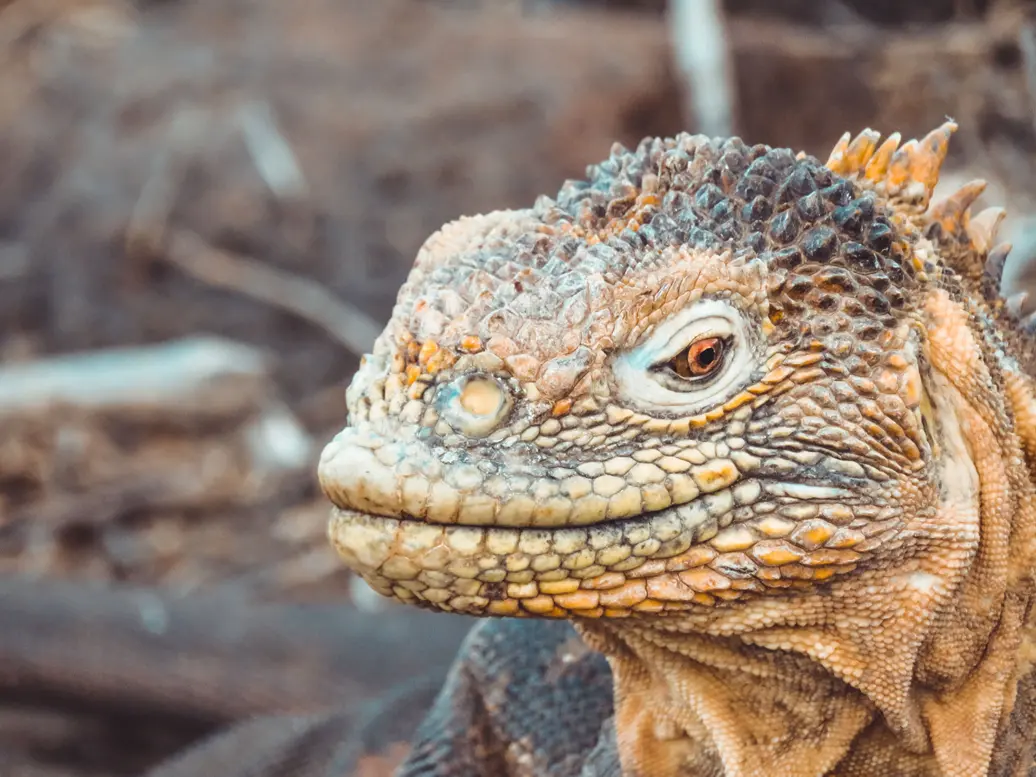
Close-up frontal of a land iguana from the Galápagos Islands
Image credit: Colin Fearing / Pexels

Santiago tells an even starker story. Introduced predators wiped out the island’s land iguana population entirely. For decades, Santiago had none at all. That changed in 2019. Conservationists reintroduced more than a thousand individuals to the island as part of a long-term ecological restoration project. This represents one of the more hopeful chapters in the species’ modern history. Moreover, it highlights how actively managed Galápagos conservation has become.

Island Variations and Hybrids

Population density and behavior vary noticeably between islands. These differences depend on vegetation, predator pressure, and human history. On South Plaza, the population is dense. As a result, visitors can expect close encounters along the trail. The island is also home to an unusual genetic curiosity: a small number of hybrid iguanas. These result from rare breeding between a male marine iguana and a female land iguana. The hybrids are sterile and relatively short-lived. However, their existence reminds us just how closely related the two iguana lineages remain, despite millions of years of separate evolution.

Comparing the Three Galápagos Land Iguana Species

Species Scientific Name Island(s) Estimated Population Color Conservation Status
Galápagos land iguana Conolophus subcristatus Fernandina, Isabela, Santa Cruz, South Plaza, Baltra, Santiago, North Seymour 5,000–10,000 Yellow with brown/black mottling Vulnerable
Santa Fe land iguana Conolophus pallidus Santa Fe (endemic) ~7,000 Pale yellow, more tapered snout Vulnerable
Pink land iguana Conolophus marthae Wolf Volcano, Isabela (restricted access) ~200 Salmon-pink with black striping Critically Endangered

The Santa Fe land iguana lives only on a single small island east of Santa Cruz. It is paler and slightly larger than its more widespread cousin. It also features smaller dorsal spines and a noticeably more conical snout. Despite a relatively healthy population, its limited range leaves it vulnerable. For example, a single bad drought or wildfire could devastate the species. It stands as a textbook example of how geographic isolation cuts both ways in evolution.

The pink land iguana is the rarest of the three. Field researchers first noticed unusually colored individuals on the slopes of Wolf Volcano decades ago. However, the population was so small and remote that scientists did not formally describe it as a distinct species until 2009. Genetic studies suggest its lineage has been diverging on its own for millions of years. This makes it one of the oldest branches in the entire Conolophus family tree. Interestingly, its rose-salmon coloring comes from a simple lack of skin pigment. This unique trait allows blood vessels beneath the skin to show through.

Behavior and Reproduction

Daily Rhythms and Territorial Habits

A land iguana’s day focuses almost entirely around temperature management. Mornings begin with sunbathing. Individuals position themselves to absorb maximum heat after a cool night underground. By late morning, once body temperature stabilizes, iguanas move off to forage. They pick through fallen cactus fruit, low shrubs, and the occasional insect or piece of carrion. As the midday sun intensifies, they retreat to shade. For instance, they rest under a cactus pad, beside a boulder, or inside a burrow. Later, they re-emerge in the cooler hours of late afternoon. Outside of breeding season, land iguanas live solitary lives. They tolerate but rarely interact with neighbors beyond brief territorial displays.

Nesting Challenges and Juvenile Survival

Breeding season timing varies by island because of local climate differences. Nesting typically begins in January on Isabela and South Plaza, June on Fernandina, and September on Santa Cruz. Females travel considerable distances to find soft soil. They dig a nest and lay between 15 and 25 eggs. Once laid, a female will guard the nest site for several days. She does this to stop other females from digging in the same patch of ground. Similarly, males become territorial around nesting areas. They occasionally drive off rival iguanas that wander too close.

Eggs incubate underground for roughly 85 to 110 days before hatching. Hatchlings receive no parental care whatsoever. Consequently, they emerge fully independent and immediately face danger. The first year is by far the most dangerous period of a land iguana’s life. Galápagos hawks account for most juvenile predation. Feral cats also present a longer-term threat. They can kill iguanas up to three or four years old. At that age, native predators would no longer consider them viable prey. Surviving juveniles take between 8 and 15 years to reach sexual maturity. Therefore, population recovery becomes a multi-decade process whenever numbers fall.

Conservation Status

The Impact of Invasive Species

The Galápagos land iguana’s population has declined sharply since Darwin’s visit. At that time, burrows covered entire stretches of Santiago Island. Introduced species represent the single greatest driver of that decline. Humans brought dogs, cats, pigs, rats, and goats to the archipelago. Unfortunately, the iguanas had no evolved defenses against them. The collapse can happen devastatingly fast. For example, in 1976, feral dogs wiped out the entire land iguana population on Santa Cruz in under six months. Only 60 individuals survived. Conservationists rescued and relocated them to the Charles Darwin Research Station in Puerto Ayora. Subsequently, they became the founding stock of a captive breeding program that continues today.

Modern Restoration Efforts

That same pattern of local extinction and intervention played out on Santiago Island. Land iguanas disappeared entirely there before being reintroduced in 2019. Galápagos National Park works closely with international conservation partners. Together, they have spent decades removing invasive predators from key islands. This slow but successful effort has allowed several iguana populations to stabilize or recover. In addition, the Galápagos Land Iguana Project, supported by the Galápagos Conservation Trust, tags and tracks adult iguanas. This project generates the vital data behind major decisions like the Santiago reintroduction.

Climate remains an open concern. Prolonged drought reduces the availability of cactus pads and fruit. Furthermore, the pink land iguana faces an additional risk. Its entire population lives on the slopes of Wolf Volcano. An active eruption could threaten the species’ very limited range in a single event. With roughly 200 individuals left, the pink land iguana remains Critically Endangered. Meanwhile, both the common Galápagos land iguana and the Santa Fe land iguana are listed as Vulnerable. Their populations are recovering but still face risks.

Where To See Them In Galápagos

Top Spots for Wild Encounters

For most visitors, North Seymour and South Plaza offer the most reliable wild encounters. They feature dense populations and well-maintained trails. These paths bring hikers close to basking and foraging iguanas without disturbing them. Santa Cruz Island offers two very different experiences. For instance, you can spot wild iguanas in the island’s arid lowlands. Alternatively, the Charles Darwin Research Station houses the descendants of the rescued 1976 population. This site runs an active breeding program for juveniles. Isabela and Fernandina also host wild populations. Even Baltra’s airport runway has occasionally welcomed wandering iguanas crossing the tarmac.

Travelers hoping to see the Santa Fe land iguana must visit Santa Fe Island itself. Camouflage makes spotting them a genuine challenge because their pale coloring blends with the dry vegetation. Therefore, a sharp-eyed naturalist guide is invaluable here. In contrast, the pink land iguana cannot currently be visited at all. Its entire population on Wolf Volcano sits within a restricted zone closed to tourism. This strict measure protects the species and ensures visitor safety near the active volcano.

Planning Your Wildlife Itinerary

Land iguanas are active throughout the year because the equatorial climate prevents seasonal migrations. However, daily timing matters a lot. Early morning and late afternoon offer the best chances for a clear sighting. During these hours, iguanas are basking or foraging rather than sheltering from the midday heat. Many of these visitor sites require interisland boat travel. Therefore, travelers planning a multi-island itinerary may find it useful to review a guide to inter-island ferry routes when mapping out which sites to prioritize.

If your itinerary includes both Santa Cruz and Isabela, it is wise to check the Santa Cruz to Isabela ferry schedule in advance. Departure times can affect how much daylight you have left for wildlife viewing on arrival. For those starting their trip independently, a look at how ferry booking and boarding works can help avoid surprises at the dock. Many visitors also combine iguana-spotting islands with stops to see the Galápagos giant tortoise. Finally, travelers booking their own interisland legs may also want to compare current ferry prices and check the port check-in guide before heading out.

Final Thoughts

There is something quietly humbling about the land iguana. This animal spent millions of years learning to need almost nothing. It requires no fresh water and no abundance of food. Yet, it nearly lost everything the moment people arrived with dogs and goats. The Galápagos land iguana’s history is not a simple conservation success story. Instead, it is a record of repeated collapse and slow recovery. Biologists have written this story island by island. They tagged adults, rescued survivors, and carried hatchlings back to islands where the species had vanished.

What makes that history worth knowing is its incredible scale. This reptile can outlive most of the people who study it. It drinks from a cactus and grooms with a finch. Furthermore, it split into three distinct species within a single archipelago. This process provides a working demonstration of evolution happening close enough to watch. Few animals make that process so visible. For example, you can stand on a trail on South Plaza and watch the same deliberate movements that puzzled a young naturalist nearly two centuries ago.

Whether that demonstration continues depends on choices we make today. These include predator removal programs, captive breeding efforts, and the discipline of travelers on the trail. For now, the land iguana endures. It basks each morning on the same black lava it has occupied for millions of years, asking nothing of the world except to be left alone in it.

Frequently Asked Questions About the Galápagos Land Iguana

Are Galápagos land iguanas dangerous to humans?

No. Despite their intimidating claws and size, Galápagos land iguanas are calm, slow-moving herbivores. They have no history of unprovoked aggression toward people. They generally ignore visitors entirely as long as humans do not touch, feed, or corner them.

Can Galápagos land iguanas swim?

Not in any meaningful sense. Their close relative, the marine iguana, forages underwater for algae. In contrast, land iguanas are built for arid terrain. Therefore, they do not swim or enter the ocean as part of their normal behavior.

How long do Galápagos land iguanas live?

Most individuals live between 50 and 60 years in the wild. The average lifespan is often cited around 55 years. Consequently, this makes them one of the longest-lived reptiles in the Galápagos Islands.

Can visitors touch or feed land iguanas in Galápagos?

No. Touching, feeding, or approaching wildlife too closely is strictly prohibited under Galápagos National Park rules. This protects visitors and prevents iguanas from associating humans with food, which alters natural foraging behavior and increases disease risk.

What is the rarest Galápagos land iguana population?

The pink land iguana (Conolophus marthae) is by far the rarest. Roughly 200 individuals are confined to a small area of Wolf Volcano on Isabela Island. As a result, it is classified as Critically Endangered and remains closed to tourists.

Do Galápagos land iguanas migrate between islands?

No. Land iguanas do not migrate. They generally remain within a limited home range on a single island for their entire lives. The only exceptions involve populations deliberately relocated by conservationists, such as the introduction to North Seymour and the 2019 reintroduction to Santiago.