Giant Tortoises and Where to Find These Galápagos Icons
Imagine walking along a volcanic trail in the Galápagos Islands. Amidst the dry palo santo vegetation, a prehistoric silhouette suddenly emerges. This animal weighs over 200 kilograms and carries on its shell more years than you could ever live. Furthermore, it moves with absolutely no rush. Galápagos giant tortoises (Chelonoidis spp.) are not simply the largest land reptiles on the planet. Instead, they act as ecosystem architects and living witnesses to evolution. Consequently, they remain the most powerful symbol of why these islands forever changed how humanity understands life.
Feature
Details
Scientific Name
Chelonoidis spp.
Average Weight
80–230 kg (176–507 lbs)
Maximum Weight
Over 300 kg (661 lbs)
Shell Length
Up to 1.8 meters (5.9 ft)
Lifespan
100+ years in the wild, up to 170 years in captivity
Diet
Herbivorous
Estimated Population
30,000–35,000 individuals
Conservation Status
Endangered
This article gathers everything you need to know about them. Therefore, you will learn about their extraordinary biology, the best places to see them, and the ongoing fight to save them from extinction.
Biology and characteristics of the Galápagos giant tortoise
Dimensions that impress
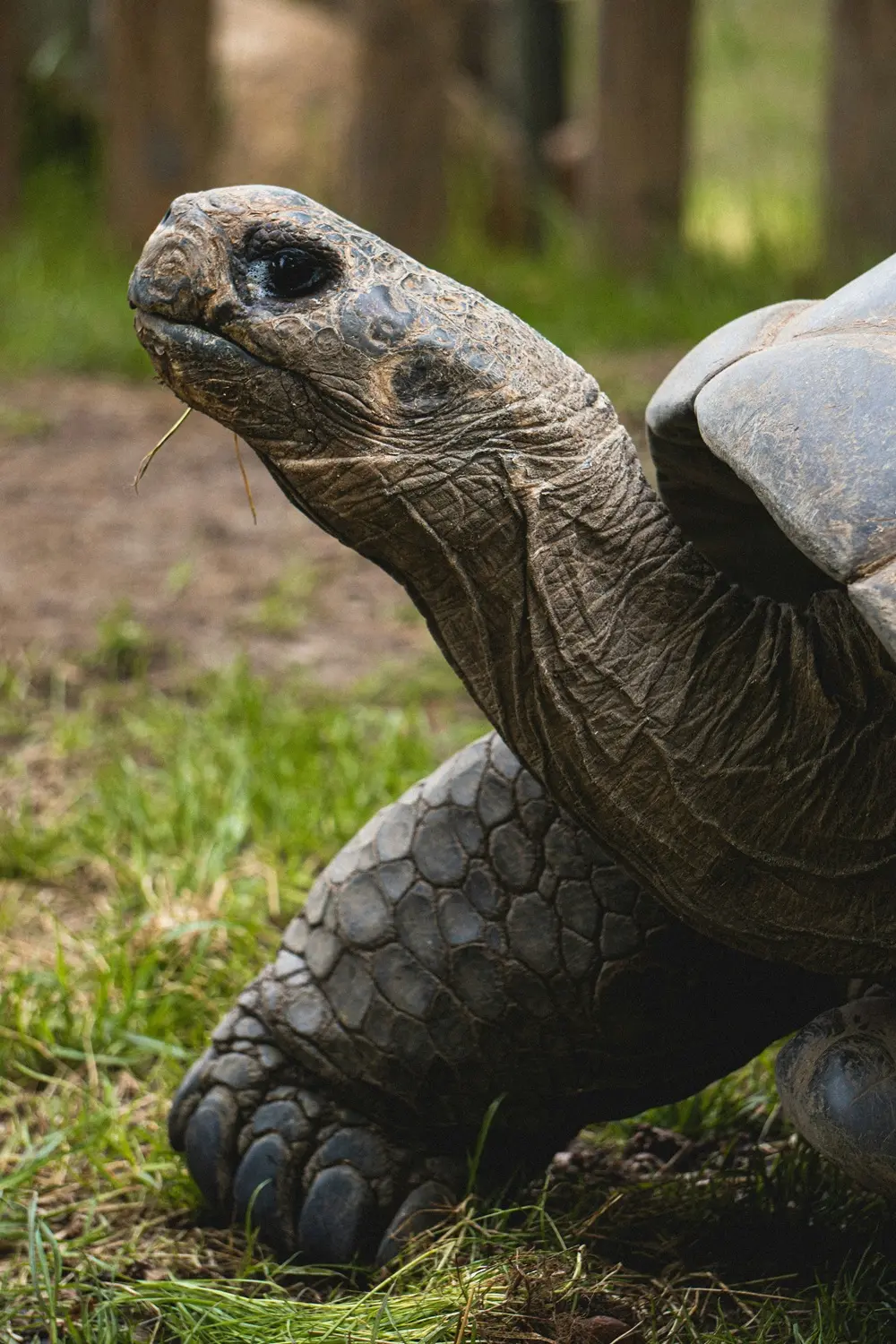
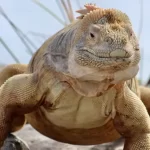
The Galápagos giant tortoise is, without question, the largest land tortoise in existence. For instance, the most robust adult specimens reach up to 1.8 meters in shell length. Additionally, they can exceed 300 kilograms in weight, although the usual wild range oscillates between 80 and 230 kg. Their life cycle is equally monumental. In fact, scientists estimate that they can live around 100 years in the wild, and up to 170 years in captivity. Two famous cases confirm this incredible longevity. First, Harriet, a female studied by Darwin himself, passed away in 2006 in an Australian zoo at around 176 years old. Similarly, the legendary Lonesome George represents the other famous case, whose story appears later on.Image credit: Bjarn Bronsveld / Unsplash
Subspecies
Main Island
Shell Type
Conservation Status
Chelonoidis chathamensis
San Cristóbal
Domed
Threatened
Chelonoidis hoodensis
Española
Saddleback
Recovering
Chelonoidis porteri
Santa Cruz
Domed
Vulnerable
Chelonoidis vicina
Isabela
Domed
Threatened
Chelonoidis abingdonii
Pinta
Saddleback
Extinct
Metabolism as a superpower
Like any reptile, the giant tortoise operates with an exceptionally slow metabolism. As a result, their digestion can take between one and three weeks. This apparent slowness is actually a first-rate evolutionary advantage. For example, tortoises store water in a specialized bladder located at the base of the neck. They also transform accumulated fat into liquid. Consequently, this process allows them to survive more than a whole year without eating or drinking. Unfortunately, this extreme endurance condemned them for centuries. Their resilience made them the perfect living pantry for pirates and whalers alike.
The three shell types and what they reveal
The environment literally molds the body shape of this species. Therefore, within the archipelago, experts distinguish three specific shell morphologies:
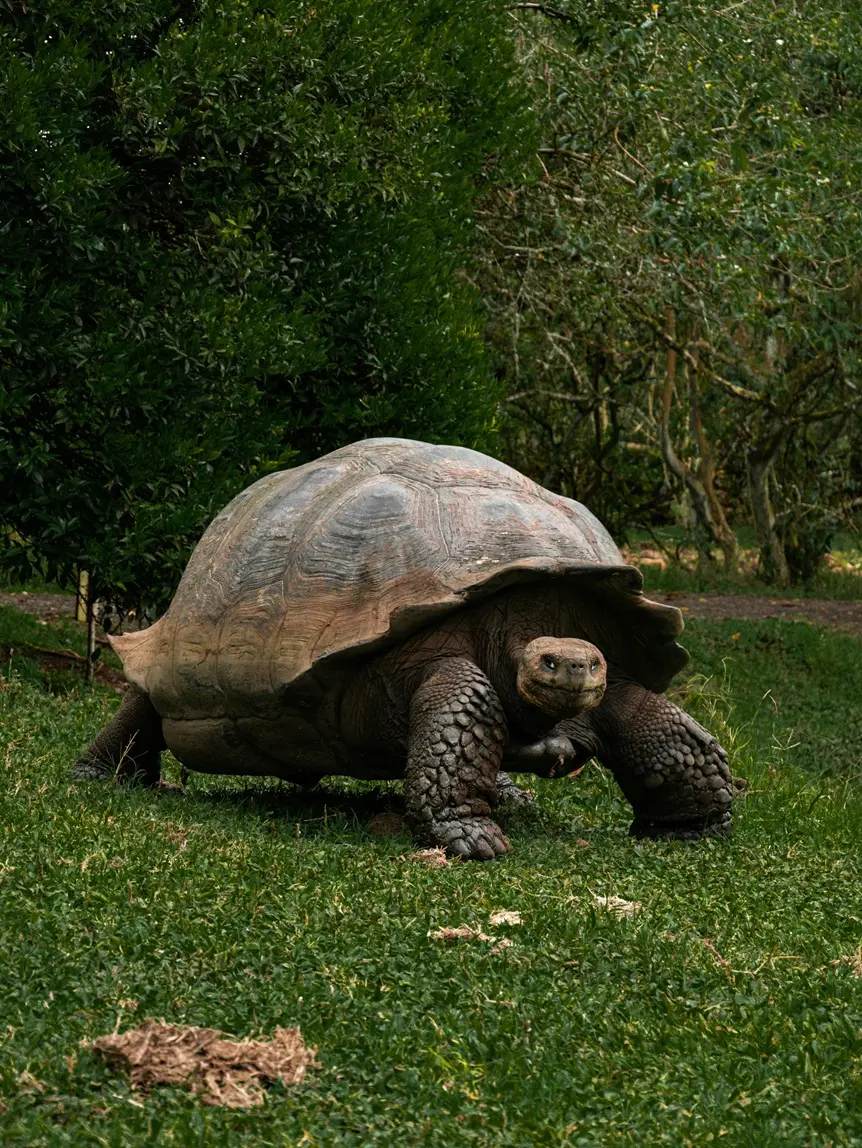
Domed shell: Rounded and high, typical of tortoises inhabiting humid islands with abundant vegetation, like the highlands of Santa Cruz. Because food is plentiful near the ground, they do not need to stretch their necks upward.
Saddleback shell: Featuring a marked elevation at the front that allows the neck to extend vertically. This helps them reach tall cacti and shrubs on drier, arid islands. In addition, these tortoises have longer, thinner limbs.
Intermediate shell: Found on Santa Fe Island, it successfully combines features of the two previous morphologies.
These differences are crucial for science. In fact, the variations among tortoises from different islands helped Charles Darwin formulate his theory of natural selection during his 1835 visit. Ultimately, each environment forges a distinct version of the same animal.
Island gigantism: how they became so large
The ancestors of these tortoises arrived at the archipelago with a conventional size, probably migrating from South America. However, lacking natural predators and having accessible resources, generations of tortoises grew larger without any evolutionary penalty. This phenomenon is known as island gigantism and is quite common in island ecology. The resulting large size grants them massive body reserves and better temperature regulation. Interestingly, a lower surface-to-volume ratio also facilitates swimming between islands, which significantly expanded their original habitat.
Daily life and social habits
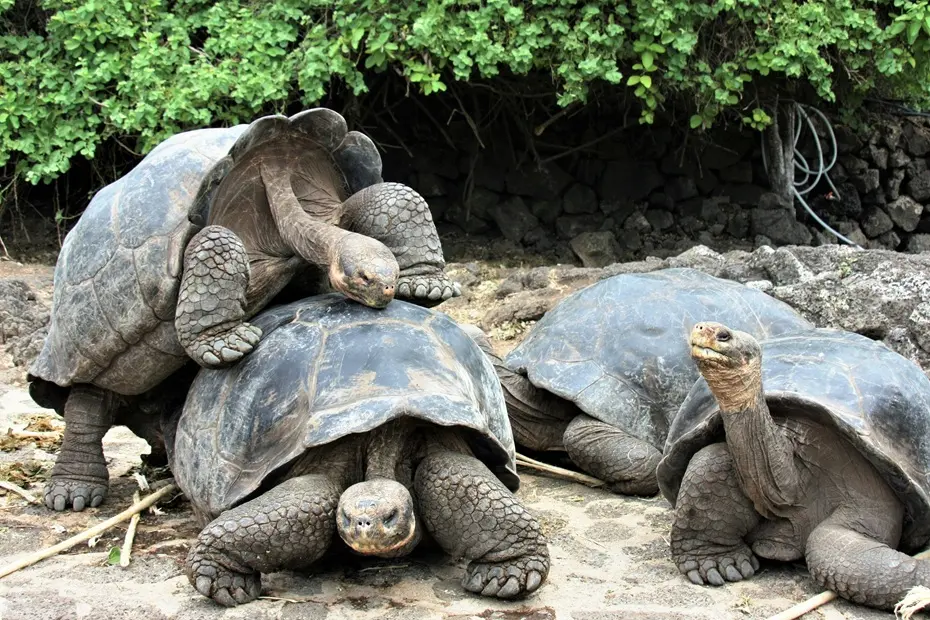
Generally, tortoises spend the cooler hours of the day moving around for food. Afterward, they spend nights resting amidst vegetation or semi-submerged in mud. This habit successfully regulates their body temperature and protects them from parasites. Although they are land reptiles, they regularly visit water holes to drink and cool off. Their social life is loose but definitely exists. For example, they establish a size-based hierarchy through interactions like shell-clashing and biting at limbs. Furthermore, they share a striking mutualistic relationship with certain birds. Darwin’s finches and vermilion flycatchers perch on them to peck ticks from their skin folds. The tortoise extends its neck to facilitate the work. As a result, the bird gets food, and the tortoise gets a clean shell. It is a perfect alliance. Their diet remains strictly herbivorous. Grass, flowers, leaves, and cactus fruits are their main foods, though they can consume carrion opportunistically.
Where to see giant tortoises in Galápagos
Observing these giants in the wild is a profound experience. Fortunately, several islands offer practically guaranteed sightings if you visit the right places.
Santa Cruz: the epicenter of sightings
Santa Cruz Island offers the greatest accessibility for travelers. In its highlands, known as El Chato, hundreds of domed-shell tortoises graze freely amidst exuberant vegetation. You can walk among them just a few meters away while respecting National Park regulations. Additionally, the Fausto Llerena Breeding Center in Puerto Ayora houses tortoises of all ages. This site helps visitors understand the captive breeding work that saved several subspecies. Moreover, Santa Cruz is the main transportation hub of the archipelago. From here you can easily take the ferry to Isabela. You can also connect with San Cristóbal to keep exploring the archipelago.
Isabela: volcanoes and tortoises on a massive scale
Isabela is the largest island in the archipelago and hosts distinct populations on each of its volcanoes. For that reason, the Puerto Villamil Breeding Center is a must-visit destination. Meanwhile, the trails of Alcedo Volcano reveal tortoises during their seasonal migration toward nesting areas. On Isabela’s Wolf Volcano, biologist James Gibbs discovered saddleback tortoises that belonged elsewhere. Decades later, this discovery proved to be the key to genetically rescuing the Floreana tortoise. The usual route to Isabela from Santa Cruz is by passenger ferry. Therefore, it is highly recommended to check schedules and availability in advance to organize your routes between islands properly.
San Cristóbal: history and nature
San Cristóbal was the first colonized island in the archipelago. Furthermore, it boasts its own subspecies of giant tortoise (Chelonoidis chathamensis). The Jacinto Gordillo Breeding Center, located a few kilometers from Puerto Baquerizo Moreno, allows visitors to see specimens up close. The island has direct access from the mainland and consistently connects by ferry to Santa Cruz on a regular basis.Image credit: Sonder Quest / Unsplash
Española and Floreana: living history of conservation
Española is home to the subspecies Chelonoidis hoodensis. The captive breeding program rescued them from extinction when only 14 individuals remained. Today, as a result, the population exceeds 2,000 specimens. Meanwhile, Floreana made history in February 2026 with an exciting milestone. The first giant tortoises returned to the island after 175 years of absence. If you plan to visit, research the ferry options from Santa Cruz beforehand, as the connection requires organization.
Logistical tips for moving between islands
Passenger ferries connect the inhabited islands and generally depart in the morning. Knowing the logistics well marks the difference between a smooth trip and one full of unexpected issues. Therefore, review inter-island routes and their practical info alongside updated fares for 2026-2027 before traveling. If you have doubts about these transfers, the ferry FAQ section resolves the most common traveler inquiries.
Conservation of the Galápagos giant tortoise
The historical collapse of a species
When the first European explorers arrived at the archipelago, they encountered a massive spectacle. Giant tortoises lived by the hundreds, scattered in all directions through the plains. Historical estimates indicate that between 250,000 and 350,000 tortoises once existed across the islands. However, what followed was systematic plundering. Whaling ships, pirates, and merchants discovered that tortoises were an ideal food for long voyages. They survived for months without water or food in cargo holds. Consequently, more than 100,000 tortoises were lost during the 17th, 18th, and 19th centuries. By 1850, the Floreana tortoise had completely vanished from its island of origin.
Introduced species: the second blow
Human hunting was the first assault, and the introduction of foreign species was the second. Throughout the centuries, rats, pigs, goats, dogs, cats, and cattle arrived on the islands. These animals compete for food and heavily destroy vegetation. In addition, pigs, rats, and dogs directly eat tortoise eggs and hatchlings. On Floreana, the situation became particularly critical. For example, ten of the 22 endemic bird species went extinct following the arrival of humans and domestic animals. Goats multiplied without control and devastated the island’s vegetation for decades. However, conservationists finally eradicated the last specimen in 2007.
Lonesome George: the symbol of an irreversible loss
No story about extinction in Galápagos is more powerful than that of Lonesome George. Found in 1971 on Pinta Island, he moved to the Charles Darwin Research Station. Subsequently, he became the most famous individual of his species as the last living representative of the Pinta subspecies. For more than three decades, the National Park searched fruitlessly for a compatible mate to save the subspecies. However, on June 24, 2012, George died at approximately 100 years old without leaving offspring. With him, the Pinta Island tortoise disappeared forever.
The historic return to Floreana in 2026
On a hot morning in February 2026, park rangers from the Galápagos National Park crested a rocky ridge on Floreana on foot. They carried 45-kilogram plastic boxes containing the first 50 hybrid Floreana giant tortoises to step on that land in 175 years. An accidental scientific discovery made this incredible achievement possible. In the year 2000, biologist James Gibbs found saddleback tortoises on Isabela’s Wolf Volcano. Surprisingly, they shared a clear link to the Floreana morphology. DNA research later revealed they were hybrids. They were likely descendants of Floreana tortoises thrown overboard by whaling ships in the 19th century and washed by currents up to Isabela.
The miracle rescue of the Floreana lineage
Over the following 15 years, a breeding program at the Santa Cruz center produced 720 new hybrid tortoises with Floreana lineage. This process included eradicating black rats and feral cats from the island. This 15-million-dollar effort has already produced great results. For instance, the Galápagos rail, absent for nearly 200 years, has returned to Floreana. Additionally, local agricultural yield increased by 80% once rats were gone. As a result, experts project that thousands of giant tortoises will repopulate Floreana once again over the next fifty years through more releases and natural reproduction.Image credit: Deb Dowd / Unsplash
Ongoing scientific work
The Galápagos Tortoise Movement Ecology Programme (GTMEP) currently monitors four species across three islands. This initiative brings together the Charles Darwin Foundation, the National Park, and the Saint Louis Zoo. For example, the 50 tortoises released on Floreana in 2026 carry GPS sensors powered by Starlink. These sensors will transmit data for a decade, tracking how they disperse, where they nest, and how they interact with the ecosystem. Furthermore, the program focuses on migratory patterns, the hatchlings’ lost years, and the impact of the invasive Cuban cedar. Tortoises, as extremely long-lived animals, act as sentinel species for the ecological health of the archipelago.
Current threats
Despite these advancements, giant tortoises remain listed as an endangered species according to the IUCN Red List. Currently, the main challenges include:
Illegal trafficking: A large tortoise can reach up to 60,000 dollars on the black market for exotic pets.
Climate change: This factor alters rainfall patterns, affects vegetation, and compromises the hatching success of nests.
Residual invasive species: Despite successful erradications, pests still persist on some islands.
Habitat fragmentation: Human expansion in rural areas limits the movement corridors used by tortoises.
Today, between 30,000 and 35,000 giant tortoises remain in the archipelago. This is barely 10-12% of the original population, distributed across 11 surviving subspecies.
Frequently asked questions about the Galápagos giant tortoise
How long does a Galápagos giant tortoise live? Galápagos giant tortoises live around 100 years in the wild. However, in captivity they can exceed 150 and even 170 years, making them one of the longest-lived vertebrates on earth. How many species or subspecies of giant tortoise are left in Galápagos? Currently, 11 living subspecies of giant tortoise exist in the archipelago. Unfortunately, three have gone definitively extinct, including the Pinta Island subspecies after Lonesome George died in 2012. What does the Galápagos giant tortoise eat? Their diet is herbivorous. Therefore, they feed mainly on grasses, flowers, leaves, and cactus fruits, though they can opportunistically consume carrion. How much does a Galápagos giant tortoise weigh and measure? The largest specimens exceed 300 kilograms in weight and reach up to 1.8 meters in shell length. However, the usual range for wild adults varies between 80 and 230 kg. How many giant tortoises are left in Galápagos? The current population stands between 30,000 and 35,000 individuals. This represents approximately 10% of the specimens that inhabited the archipelago before European explorers arrived. Do they have natural predators? Adults have no natural predators. However, their eggs and hatchlings remain vulnerable to introduced species like pigs, rats, dogs, cats, and fire ants. Where do Galápagos giant tortoises lay their eggs? Females migrate to the lower zones of the islands to nest. Afterward, they dig a hole in sandy soil and deposit between 4 and 19 eggs, which take 4 to 5 months to hatch. On which island is it easiest to see giant tortoises in the wild? The highlands of Santa Cruz, especially the El Chato area and the Fausto Llerena Breeding Center, offer the most accessible and reliable sightings for travelers. How do I move between the islands to see tortoises? The most practical way to travel between the main islands is by inter-island ferry. Therefore, you can check schedules, routes, and book your tickets in advance to plan your itinerary smoothly. For more logistical details, make sure to read the essential ferry travel guide to Galápagos before boarding. How long does it take for the giant tortoise to digest its food? Thanks to their exceptionally slow metabolism, the Galápagos giant tortoise can take between one and three weeks to complete the entire digestive process.
Final Thoughts
The Galápagos giant tortoise is much more than the world’s largest tortoise. It represents millions of years of evolution, ecological resilience, and one of the greatest conservation success stories ever achieved on islands. Despite centuries of exploitation, invasive species, and habitat degradation, dedicated restoration efforts have allowed several populations to recover. Recent milestones, such as the return of giant tortoises to Floreana Island after 175 years, demonstrate that science and long-term conservation can reverse seemingly irreversible losses. Whether you are fascinated by evolution, wildlife photography, or planning a trip to the Galápagos, observing these ancient reptiles in their natural habitat remains one of the most memorable experiences on Earth. Protecting them means preserving a living symbol of biodiversity for future generations.
Frequently Asked Questions About Galápagos Giant Tortoises
Are Galápagos giant tortoises dangerous to humans?
No. Galápagos giant tortoises are gentle herbivores and pose virtually no threat to humans. They are calm animals that generally ignore visitors, although people should always keep a respectful distance and follow Galápagos National Park regulations.
Can Galápagos giant tortoises swim?
Yes. Although they are primarily terrestrial reptiles, giant tortoises are capable swimmers and can float for long periods. Scientists believe their ancestors colonized different islands by drifting across ocean currents millions of years ago.
Why did Galápagos giant tortoises evolve to become so large?
Their impressive size is the result of a process known as island gigantism. With few natural predators and abundant food resources, tortoises evolved larger bodies that allow them to store water and energy more efficiently.
Can visitors touch giant tortoises in the Galápagos?
No. Visitors are not permitted to touch, feed, or disturb giant tortoises. These regulations help minimize stress on the animals and ensure that they maintain their natural behaviors in the wild.
Do giant tortoises migrate within the islands?
Yes. Some populations undertake seasonal migrations between humid highlands and drier lowlands. These movements are mainly related to food availability, nesting sites, and favorable environmental conditions.
What is the rarest Galápagos giant tortoise?
The Pinta Island tortoise (Chelonoidis abingdonii) became extinct in 2012 with the death of Lonesome George. Today, conservationists are focusing on recovering other rare lineages, including tortoises with Floreana ancestry.