The Galápagos Penguin: A Tropical Survivor Unlike Any Other Penguin on Earth
Penguins belong in cold places. That’s the assumption most people carry into the Galápagos, right up until they see a small, black-and-white bird standing on sun-scorched lava rock, a few degrees south of the equator, seemingly unbothered by the heat. The Galápagos penguin (Spheniscus mendiculus) is the only penguin species on Earth that lives and breeds in the wild north of the equator, and it does so without ice, snow, or freezing wind anywhere in sight. Its survival here is not a curiosity of evolution so much as a direct consequence of ocean chemistry. Two cold-water currents — the Humboldt, arriving from the south, and the Cromwell, welling up from the deep — collide around the western islands and keep sea temperatures low enough to support the small fish this penguin depends on. Remove those currents, and the species simply could not exist this close to the equator.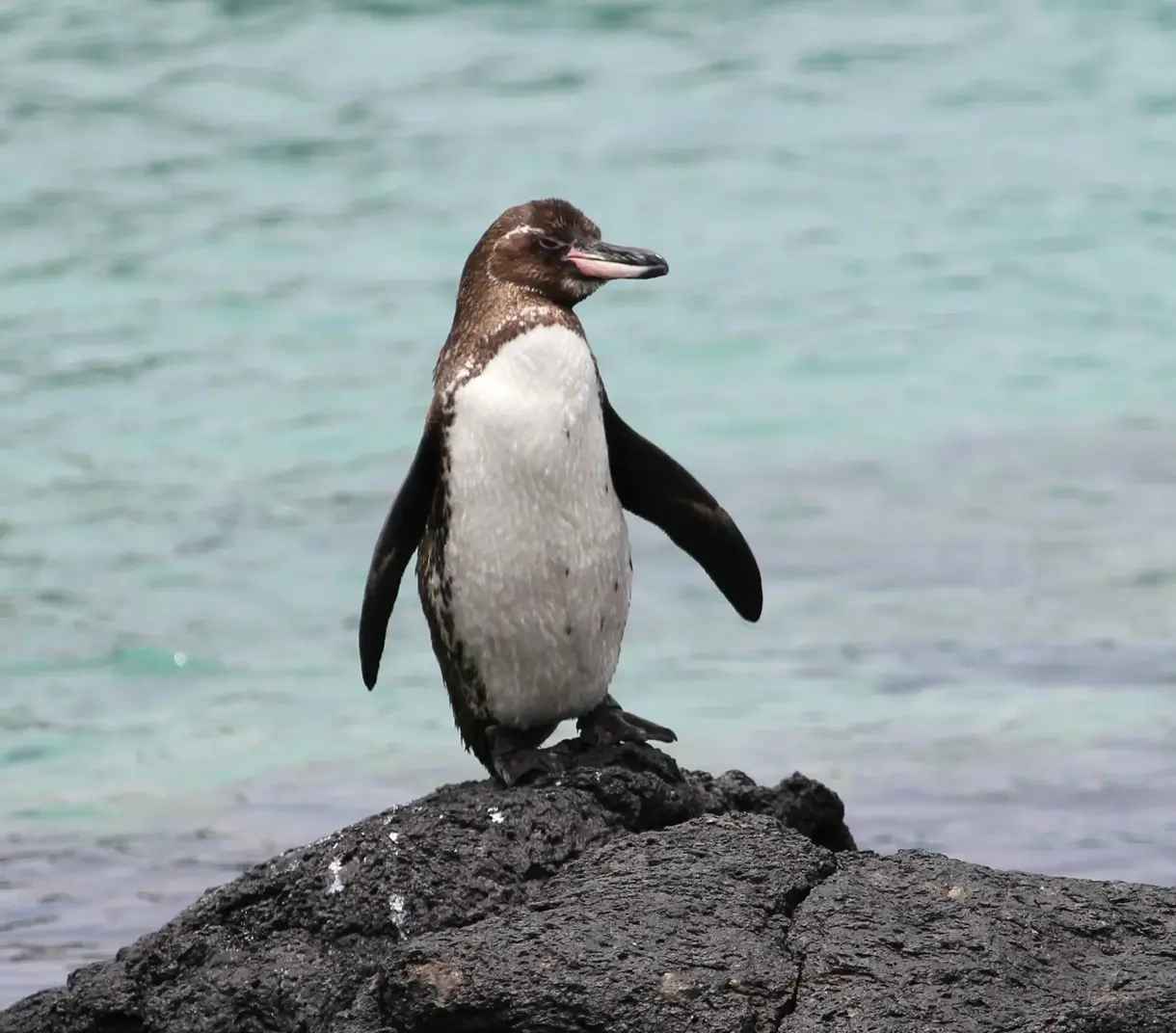
Quick Facts About The Galápagos Penguin
| Category | Details |
|---|---|
| Scientific name | Spheniscus mendiculus |
| Average size | 49 cm |
| Maximum size | 55 cm |
| Weight | Approximately 2.5 kg |
| Lifespan | 15–20 years in the wild |
| Diet | Sardines, anchovies, mullet, and occasional crustaceans |
| Conservation status | Endangered (IUCN) |
| Population estimate | Under 2,000 individuals; fewer than 1,000 breeding pairs |
| Distribution | Mainly Isabela and Fernandina, with small colonies on Bartolomé, Santiago, and Floreana |
| Unique trait | Only penguin species that breeds in the wild north of the equator |
Evolutionary Origins
The Galápagos penguin’s closest living relative is the Magellanic penguin of southern Chile and Argentina, followed more distantly by the Humboldt penguin and the African penguin. All four belong to the genus Spheniscus, a group of mid-sized, burrow- and crevice-nesting penguins built for temperate rather than polar climates. The prevailing theory is that ancestral penguins were swept north from the coast of South America thousands of years ago, most likely carried by a shift in ocean currents or a storm event, and became stranded in the Galápagos archipelago. Cut off from their southern relatives and facing a warmer, food-scarcer environment, the population that survived did so by getting smaller. This process, known as island dwarfism, reduced their body mass and heat retention, both of which were liabilities in the tropics but became advantages for a bird now living far outside its ancestral range. Over time, the species also lost the dense fat reserves typical of cold-water penguins, relying instead on behavioral cooling strategies described below. The result is a bird that looks unmistakably like a penguin, yet is built almost entirely around surviving heat rather than cold.Physical Characteristics
At just 49 cm tall and roughly 2.5 kg, the Galápagos penguin is the second-smallest penguin species in the world, behind only the little penguin native to Australia and New Zealand. Its head is black, bordered by a narrow white band that runs from behind the eye, around the dark ear coverts and chin, and joins at the throat. The back is a dark, blue-grey black, the underside is white, and two black bands cross the chest, the lower one extending down the flanks toward the thighs. Juveniles look distinctly different: their heads are uniformly dark grey with no white banding, and they lack the chest stripes entirely until they mature. Adult females tend to be visibly smaller than males, with a comparatively thinner bill. During the breeding season, patches of bare pink skin appear around the base of the bill and eyes — a detail thought to assist with heat dissipation exactly when the birds need it most, while courting and incubating. The bill itself is a practical two-tone design: black on the upper mandible, pink with a black tip on the lower one. Feet and legs are black, and the eyes are a warm brown. Underwater, none of this slows the bird down — Galápagos penguins can reach speeds of up to 35 km/h in short pursuit dives, using their flippers as fins and a streamlined, torpedo-shaped body built for speed over distance.Extraordinary Adaptations
Every unusual trait in this species traces back to one problem: staying alive in a climate penguins were never meant to inhabit. Thermoregulation. Unlike polar penguins that huddle for warmth, Galápagos penguins actively work to shed heat. On land, they stretch their flippers outward and hunch their bodies forward to shade their feet, using the blood flow in their flippers to release excess body heat into the air. When that isn’t enough, they pant, cooling their throat and respiratory tract through evaporation, much like a dog. Crevice nesting instead of burrowing. Its closest relatives — the African and Humboldt penguins — dig burrows into soft soil or guano deposits. The volcanic terrain of the Galápagos offers no such material, so this species nests instead in natural cracks, lava tubes, and caves along the coast, using the surrounding rock as insulation and shade for eggs and chicks. Opportunistic breeding. Rather than following a fixed annual breeding season like most penguins, Galápagos penguins breed whenever sea temperatures and food supply allow, sometimes attempting multiple clutches in a single year, and skipping breeding entirely during poor conditions. Reduced body fat. Where cold-water penguins rely on thick fat layers for insulation, this species has trimmed that reserve down, since retaining heat here is a hazard rather than a survival tool.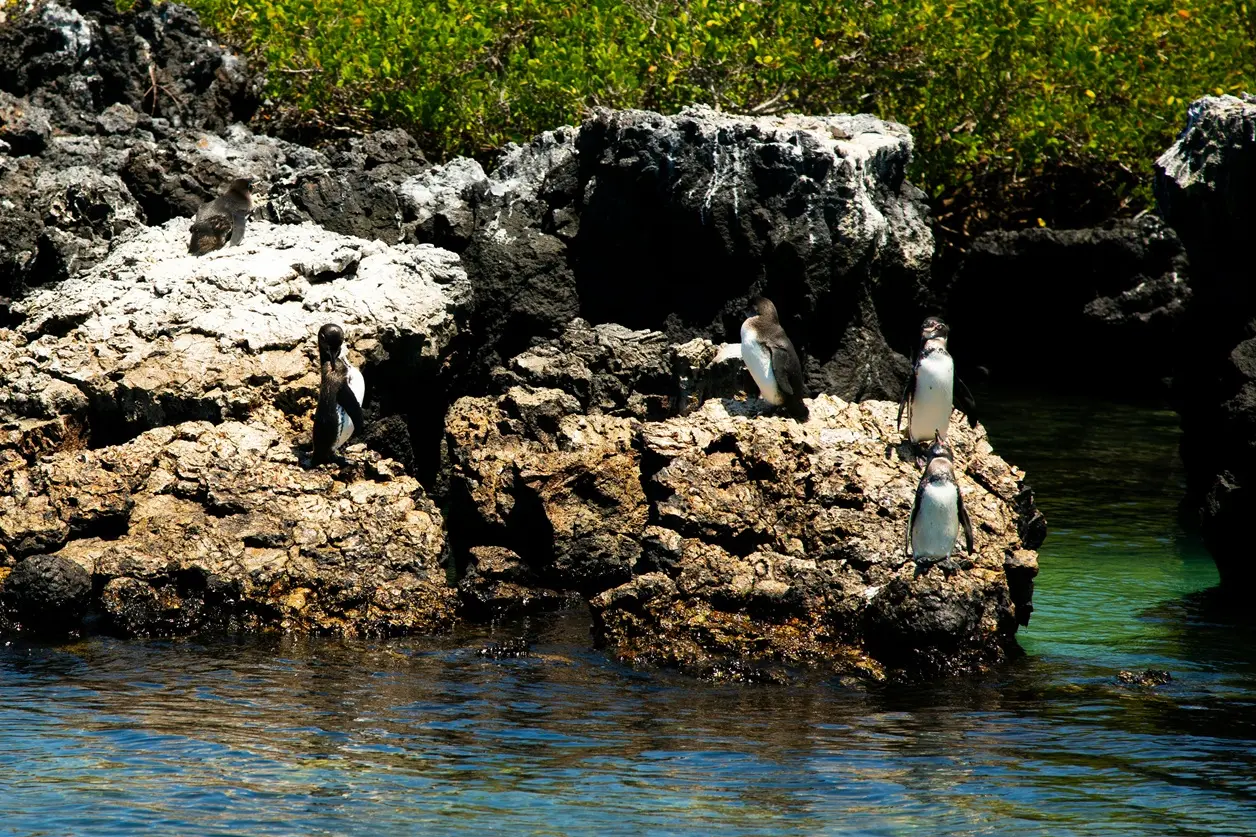
Distribution
Around 95% of the world’s Galápagos penguins live along the coastlines of Isabela and Fernandina, the two youngest and most volcanically active islands in the archipelago. Both sit directly in the path of the Cromwell Current, which delivers a steady supply of cold, nutrient-rich water even at the equator. The remaining 5% is spread thinly across Bartolomé, Santiago, and Floreana, in colonies small enough that a single bad breeding season can meaningfully affect the local population. Vagrant individuals have occasionally turned up far outside this range, including sightings on mainland Ecuador, Colombia’s Isla Gorgona, and even Panama, though these are rare, isolated events rather than an indication of range expansion. Travelers moving between islands by ferry — for example on the route from Santa Cruz to Isabela — pass directly through this core habitat, which is part of why western-island itineraries carry the best odds of a sighting.Where Populations Differ Across the Islands
| Island | Population Share | Habitat | Notable Trait |
|---|---|---|---|
| Isabela & Fernandina | ~95% | Coastal lava fields, Cromwell Current upwelling | Largest, most genetically stable colonies |
| Bartolomé | Small colony | Volcanic islet near Pinnacle Rock | Most accessible for snorkeling encounters |
| Santiago | Small colony | Lava rubble shoreline, shared with sea lions | Frequently seen near Chinese Hat islet |
| Floreana | Very small, fluctuating | Rocky coastline | Most vulnerable to local population loss |
Behavior and Reproduction
Galápagos penguins are strictly diurnal hunters. They typically forage within a few kilometers of their nesting site, diving repeatedly for less than a minute at a time to depths of 8–12 meters, chasing sardines, anchovies, and mullet in short, fast bursts. Once the day heats up, they retreat to shaded rock crevices or slip into the water simply to cool off, often swimming with their heads held above the surface at an unhurried pace that looks almost leisurely compared to their underwater speed. Pairs mate for life, reinforcing the bond through bill-tapping and mutual preening near the nest site year-round. Because there is no fixed breeding season, courtship and egg-laying can occur whenever sea surface temperatures drop below roughly 24°C, a signal of abundant food. A clutch is usually one to two eggs, incubated for 38–40 days by both parents, who alternate incubation duties with multi-day foraging trips at sea. Chicks remain in the nest for around 60 days under close parental protection before heading into the water to fend for themselves, at which point they become vulnerable to threats their parents can partially shield them from, including introduced predators and, increasingly, avian malaria. On land, predators include snakes, Galápagos hawks, and short-eared owls, though these account for relatively little predation compared to introduced cats and rats. In the water, sharks, fur seals, and sea lions pose the greater risk.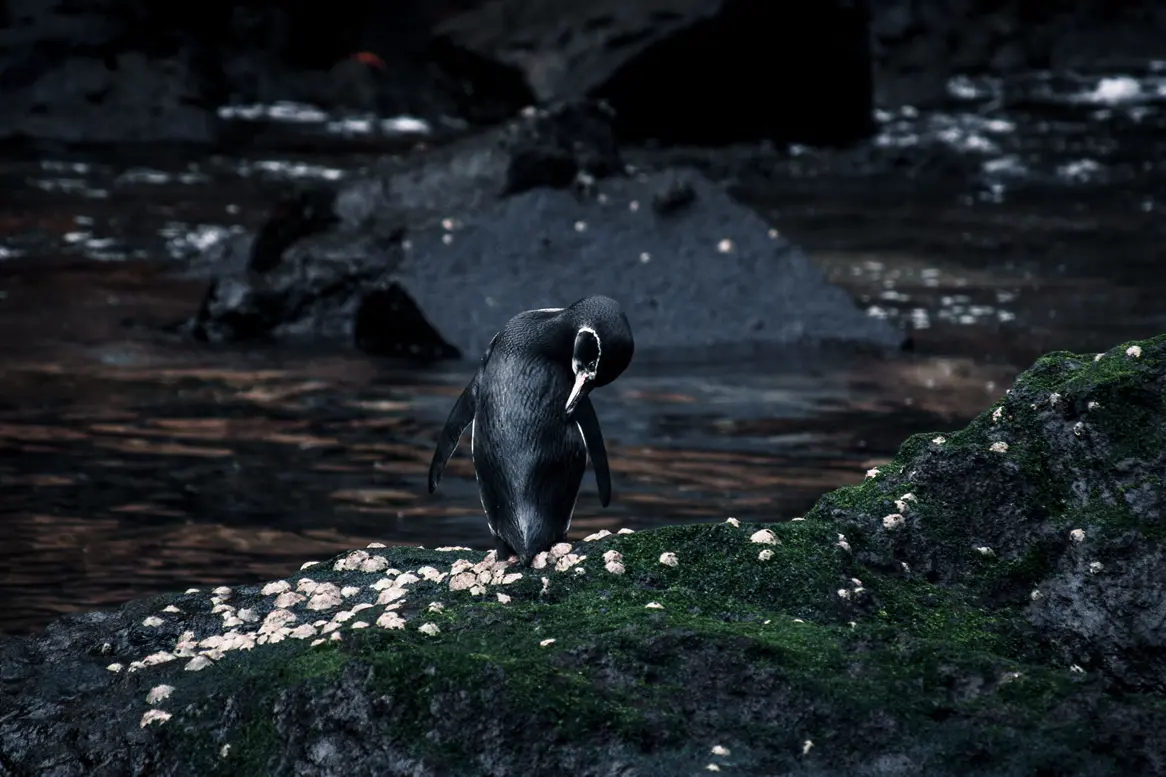
Conservation Status
The Galápagos penguin is currently classified as Endangered. Its population history is a story of sharp shocks rather than gradual decline: a severe El Niño event in the 1980s wiped out more than 70% of the population in a single stretch, and the species has never fully recovered that ground, hovering at under 2,000 individuals for years since. Several overlapping pressures keep the population capped low:- El Niño events: Warm water displaces the cold currents the penguins depend on, collapsing local fish stocks and forcing widespread breeding failure and starvation.
- Introduced predators: Cats, dogs, and rats raid nests for eggs and chicks, particularly on Isabela.
- Marine predators and bycatch: Sharks and sea lions take adult birds, while some penguins are accidentally caught in fishing nets.
- Pollution: Oil spills and plastic debris threaten both the birds directly and the small fish populations they rely on.
- Avian malaria: Spread by mosquitoes introduced through human settlement, this disease is an emerging concern given the species has no evolved immunity to it.