The Waved Albatross: Gal谩pagos’ Only Albatross, Found Nowhere Else on Earth
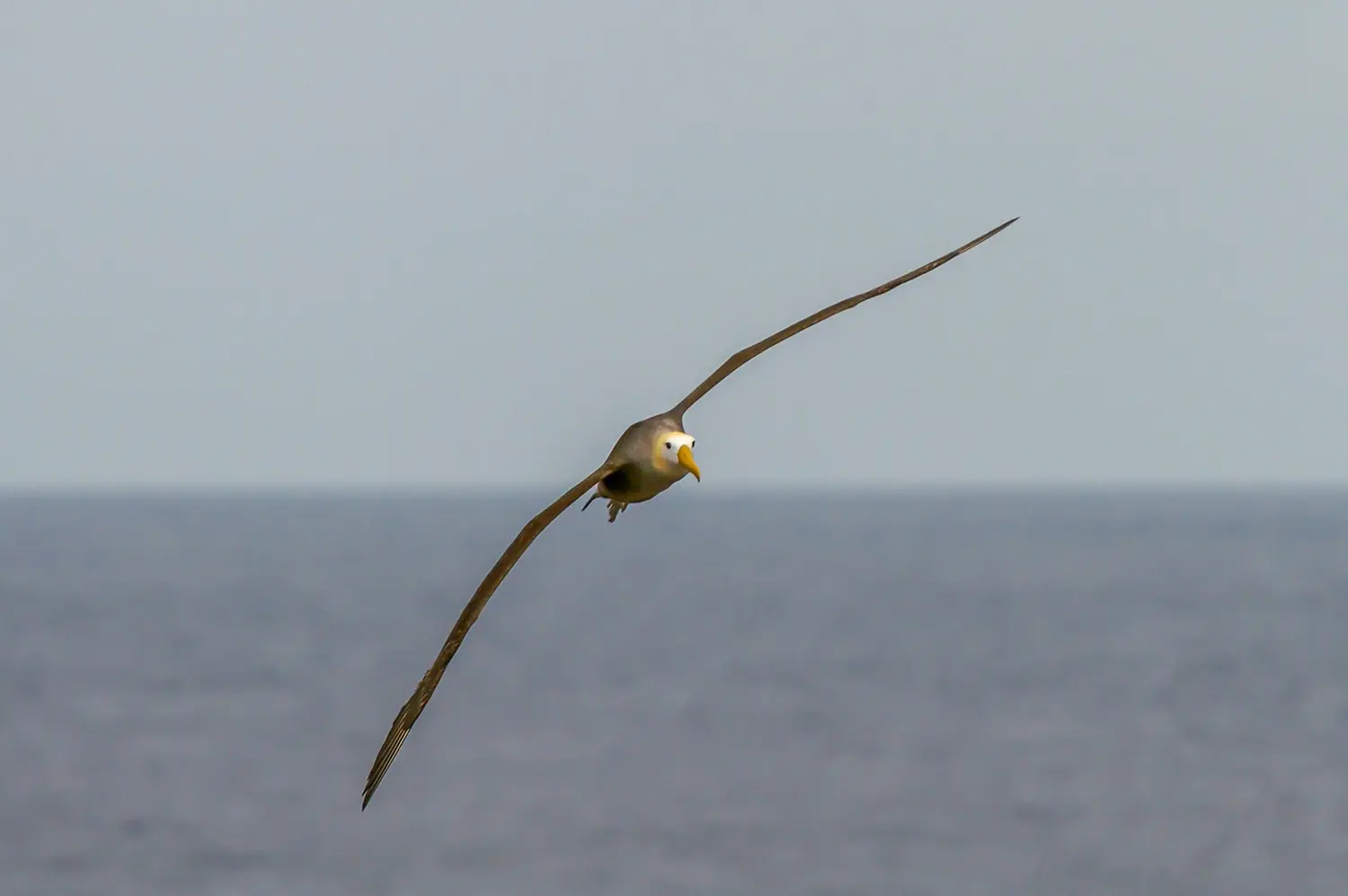
Land on Espa帽ola Island between April and December and you’ll walk straight into one of the strangest courtships in the animal kingdom. A pair of birds face each other, bow, throw their heads back, and clack their bills together like fencers testing blades. This is the Waved Albatross, and Espa帽ola is the only place on the planet where you can watch this happen in the wild. Everywhere else in its range, this bird is a speck on the horizon, gliding for hours without a single wingbeat. Here, for nine months a year, it comes down to land, picks a mate, and raises a single chick on bare volcanic rock. There’s no other seabird colony in Gal谩pagos quite like it, and there’s no other albatross on Earth that breeds in the tropics.Image credit: Hans-Jurgen Mager / Unsplash The species is also running out of room. With one nesting site and a shrinking population, the Waved Albatross carries a critically endangered label that few visitors expect to see attached to a bird this large and this visible.
Quick Facts About The Gal谩pagos Waved Albatross
Category
Detail
Scientific name
Phoebastria irrorata
Average size
80鈥90 cm (31鈥35 in) in length
Maximum wingspan
Up to 250 cm (8.2 ft)
Weight
2.7鈥4.0 kg (6鈥8.8 lb)
Lifespan
Around 40 years; some individuals reach 50
Diet
Squid, fish, and crustaceans, hunted mostly at night
Conservation status
Critically Endangered (IUCN)
Population estimate
Roughly 12,000 breeding pairs
Distribution
Breeds on Espa帽ola Island (Gal谩pagos); a handful of pairs nest on Isla de la Plata, off mainland Ecuador
Unique trait
The only albatross species that breeds in the tropics
Evolutionary Origins
The Waved Albatross belongs to Phoebastria, the group scientists call the North Pacific albatrosses, alongside the Laysan and Black-footed Albatross. The name is a bit misleading in this case. Most of the Waved Albatross’s life happens south of the equator, feeding along the coasts of Peru and northern Chile, far from the North Pacific waters its relatives favor. How the species ended up nesting on the equator, rather than in the sub-Antarctic latitudes favored by most albatrosses, is still debated among ornithologists. The leading explanation ties it to the cold, food-rich Humboldt Current, which sweeps up from the south and keeps the waters around Espa帽ola unusually productive for a tropical latitude. That current effectively imported a cold-water food supply into a warm-water breeding site, letting an otherwise cold-adapted lineage settle at the equator without giving up its diet. Isolation did the rest. Once a population settled on Espa帽ola, generations of birds returning to the same cliffs each year locked the species into a single breeding ground, a pattern common across Gal谩pagos wildlife but rarely this extreme even by island standards.
Physical Characteristics
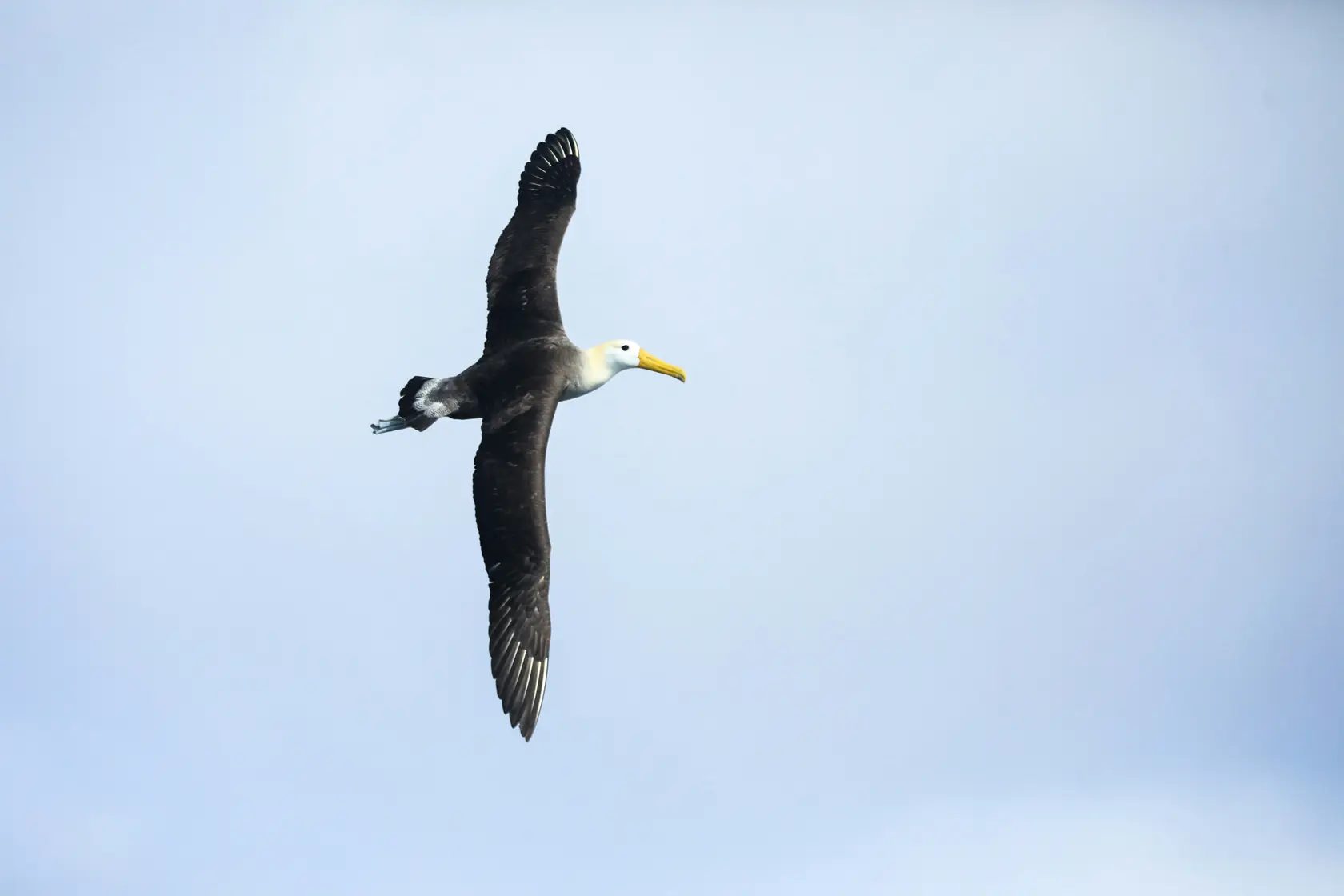
At close range, the Waved Albatross is unmistakable. Adults carry a white head with a cream-colored crown, a mustard-yellow bill, and bluish legs and feet. The name comes from the fine, wavy brown lines running across the white underparts, from the upper breast down to the tail. Chicks look nothing like this at first: newly hatched birds are covered in plain brown down and only grow the white head as they mature, usually over several years. Size sets this bird apart from every other species in the archipelago. It’s the largest bird found in Gal谩pagos, though by albatross standards it’s only medium-sized. The Wandering Albatross, found much further south, can carry a wingspan close to 12 feet. Males run larger and heavier than females, which matters during the courtship dance, when size and stamina both play a visible role. On land, none of that grace holds up. Waved Albatrosses walk with an awkward, side-to-side waddle, and their takeoffs and landings can look closer to a controlled crash than flight. Once airborne over open water, the same bird becomes one of the most efficient gliders alive, capable of covering enormous distances on wind alone.Image credit: Dylan Shaw / Unsplash
Extraordinary Adaptations
Three traits explain how this bird survives at the equator, a latitude that suits almost no other albatross species. The first is its reliance on the Humboldt Current. Rather than adapting to warm, nutrient-poor tropical seas, the Waved Albatross simply commutes to colder water. Tracking studies have recorded foraging trips that push more than 1,500 km east to the coast of Peru, with total distance covered on a single trip exceeding 3,000 km. Few seabirds this size travel that far to find a meal. The second is a nesting strategy built entirely around wind. Espa帽ola’s cliffs and open, flat terrain give the birds the runway and updrafts they need to get a body this heavy off the ground. Without strong, reliable wind, a Waved Albatross can be grounded for days. The third is a habit nobody has fully explained: egg-rolling. Incubating parents have been observed rotating their single egg during incubation, a behavior documented but not yet tied to any confirmed function. It’s one of several small mysteries still attached to a bird that’s otherwise been studied closely for decades.
Distribution
Espa帽ola Island holds essentially the entire world population of breeding Waved Albatrosses. A very small number of pairs, sometimes just a handful in a given year, nest on Isla de la Plata, off Ecuador’s mainland coast, but that colony has never grown into a meaningful second stronghold. For a species this large and this widely traveled at sea, having only one real nesting site is an unusual vulnerability, and it’s the main reason the population is classified as critically endangered rather than simply threatened. Once breeding ends, the entire population disperses east and southeast, spreading across the continental shelf waters of Ecuador and Peru until the birds return to Espa帽ola the following April.
Waved Albatross Breeding Sites Compared
Site
Approx. Population
Status
Notes
Espa帽ola Island, Gal谩pagos
~12,000 breeding pairs
Primary and near-total breeding population
Accessible via Punta Su谩rez visitor site
Isla de la Plata, mainland Ecuador
A few pairs
Minor, irregular breeding site
Not a viable backup population on its own
Behavior and Reproduction
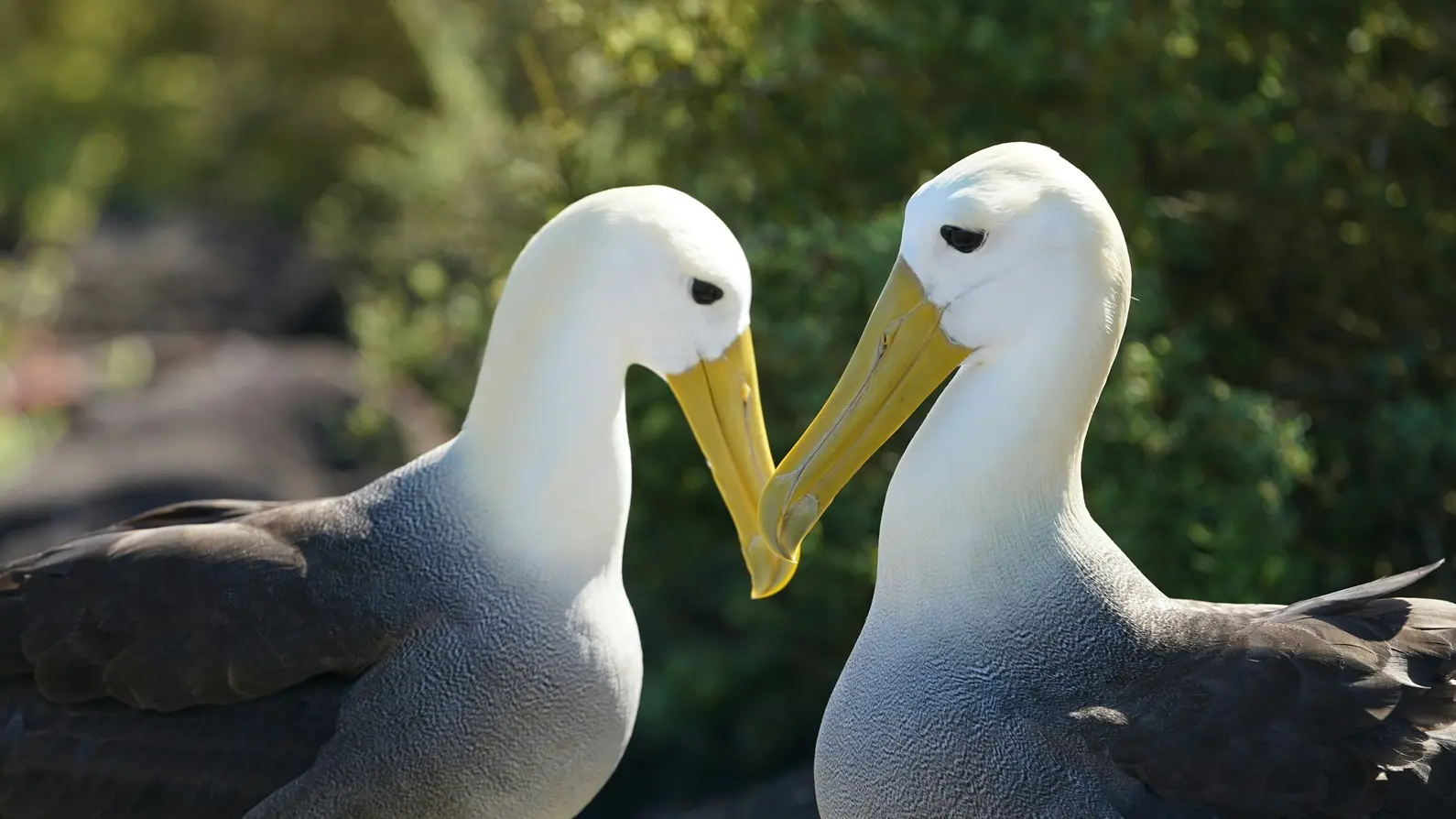
Males arrive on Espa帽ola first, usually in April, and wait for females to return from months at sea. What follows is a courtship ritual that can take up to two years to complete for a first-time pair: bill circling, bowing, a strange bill-clacking duel, waddling side by side, and a low, distinctive “moo” call that carries across the colony. Established pairs repeat a shorter version of the same dance every season, since the ritual also serves to renew the bond between mates who spend most of the year apart at sea.Image credit: Mac Gaither / Unsplash The pair produces a single egg, laid directly on bare ground between April and June. Both parents share incubation duties over roughly two months, and genetic studies have turned up an odd wrinkle in what looked like strict lifelong monogamy: some chicks turn out not to be fathered by the male doing the incubating. Extra-pair matings happen before the primary mate arrives back on the island, something researchers only confirmed once DNA testing became available. Chicks are fed a rich, oily regurgitated mix of digested fish and squid, and they’re ready to leave the nest after five to six months. By mid-January, when the winds that make flight possible begin to die down, any young bird still on Espa帽ola risks being stranded. The ones that make it out spend roughly five to six years entirely at sea before returning to Espa帽ola to find a mate of their own.
Conservation Status
The IUCN lists the Waved Albatross as Critically Endangered, and the population has continued to slide even with active protection in place. Three pressures explain most of the decline. Longline fishing does the most damage. Baited hooks set for tuna and other commercial species also attract albatrosses, which get hooked and drown when they try to take the bait. Longlining is banned inside the Gal谩pagos Marine Reserve, but the birds routinely travel far beyond that boundary to feed, and once they leave protected waters, they’re exposed to the same fishing fleets operating off Ecuador and Peru. Plastic pollution compounds the problem. Squid and small plastic fragments look similar from the air, and a bird that mistakes one for the other can suffer fatal blockages or starve slowly with a stomach full of debris. Climate variability, particularly El Ni帽o events, adds a third layer of risk. Because the entire species depends on one narrow strip of coastline and one current system for food, a shift in ocean temperature can suppress prey across the birds’ entire foraging range at once, with no alternative feeding grounds to fall back on. On land, the picture has improved. Invasive goats, which trampled nesting sites on Espa帽ola for decades, were fully eradicated from the island, removing a threat that had degraded the colony’s habitat for years. Conservation groups, including organizations such as the American Bird Conservancy, now work directly with small-scale longline fishers in Ecuador on gear modifications and bycatch-reduction techniques, alongside GPS tracking programs that map exactly where boats and albatrosses cross paths at sea.
Where To See Them In Gal谩pagos
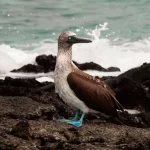
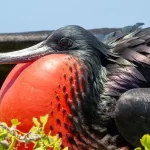
Punta Su谩rez, on the western tip of Espa帽ola Island, is the only regular access point to a wild Waved Albatross colony anywhere on Earth. It’s a standard stop on most multi-day Gal谩pagos cruise itineraries and an occasional day-trip destination from San Crist贸bal. The site also hosts breeding colonies of Nazca Boobies and Blue-footed Boobies, plus a resident population of the strikingly colored Espa帽ola marine iguana subspecies, so the walk from the landing beach rarely goes more than a few minutes without another animal encounter. Timing matters. The colony is active from April through December, with the courtship dance most visible early in the season and chicks present from around June onward. Between January and March, the birds abandon the island almost entirely, so a visit during those months means an empty colony and a missed highlight of any Gal谩pagos wildlife trip, alongside icons like the Gal谩pagos giant tortoise.
Most visitors reach Espa帽ola as part of a live-aboard cruise itinerary rather than a same-day ferry crossing, since the island sits far from the inhabited ports. If your plans combine Espa帽ola with island-hopping between Santa Cruz, San Crist贸bal, or Isabela, it’s worth checking current inter-island ferry prices and reading through an essential ferry travel guide before booking, since crossings between the populated islands run on a fixed schedule separate from cruise operations. The open-water legs on these routes can get choppy, so it’s also worth glancing at a few seasickness tips ahead of time if you haven’t sailed in open Pacific swell before.
Final Thoughts
What stays with most people who visit Punta Su谩rez isn’t the size of the bird, though at nearly eight feet across the wings, that’s hard to miss. It’s the mismatch between the two lives this animal leads: clumsy and almost comic on land, then entirely transformed the moment it reaches the cliff edge and drops into open air. That transformation is also the reason the species survives at all in a place this unlikely. A tropical breeding ground works only because a cold, food-rich current runs close enough to reach, and only because the birds can fly far enough, fast enough, to use it. Every part of the Waved Albatross’s biology, from its wingspan to its migration route, exists to solve that one problem. None of that guarantees the species a future. With one nesting island and a population still shrinking under pressure from fishing gear and plastic it never evolved to recognize as a threat, the Waved Albatross remains one of the more fragile success stories in Gal谩pagos. Seeing one glide past a cliff on Espa帽ola is still possible today. Whether that’s true in another fifty years depends on decisions being made now, far from that cliff, on fishing boats and in policy meetings the birds will never know about.
Frequently Asked Questions About the Waved Albatross
Are Waved Albatrosses dangerous to humans?
No. They show little fear of visitors and often walk close to trails on Espa帽ola, but they have no history of aggression toward people. Park rules still require keeping a respectful distance so the birds aren’t disturbed during nesting.
Can Waved Albatrosses swim?
Yes, they rest and float on the ocean surface between foraging flights, but they don’t dive or swim underwater the way boobies or cormorants do. Most of their feeding happens at night, snatching squid and fish near the surface.
Do Waved Albatrosses migrate?
They don’t migrate in a fixed north-south pattern, but the entire population disperses from Espa帽ola once breeding ends, spreading across the coastal waters of Ecuador and Peru until the next breeding season begins in April.
How long do Waved Albatrosses live?
Most live around 40 years, and some individuals have been recorded living past 50, which is long even by albatross standards.
Can visitors touch or feed the albatrosses?
No. Touching or feeding any wildlife in the Gal谩pagos National Park is prohibited, both to protect the animals and to keep their behavior natural for future visitors and researchers.
Is there anywhere else in the world to see a Waved Albatross colony?
Almost nowhere. A small, irregular number of pairs nest on Isla de la Plata off mainland Ecuador, but Espa帽ola Island holds essentially the entire global breeding population, which is the main reason the species is classified as critically endangered.