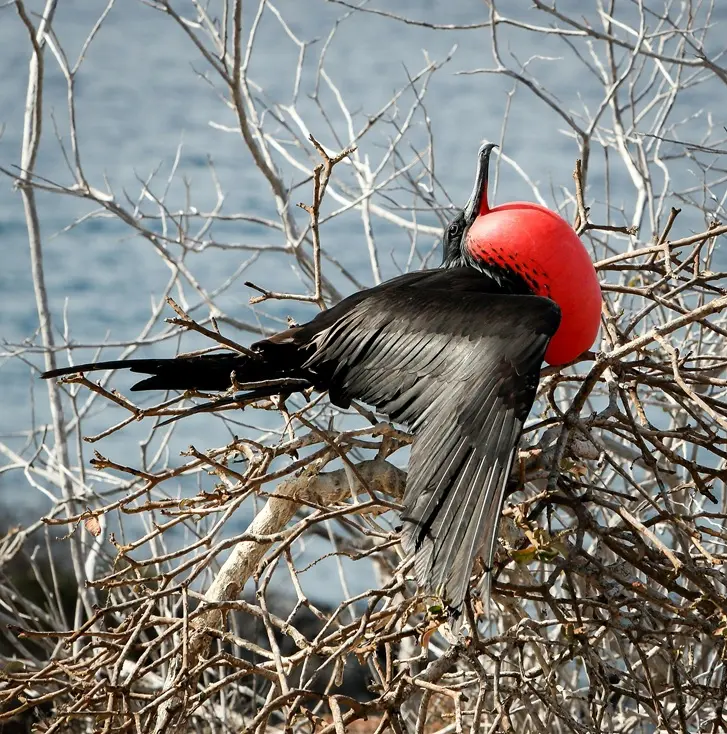
There is a moment on North Seymour Island that stops most visitors cold. A male frigatebird perches low in a saltbush, wings half-spread against a bleached sky, his throat ballooned into a perfect scarlet globe the size of a grapefruit. He tilts his head back and rattles his bill at the females gliding overhead in slow, evaluating circles. It is, in the truest sense, one of the great wildlife spectacles on Earth. Two species of frigatebird inhabit the Galápagos — the Magnificent (Fregata magnificens) and the Great (Fregata minor). Together, they are among the most ecologically fascinating birds in the entire archipelago. These creatures hold the largest wingspan-to-body-weight ratio of any bird alive. Remarkably, they can remain airborne for weeks at a time, sleeping in ten-second bursts on the wing. In mid-air, they steal meals from other seabirds with the calculated efficiency of practiced thieves.Image credit: Aussie Active / Pexels According to Smithsonian Institution researchers, the resident population of Magnificent Frigatebirds may constitute a genetically distinct evolutionary lineage. This population has been isolated here for hundreds of thousands of years. This discovery quietly reshuffled what scientists thought they knew about these birds. Charles Darwin, who was not easily impressed, called them “the condor of the oceans” The Spanish who sailed these waters first dubbed them Man-o’-War birds, borrowing the name from the fast pirate warships they resembled. The comparison was apt. Frigatebirds are fast, aggressive in pursuit, and built for sustained aerial dominance. These birds do not dive for fish. Nor do they land on water. Instead, they simply outfly every other bird in the sky and take what they need. Understanding how they pull this off reveals an animal finely tuned to its environment.
Largest wingspan-to-body-weight ratio of any bird; capable of flight for 56+ days without landing
Evolutionary Origins
Frigatebirds as a family (Fregatidae) are ancient. Fossil evidence places their lineage back tens of millions of years. Today, modern species are distributed across tropical and subtropical oceans worldwide. Of the five living species, two colonized the Galápagos. They almost certainly arrived as wind-blown or storm-displaced individuals from the eastern Pacific, matching the history of many local founder species. What makes the Galápagos Magnificent Frigatebird particularly significant is a 2010 genetic study. Smithsonian Institution researchers found clear DNA differences between the Galápagos population and mainland relatives from Panama and coastal Ecuador. The island birds are also measurably larger. This makes them the biggest frigatebirds in the world. The Smithsonian team concluded this population has been on a separate evolutionary path for several hundred thousand years. This isolation is long enough that some scientists believe it qualifies as a distinct subspecies, or even a separate species entirely. This finding carries real conservation weight. Globally, the Magnificent Frigatebird carries a “Least Concern” designation. However, the unique Galápagos lineage comprises only about 1,000 breeding pairs. This low number makes them far more vulnerable than their global classification implies. A major El Niño event, an oil spill, or a disease outbreak could eliminate something irreplaceable. This discovery quietly changes the conservation calculus.Image credit: Francesco Ungro / Pexels The Great Frigatebird has a wider Pacific and Indian Ocean distribution. This expansive range provides a buffer against localized threats. Within the Galápagos, it tends to forage further offshore than its Magnificent cousin, reducing direct competition between the two species.
Physical Characteristics
An Unmistakable Silhouette
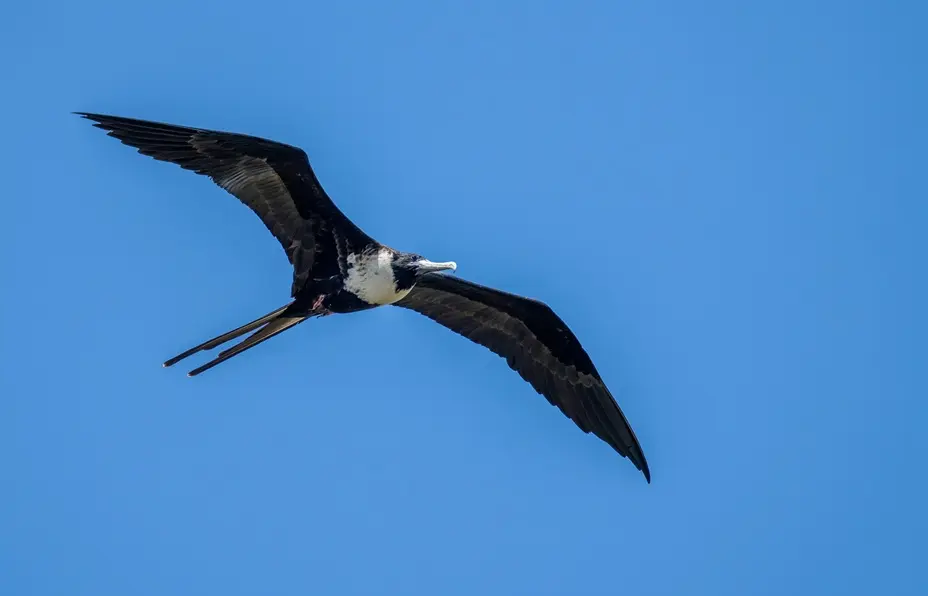
Both species share the frigatebird’s unmistakable silhouette. They feature long, narrow, angular wings with a distinctive mid-wing bend. They also possess a deeply forked tail, a long hooked bill, and a small, sleek head. In flight, they look almost architectural, appearing more like an aerospace design than a product of natural evolution. On land, they are considerably less elegant. Their legs are short, and their feet are small and weak. Consequently, they move on the ground with the reluctant shuffle of an animal out of its element.
Distinguishing Males and Females
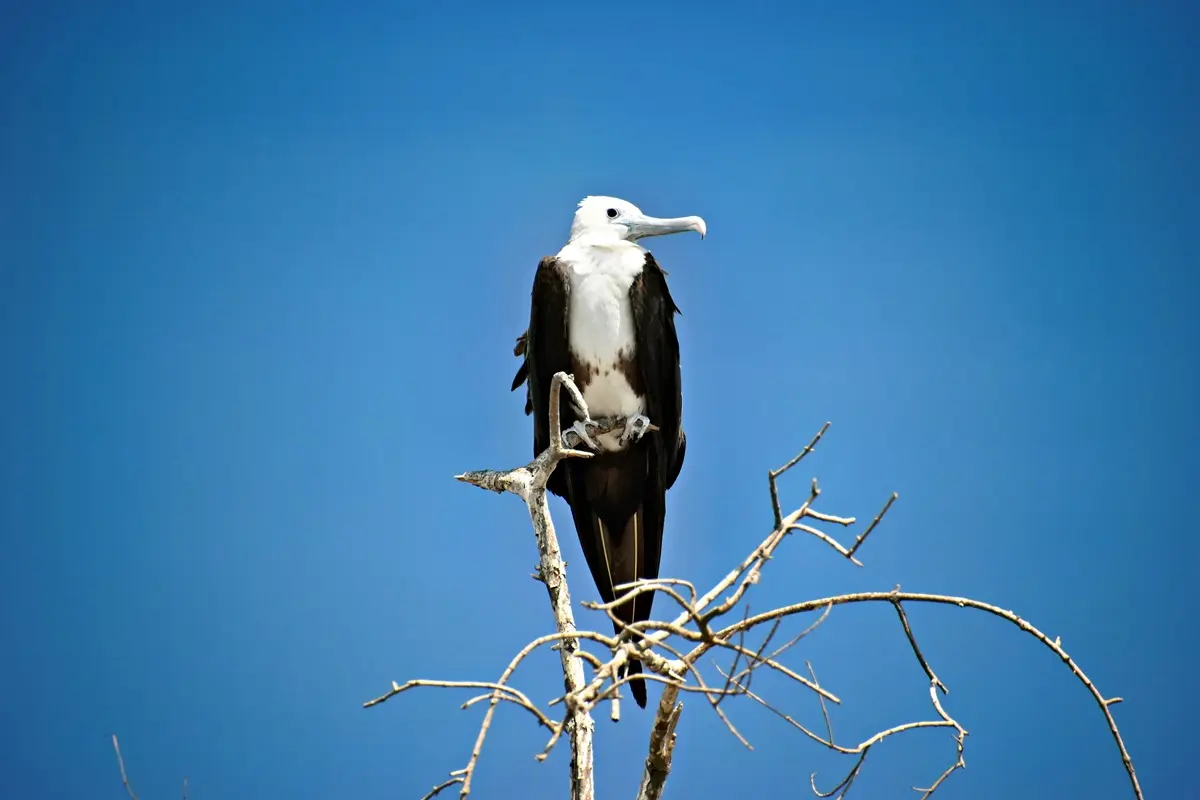
Males of both species are predominantly glossy black. The easiest way to distinguish them in the field is the sheen of their plumage in good light. The Magnificent shows a rich purple iridescence on its upper back. In contrast, the Great shows a green sheen in the same light. The Magnificent is also the larger of the two, which often confuses first-time observers. Females are more easily separated. Female Magnificent Frigatebirds have a black throat, a distinctive blue eye-ring, and white underparts. Female Great Frigatebirds display a completely white throat, a red eye-ring, and fully white underparts. Both females are slightly larger than their respective males, which is an unusual reversal for seabirds. Juveniles of both species have white heads and chests. They transition through several intermediate plumages over multiple years before reaching full adult coloration. Outside of the breeding season, the male’s gular pouch fades from vivid red to a muted orange. It then lies flat and inconspicuous on the throat.
Extraordinary Adaptations
Built for Supreme Flight
The frigatebird’s skeleton is one of the most extreme structural solutions in the avian world. Their bones are hollow and air-filled. As a result, the entire skeleton of a Magnificent Frigatebird weighs less than its feathers. Combined with an enormous wingspan relative to body mass, this makes staying airborne nearly effortless. On warm air thermals, frigatebirds can rise to altitudes of several kilometers. They then glide for hours without a single wingbeat, covering an average of around 420 km per day. Tracked individuals have remained continuously aloft for 56 days. Researchers from Germany and Switzerland discovered how these birds sleep in flight by using neurological monitors. The birds utilize unihemispheric slow-wave sleep, resting one half of the brain while the other remains alert. These in-flight naps last only about ten seconds at a time. They accumulate to roughly 40 minutes of total sleep per day while airborne. On land, they sleep normally and for much longer.Image credit: Jeffrey Eisen / Unsplash
The Challenge of Water
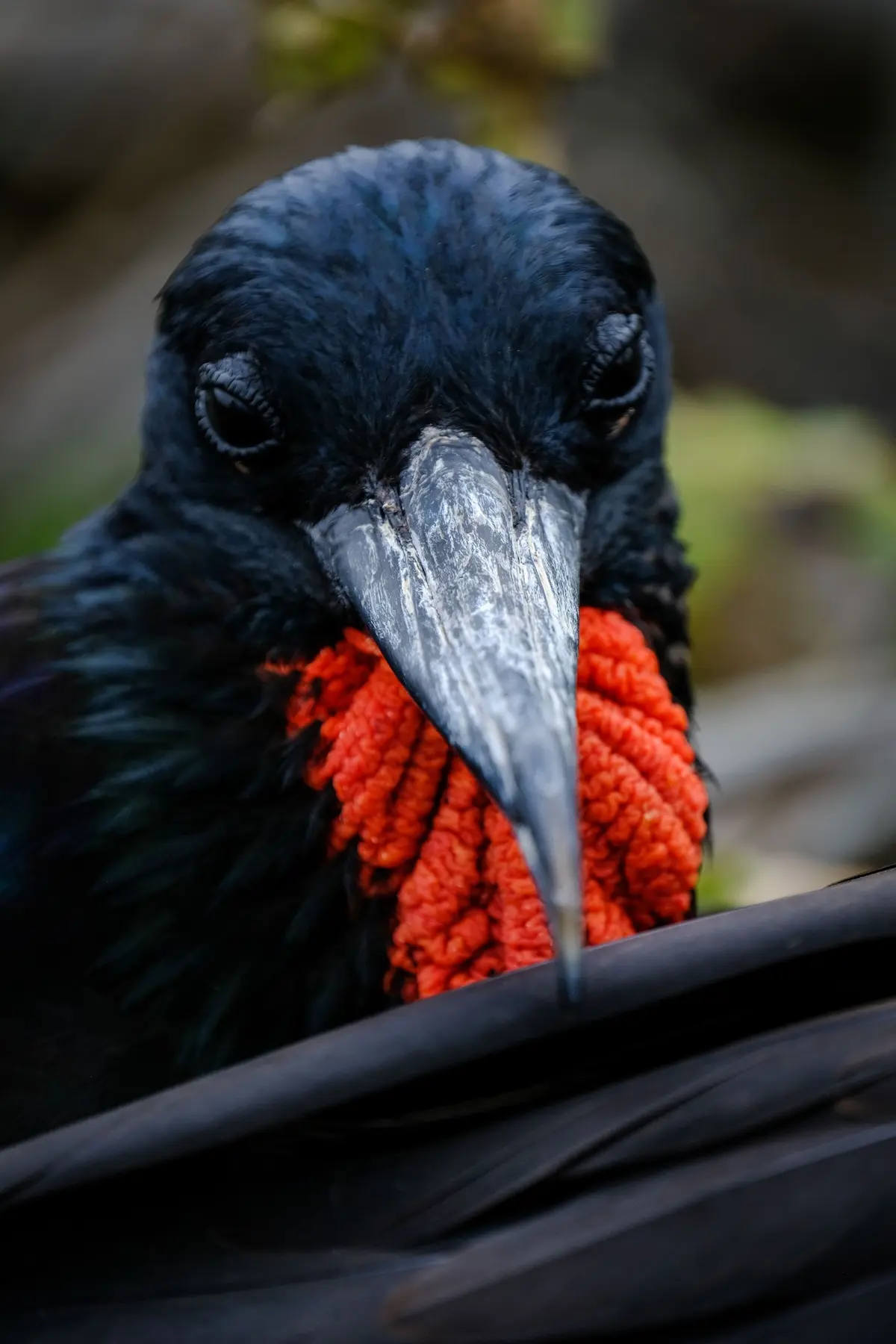
The other defining adaptation is what frigatebirds cannot do: land on water. Unlike boobies and pelicans, frigatebirds have a severely underdeveloped uropygial gland. This is the organ that produces waterproofing oil. Without that oil, frigatebird plumage becomes waterlogged almost immediately on contact with the sea. This plumage issue makes submersion potentially fatal. This constraint drove the evolution of their remarkable kleptoparasitism. It also shaped their ability to snatch prey from the water surface without touching it, dipping and grabbing in a single fluid motion. Their bones are filled with air cavities that extend the respiratory system, maximizing buoyancy and oxygen extraction at altitude. The breast muscles are unusually well developed for a gliding bird, providing explosive acceleration to intercept targets mid-flight. Males can inflate their gular pouch by pumping air into the sac. This process takes up to 30 minutes, turning the pouch into a taut, bright-red balloon. The pouch plays no role in feeding or vocalization, existing solely for reproductive display.
Distribution Across the Galápagos
Frigatebirds are present throughout the archipelago year-round. They soar over virtually every island and follow boats with opportunistic interest. Both species nest colonially in low shrubs, saltbushes, and coastal mangrove trees. The two species often share the same colony site while maintaining subtle habitat partitioning.
Key Colony Sites
The Magnificent Frigatebird is most reliably seen at North Seymour Island. This location hosts the archipelago’s best-known nesting colony. It is arguably the single most accessible seabird viewing site in the Galápagos. San Cristóbal and Genovesa also support significant colonies. Frigatebird tends to nest more heavily on outlying islands like Genovesa and Floreana. It forages further offshore, reflecting its broader ocean-going habits. Breeding seasons vary by island. With a well-planned itinerary, visitors can observe courtship displays at different stages across multiple locations. On Genovesa and San Cristóbal, males begin inflating their pouches as early as March. Peak display activity there lasts through April and May. On North Seymour, the cycle begins later, with males displaying through June and eggs hatching in July and August.
Island
Species Present
Best Viewing Months
Key Feature
North Seymour
Magnificent (primary)
June–August
Best colony access; males reliably displaying
Genovesa
Both species
March–May
Large mixed colony; remote island atmosphere
San Cristóbal
Magnificent (primary)
March–May
Accessible colony near populated island
Floreana
Both species
Varies
Scenic coastal nesting habitat
Isabela
Both species (scattered)
Year-round
Often seen in flight along coastline
Behavior and Reproduction
Courtship and Nesting Rituals
A frigatebird colony at the height of courtship season is a spectacular natural scene. Dozens of males sit in low shrubs with pouches inflated and wings half-spread. They throw their heads back, rattling their bills to produce a low drumming sound. Meanwhile, females cruise the airspace above in slow, banking circles. The female’s inspection process is deliberate. She may circle for many minutes to assess the male’s pouch size and color intensity. She also evaluates the quality of his nest and his position within the colony. Research suggests females actively prefer males with larger, brighter red pouches.Image credit: Bob Brewer / Unsplash Once a pair bonds, they work together on the nest. This structure is a shallow platform of twigs built in a low bush or tree. The female lays a single egg, which the pair incubates for approximately 50 days.
Long-Term Parental Care
After hatching, parental duties are shared for the first three months. Both adults take turns brooding the chick and regurgitating food. After roughly three months, the male departs for the ocean. The female then continues to care for the chick alone for up to another nine months. This total investment can run to a full year or longer, making frigatebird parental care among the longest of any bird species. Chicks can make short flights after about five months, but they remain dependent on the female for food well past this point. The extended care reflects how much the juvenile needs to learn. They must master thermal soaring, mid-air maneuvers, and the split-second timing needed to steal food. Because of this investment, frigatebirds breed only once every other year. Sexual maturity is reached late, around age ten, meaning each individual contributes relatively few breeding attempts over its lifetime.
The Art of Kleptoparasitism
Kleptoparasitism, or food piracy, is practiced routinely and with considerable skill. A frigatebird pursuing a booby will chase it at high speed. It grabs the victim’s tail feathers or wingtip, shaking the bird until it drops its catch. The frigatebird then intercepts the falling food before it hits the water. These pirates also pursue tropicbirds, pelicans, and other seabirds. They have even been observed stealing from members of their own species. On rare occasions, they snatch unattended eggs or small chicks from nearby nests. Watching a pair of frigatebirds harry a blue-footed booby reveals evolution’s version of a confidence trick: audacious, efficient, and completely effective.
Conservation Status
Hidden Vulnerabilities
On paper, both frigatebird species in the Galápagos carry the IUCN’s “Least Concern” rating globally. In practice, the picture is more complicated, particularly for the Magnificent Frigatebird. The 2010 Smithsonian genetic study suggests the Galápagos population is evolutionary unique. Because of this, those 1,000 breeding pairs represent a lineage that does not exist anywhere else. A major disruption could easily eliminate them. Threat examples include a catastrophic El Niño reducing fish stocks, a large-scale oil spill near nesting colonies, or an introduced predator. Within the Galápagos Marine Reserve, frigatebirds receive protective status. There are no active conservation programs targeting frigatebirds specifically, as their populations currently appear stable. However, authorities monitor them as part of broader seabird surveys. Their numbers serve as an indicator of general marine health.
Environmental Threats
Climate change and El Niño cycles pose the most significant long-term risks. During severe El Niño events, water temperatures rise and prey fish disperse to deeper water. Consequently, seabirds across the archipelago can experience widespread breeding failure. Frigatebirds recover poorly from food scarcity due to their low breeding frequency. The projected shift toward more intense El Niño events remains a legitimate concern for both species. Introduced species, particularly rats on inhabited islands, can devastate ground-nesting seabirds. Fortunately, the frigatebirds’ tendency to nest in shrubs offers some protection. Plastic ingestion is also emerging as a documented concern for many pelagic seabirds in the Pacific. Frigatebirds sometimes mistake floating debris for food, accidentally feeding plastic fragments to their chicks.
Where to See Frigatebirds in the Galápagos
Top Island Locations
Frigatebirds are year-round residents, making them easy to spot almost anywhere. However, seeing one soaring overhead is very different from standing near a colony mid-courtship. North Seymour Island is the single best destination for a close encounter with displaying Magnificent Frigatebirds. The visitor trail passes directly through an active nesting colony, where males with inflated pouches are present from June through August. Reaching North Seymour typically involves a day trip from Santa Cruz. If you are traveling between islands, check inter-island ferry schedules to plan your base island efficiently. Genovesa Island is more remote and requires a longer journey. However, it rewards the effort with large mixed colonies of both species. These birds often share sites with red-footed boobies. The best months to visit Genovesa are March through May. San Cristóbal also has accessible colonies viewable from land, making it a good option if you are crossing from Santa Cruz.
Spotting from the Water
On any inter-island ferry crossing, keep an eye on the sky. Frigatebirds routinely follow boats. The open channel between Santa Cruz and Isabela is excellent for spotting them soaring at altitude. You may also see them harassing boobies directly from the deck. For tips on making the most of your crossing, the inter-island ferry guide covers all main routes. If you want the best vantage point on the boat for wildlife spotting, choosing the right seat on the Galápagos ferry makes a real difference.
Final Thoughts
There is something quietly humbling about watching a frigatebird work a thermal. The bird barely moves, using just a fractional tilt of the wing or a small tail adjustment. Hours pass while other birds flap and struggle. The frigatebird simply climbs. It is a creature that has mastered flight at an incredible level. Yet, this same animal cannot touch the ocean that sustains it. This total constraint reshaped the bird’s entire behavioral ecology, from its kleptoparasitism to its marathon airborne endurance. The 2010 Smithsonian finding adds another layer of significance to every frigatebird you see. Those particular birds may represent a lineage that diverged from the mainland population before Homo sapiens existed. They have been here, doing exactly this, for longer than human civilization. The fact that conservation science has not fully caught up to this is just a routine gap between knowledge and action. Visiting the Galápagos and watching a male frigatebird display is not a casual wildlife encounter. It is contact with something genuinely ancient, irreplaceable, and strange. The inflated red pouch and the rattling bill represent a system that has been running for hundreds of thousands of years. Respect for that history may be the most important thing a visitor can carry away. To plan your visit and make the most of inter-island travel, the essential Galápagos ferry travel guide is a good place to start.
Frequently Asked Questions About the Galápagos Frigatebird
Are there two different frigatebird species in the Galápagos, and how do I tell them apart?
Yes — the Magnificent Frigatebird (Fregata magnificens) and the Great Frigatebird (Fregata minor) both live in the archipelago. Despite the name, the Magnificent is the larger of the two. In good light, males can be distinguished by the sheen of their back feathers: the Magnificent shows a purple iridescence, while the Great shows a green one. Females are easier to separate: Magnificent females have a blue eye-ring and a black throat, while Great females have a red eye-ring and a white throat.
Why can’t frigatebirds land on water?
Frigatebirds have a severely underdeveloped uropygial gland — the organ that produces the waterproofing oil most seabirds spread through their feathers. Without this oil, their plumage becomes waterlogged within seconds of contact with the sea, making submersion potentially fatal. As a result, frigatebirds snatch food from the water surface in brief, hovering contact, or steal it from other birds mid-air, but they never dive and never land on the ocean. This constraint is, in evolutionary terms, the engine behind their extraordinary aerial abilities and their kleptoparasitic habits.
How long can a frigatebird fly without landing?
Tracked individuals have remained continuously airborne for 56 days — the longest confirmed non-stop flight of any bird species. This is made possible by their hollow, air-filled bones, their enormous wingspan relative to body weight, and their ability to ride thermal currents for hours without flapping. They can also sleep in brief ten-second bursts while flying, using unihemispheric sleep in which one half of the brain rests while the other stays alert.
What is the red pouch on the male frigatebird’s throat?
It is called a gular sac, and its sole purpose is courtship display. Males inflate it by pumping air into the thin, bright-red skin of the throat — a process that takes up to 30 minutes — until it reaches roughly the size of a football. During breeding season, males sit in the nesting shrubs with their pouches inflated, wings spread, and bills pointed skyward, while females circle overhead evaluating potential mates. Once breeding season ends, the pouch deflates and fades to a muted orange, barely noticeable unless you look closely.
How long do frigatebirds care for their chicks?
Frigatebird parental care is among the longest of any bird species. After a 50-day incubation period, both parents share duties for the first three months after hatching. Then the male departs, and the female continues feeding the chick alone for up to nine more months — meaning total parental investment can exceed a year. Chicks can make short flights after about five months but remain dependent on the mother for food long afterward. Because of this investment, frigatebirds breed only every other year, and do not reach sexual maturity until around age ten.
Are the Galápagos frigatebirds considered endangered?
Globally, both species are classified as “Least Concern” by the IUCN. However, a 2010 Smithsonian Institution genetic study found that the Galápagos Magnificent Frigatebird population has been on a separate evolutionary trajectory for hundreds of thousands of years and is also measurably larger than mainland birds, suggesting it may represent a distinct subspecies or evolutionary unit. With an estimated 1,000 breeding pairs, this lineage is far more vulnerable than the global “Least Concern” rating implies. Intensifying El Niño events, oil spills, and plastic pollution are the most pressing long-term risks.