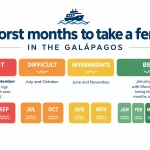
There’s no bad month to visit Galápagos in terms of weather, the islands take visitors 365 days a year. What actually changes is how many people you’re sharing cruises, lodges, and trails with, and that’s driven by international holidays more than by water temperature or swell. July and August get overwhelmed by summer break in North America and Europe, September is nearly empty, and everything in between follows its own logic.

Here’s the real order, from busiest to quietest, with the specific reason behind each month.
| Rank | Month | Why it’s busy |
|---|---|---|
| 1 | July | Absolute peak. Coincides with summer vacation in North America and Europe, plus school holidays in Ecuador’s Sierra region. Bookings sell out months in advance, so it’s worth reviewing common ferry booking mistakes before locking anything in. |
| 2 | August | Keeps the summer momentum going, with heavy family travel from both North America and Europe. |
| 3 | December | A month of contrasts: the first three weeks see moderate traffic, but Christmas and New Year’s fill cruises and hotels to full capacity. |
| 4 | January | Carries over the New Year momentum and marks the start of the warm, humid season, with calm seas. |
| 5 | June | Northern Hemisphere summer travelers start arriving, and the Humboldt Current kicks in, bringing colder water and more marine activity. Choppier seas also make this a good stretch to check seasickness tips for the ferry crossing. |
| 6 | March | A sharp spike whenever Easter or spring break falls within the month. |
| 7 | April | Fluctuates depending on the exact date of Easter. Popular for warm water and pleasant weather. |
| 8 | February | Steady traffic driven by warm water, good snorkel visibility, and a mix of couples and adult travelers. |
| 9 | November | The second half of the month starts picking up travelers getting ahead of the holiday season. |
| 10 | May | A climate transition month with a noticeable drop in tourist volume, right before the summer surge in June and July. |
| 11 | October | Strong diving conditions thanks to marine life drawn in by colder water, but overall tourism drops off quite a bit. |
| 12 | September | The lowest point of the year for visitor numbers. Many boats and cruises use these weeks for dry-dock maintenance. |
Calm Seas vs. Rough Seas: What It Means for Your Inter-Island Crossing
The same seasonal shift that drives tourist numbers also changes what the ferry ride itself feels like. If you’re prone to seasickness, this table matters as much as the crowd data above.
| Period | Sea Conditions | What to Expect |
|---|---|---|
| January – May | Warm water, calmer seas | Smoother inter-island crossings, generally the easiest window for anyone worried about motion sickness on the ferry. |
| July – November | Colder water, choppier seas | Rougher inter-island navigation due to the Humboldt Current. Worth planning ahead with these seasickness tips for the ferry crossing if you’re sensitive to it. |
Season Summary
Grouping the twelve months gives three clear blocks, useful for deciding based on what matters most: price, availability, or avoiding crowds.
| Season | Months | Characteristics |
|---|---|---|
| High (peak) | July, August, December (holidays) | Higher prices, sold-out slots, and larger volume on boats. Check current ferry prices for 2026-2027 before budgeting your trip. |
| Mid / holiday windows | January, June, March/April | Moderate-to-high traffic, driven by specific holidays or warm weather. |
| Low | May, September, October, November | Best option for avoiding crowds, finding lower prices, and getting last-minute availability. |
What to Do With This
If the goal is a cheap trip without crowds, September is the clearest window: it’s the lowest-traffic month of the year, though some boats will be in maintenance and cruise availability needs checking more carefully. October and November offer something similar, with October having the added bonus of strong diving thanks to the marine activity the cold current brings in. Whichever month you land on, it’s worth browsing the best things to do in the Galápagos Islands to build out the itinerary.
For travelers who’d rather book with plenty of lead time and don’t mind sharing the destination with more people, July and August are the busiest months and should be booked several months ahead, especially cruises. December has a quirk: the first few weeks behave almost like low season, and it only explodes in the final stretch around Christmas and New Year’s.
Frequently Asked Questions
What is the cheapest month to visit Galápagos?
September, since it’s the lowest-traffic month of the year and boats have the most last-minute availability. Some vessels are in dry-dock maintenance that month, so it’s worth confirming schedules ahead of time.
What is the busiest month in Galápagos?
July, driven by summer vacation in North America and Europe plus school holidays in Ecuador’s Sierra region. Bookings routinely sell out months in advance.
Which months have calmer seas for the ferry between islands?
January through May tend to have warmer water and calmer seas, making inter-island ferry crossings smoother. July through November bring colder water and choppier conditions due to the Humboldt Current.