Photographing the Sea From a Moving Galápagos Ferry: A Technical Field Guide
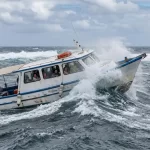
The inter-island ferries of the Galápagos are small, fast fiberglass speedboats, and they make a difficult camera platform. A typical crossing between Santa Cruz and San Cristóbal or Isabela lasts about two hours. The boat runs at high speed over open Pacific swell, with powerful outboard engines sending a constant vibration through the hull. Even so, these crossings regularly put passengers within sight of frigatebirds, boobies, dolphins, manta rays and, in some months, whales, along with volcanic coastlines that cannot be seen from land.
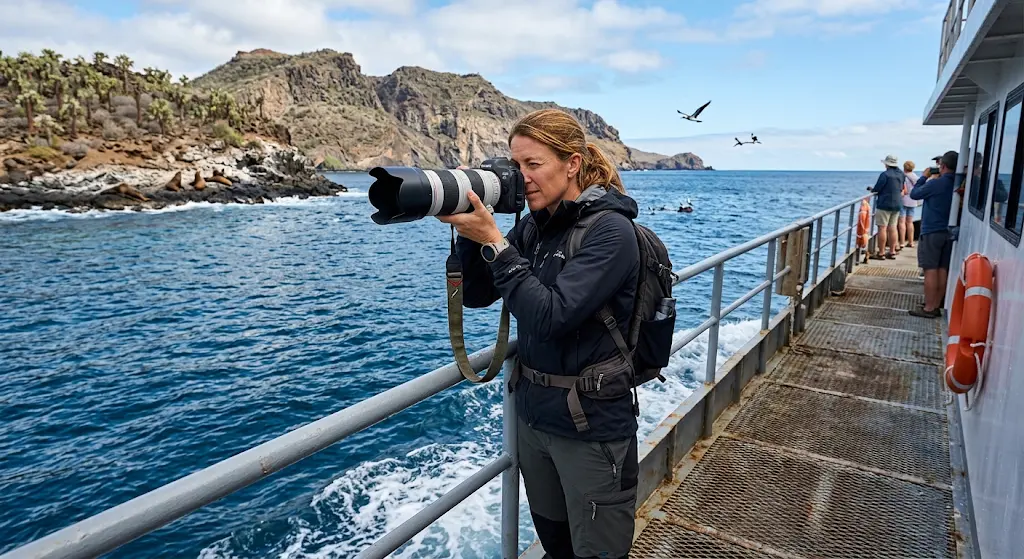
The difficulty comes from three forces acting at once: hull vibration, which blurs fine detail; pitch and roll, which tilt the horizon and push subjects out of frame; and salt spray, which coats lenses within minutes. Add equatorial sunlight, which turns harsh soon after mid-morning, and most casual photos from the deck come back blurred, tilted or washed out.
This guide sets out the technical and practical factors that decide whether ferry photography succeeds: camera settings, seat position, timing, route-specific opportunities and the rules that apply on board and inside the protected marine reserve.
| Factor | Reference Value / Recommendation |
|---|---|
| Typical crossing time | About 2 hours (Santa Cruz to San Cristóbal or Isabela) |
| Minimum shutter speed, landscapes | 1/1000 s |
| Minimum shutter speed, birds in flight | 1/2000 s or faster |
| Most useful focal range | 24 to 200 mm (full-frame equivalent) |
| Best light window | First 2 to 3 hours after sunrise; last 2 hours before sunset |
| Calmest sea period | Warm season, roughly January to May |
| Drone use | Requires Galápagos National Park authorization; not possible from passenger ferries |
Why Equatorial Light and Open Swell Shape Every Image
The Galápagos lie on the equator, so daylight hours barely change through the year. Sunrise falls close to 6:00 and sunset close to 18:00 local time in every month. This consistency matters: the sun climbs steeply, and by roughly 10:00 it sits high enough to flatten texture on lava rock and produce strong specular glare on the water surface. The usable “soft light” windows are short and predictable.
The seas between the islands are open ocean, not sheltered channels. Swell generated far away in the Pacific reaches the archipelago year-round, and its intensity follows the two climate seasons. During the cool garúa season, roughly June to November, the Humboldt Current brings cooler water, overcast skies and choppier crossings. The warm season brings brighter sun, calmer water and stronger contrast. For photographers, overcast garúa days actually reduce glare and soften shadows, while warm-season days reward early departures.
Inter-island transport has evolved from cargo vessels to today’s speedboat fleet, a history covered in our article on Galápagos maritime transport history. The modern boats are faster and more comfortable, but their speed is exactly what makes stable photography challenging.
Camera Settings That Counter Vibration and Motion
Shutter speed is the single most important setting. Outboard engines create high-frequency vibration that ordinary image stabilization cannot fully cancel. A floor of 1/1000 s works for coastlines and seascapes; birds tracking alongside the boat need 1/2000 s or faster. Shutter priority mode or manual exposure with auto ISO is the most reliable approach, letting the camera raise sensitivity rather than slow the shutter.
Practical settings that consistently produce sharper results:
- Continuous autofocus (AF-C / AI Servo) with a wide or zone area, since the subject and the platform both move.
- Burst mode at the highest frame rate. One frame in a sequence often lands at the brief pause between wave impacts.
- Aperture of f/5.6 to f/8 for enough depth of field to absorb focusing errors.
- Stabilization switched on, set to the mode designed for panning or active movement where available.
- RAW format, which leaves room to correct horizon tilt, exposure and white balance afterward.
Smartphones can perform well if users avoid digital zoom, tap to lock exposure on the brightest area of the scene and use burst capture. Their weakness is reach: distant wildlife rarely fills the frame.
Body Technique, Seat Position and the Glare Problem
How the photographer holds the camera matters as much as the settings. Bracing the camera or elbows against the railing or hull transmits engine vibration directly into the lens. The better technique is to keep elbows tucked against the body and let the knees and torso absorb motion, with the body acting as a natural shock absorber.
Seat choice determines what is possible. Rear seats near the open stern usually offer the clearest unobstructed views, but they also catch exhaust, spray and the most engine vibration. Seats near the front feel more pitching. A full breakdown of these trade-offs appears in our guide to the best seats on a Galápagos ferry. Passengers prone to nausea should know that looking through a viewfinder for long periods can worsen it; our seasickness tips for Galápagos ferries explain prevention.
For glare, a circular polarizing filter cuts reflection from the water surface and deepens the blue of sky and sea. It also costs about one to two stops of light, which must be offset with higher ISO to keep shutter speeds fast. Shooting with the sun behind or beside the boat, rather than ahead, reduces flare.
Spray, Salt and Equipment Protection
Saltwater is the main risk to equipment on these crossings. Fine spray reaches almost every seat once the boat accelerates, and dried salt crystals can scratch lens coatings if wiped carelessly. Recommended precautions:
- A clear protective or UV filter that can be cleaned aggressively without risk to the front element.
- Several microfiber cloths kept dry in a sealed bag, plus a blower to lift salt before wiping.
- A dry bag or waterproof case for storing gear between shots.
- A neck or wrist strap at all times. A dropped camera at sea is unrecoverable.
- Wiping the camera body with a slightly damp freshwater cloth after arrival.
Large camera bags may be stowed in the luggage area away from passengers, so essential gear should travel in a small bag kept on the lap. The rules on what stays with you are explained in our Galápagos ferry luggage policy.
Route-Specific Opportunities and Seasonal Wildlife
Each route offers a different set of subjects. Departures from Puerto Ayora on Santa Cruz pass the bay’s anchored fleet and rocky shoreline, which is most photogenic on early morning departures. Arrivals in Puerto Villamil on Isabela pass through a reef-lined entrance where sea lions, marine iguanas and sometimes Galápagos penguins gather near the dock. Arrivals in Puerto Baquerizo Moreno on San Cristóbal frame the town against its hills, with sea lions resting on the waterfront.
In open water, the most frequent subjects are frigatebirds and boobies riding the boat’s slipstream, flying fish skipping across the surface, and dolphins that occasionally ride the bow wave. During the cool season, upwelling raises productivity and increases the chance of whale sightings; our article on September whales and marine wildlife covers this period. Sightings depend on chance, and ferries do not stop or change course for wildlife.
Rules, Safety and Conduct on Board
Ferries are public transport, not tour boats. Crew members generally require passengers to remain seated while the boat is moving, and life jackets must be available or worn according to the operator’s instructions. Standing at the stern to shoot is often not allowed at speed, so the best moments usually come during departure, arrival or slower stretches.
The entire marine area surrounding the islands is a protected reserve. Drones require prior authorization from the Galápagos National Park Directorate and cannot be flown from passenger boats. Flash photography of wildlife at the docks should be avoided, and visitors must not lean out to approach animals in the water.
Departure Timing and Season Selection
Morning departures, commonly scheduled around 7:00, provide the best light: low sun angle, warmer color and calmer surface conditions on many days. Afternoon departures in the mid-afternoon meet harsher light at first, but arrivals near the end of the day can deliver soft side lighting on coastlines. For calm seas and clearer frames, the warm season is the more reliable choice, while the rougher months covered in our guide to the worst months for Galápagos ferry crossings require faster shutter speeds and more patience.
What the Crossing Reveals Through a Lens
Photography from a Galápagos ferry exposes a part of the archipelago that land-based visitors rarely document: the open water between islands, where seabirds forage, currents meet and the scale of the volcanic landscape becomes visible from a distance. The images that succeed are rarely accidental. They result from fast shutter speeds, deliberate body technique, protected equipment and an understanding of how equatorial light behaves through the day.
The conditions also illustrate the archipelago’s oceanography in a practical way. The calm, bright warm season and the gray, choppy garúa months are the visible surface of current systems that drive the islands’ entire ecology, from the abundance of seabirds to the presence of whales. A photographer who learns to read sea state and light is, in effect, reading the same signals that determine where wildlife concentrates.
As inter-island travel grows, so does the volume of images produced on these crossings. The constraints of the platform, combined with the protections that govern the marine reserve, make ferry photography an exercise in working within limits rather than around them. That discipline produces better images and keeps the activity compatible with one of the world’s most closely managed marine environments.
Related Questions
What shutter speed should I use on a Galápagos ferry?
Use at least 1/1000 s for seascapes and coastlines, and 1/2000 s or faster for birds in flight or dolphins. Engine vibration and wave impacts cause blur at slower speeds, even with image stabilization.
Can I stand on the deck to take photos during the crossing?
Usually not while the boat is moving at speed. Crew members typically require passengers to stay seated for safety. The best chances to photograph standing or from open areas are during departure, arrival and any slower sections near the ports.
Is it possible to fly a drone from an inter-island ferry?
No. Drone flights in the Galápagos require prior authorization from the Galápagos National Park Directorate, and launching one from a passenger ferry is not permitted.
Which ferry route offers the best photography opportunities?
The Santa Cruz to Isabela route is often considered the most rewarding because the arrival into Puerto Villamil passes reefs and rocks where sea lions, marine iguanas and occasionally penguins are visible. Santa Cruz to San Cristóbal offers strong seabird activity in open water.
How do I protect my camera from salt spray on the ferry?
Fit a protective filter, carry dry microfiber cloths and a blower, keep the camera in a dry bag between shots and always use a strap. After arrival, wipe the body with a cloth lightly dampened with fresh water to remove salt residue.
Is a smartphone good enough for ferry photography in Galápagos?
For landscapes, harbors and wide views, yes, provided you avoid digital zoom, use burst mode and lock exposure on bright areas. For distant wildlife, a camera with a telephoto lens of around 200 mm or longer produces far better results.