The Galápagos Sea Lion: Inside the Life of the Archipelago’s Boldest Swimmer
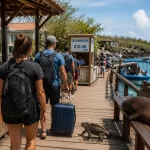
You smell them before you see them. Walk down the pier at Puerto Ayora early enough and the fish market crowd is already there, sprawled across benches and bollards like they own the place, because in a sense they do. A Galápagos sea lion doesn’t scatter when a boat idles past or a fisherman guts the day’s catch three feet away. It just watches, or doesn’t bother to. That indifference to humans is the first thing every visitor notices, and it’s also the reason this animal has become the unofficial mascot of the islands. Zalophus wollebaeki isn’t shy, isn’t rare in the way a hammerhead or a flightless cormorant is rare, and isn’t hard to find. What makes it remarkable is almost the opposite: it evolved in near-total isolation, on lava rock instead of sand, without a single natural predator on land, and the result is a sea lion that behaves like nothing ever taught it to be afraid.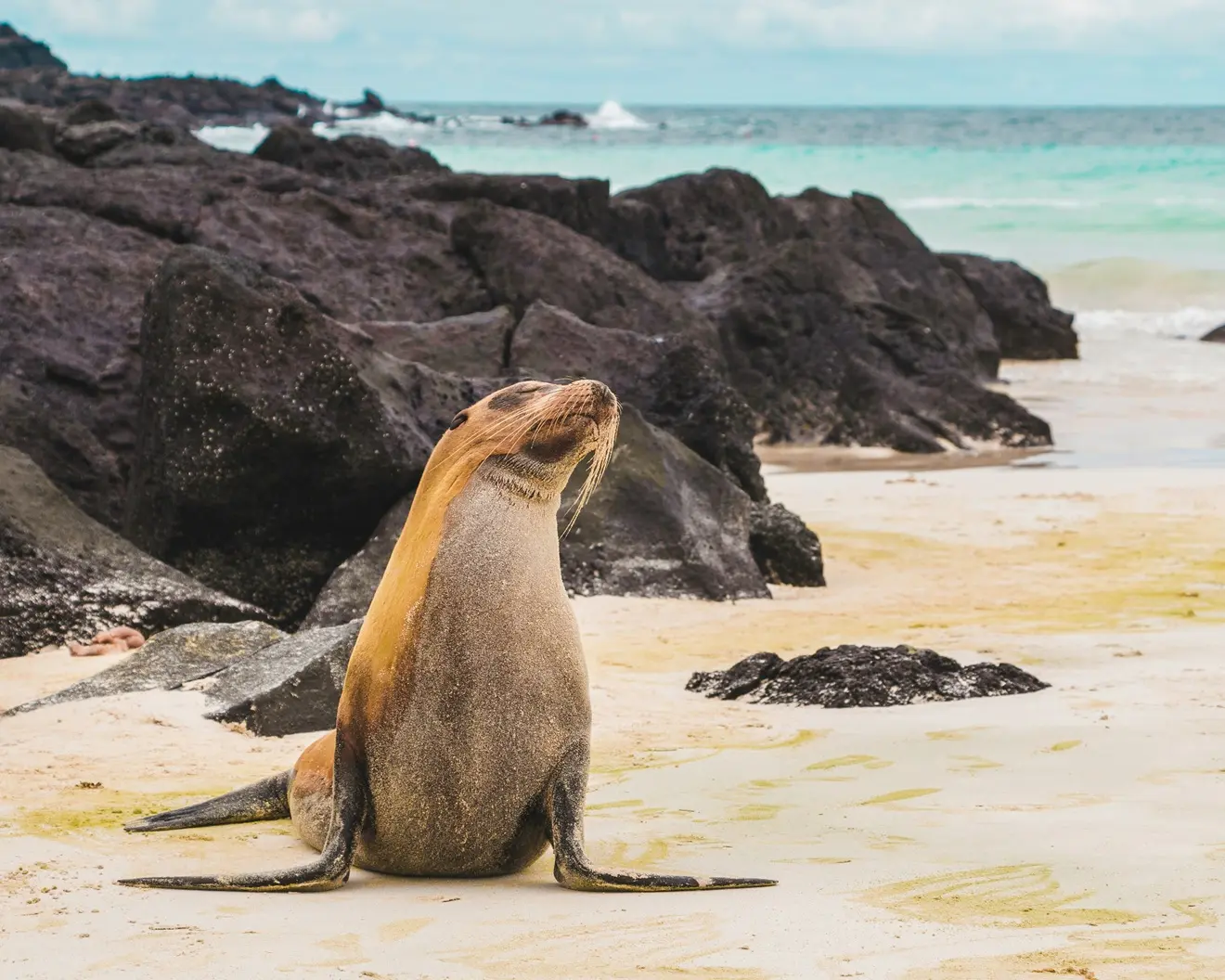
Quick Facts About The Galápagos Sea Lion
| Category | Details |
|---|---|
| Scientific name | Zalophus wollebaeki |
| Average size | Females: 1.5–1.7 m | Males: 2–2.3 m |
| Maximum size | Females: up to 2 m | Males: up to 2.5–2.7 m |
| Weight | Females: 50–100 kg | Males: 200–250 kg (large bulls can exceed this) |
| Lifespan | 15–20 years in the wild |
| Diet | Sardines, small herring, lantern fish, squid, occasionally tuna |
| Conservation status | Endangered (IUCN, listed since 1996) |
| Population estimate | Roughly 20,000–50,000, though numbers swing with El Niño cycles |
| Distribution | Endemic breeding range across the Galápagos archipelago; occasional wanderers reach Isla de la Plata, Malpelo, Cocos Island, and Panama |
| Unique trait | Can rotate its rear flippers forward to “gallop” across lava rock faster than a person can run on the same ground |
Evolutionary Origins
The story starts with a mistake that took fifty years to correct. For most of the twentieth century, the Galápagos sea lion was filed away as a subspecies of the California sea lion — same animal, different zip code. Norwegian zoologist Erling Sivertsen pushed back on that in 1953 after cataloguing skulls collected decades earlier by the expedition ship Norvegia, but the split wasn’t confirmed until genetic labs in Cologne and Plön ran the mitochondrial numbers in the early 2000s. What they found: the Galápagos and California populations diverged roughly 2 million years ago, give or take a few hundred thousand. That’s old enough, and the genetic distance is wide enough, that most researchers now treat Zalophus wollebaeki as its own species rather than a regional variant. One detail sealed it for a lot of scientists — populations that split off recently usually show a genetic bottleneck, a narrowing of diversity from a small founding group. The Galápagos sea lion doesn’t show one. Whatever ancestral group drifted or swam its way to the islands, it arrived with enough numbers and enough time to build a genetically distinct population rather than a diminished copy of its mainland cousin. Isolation did the rest of the work. Cut off from mainland predators and mainland competition, the founding population adapted to volcanic shoreline instead of the sandy beaches California sea lions favor, and its skull and muzzle shape drifted away from the parent stock along the way. It’s a small, quiet example of the same evolutionary pressure that gave the islands giant tortoises and marine iguanas: put a mammal on a chain of volcanic islands with nothing chasing it, and a few million years will reliably produce something new.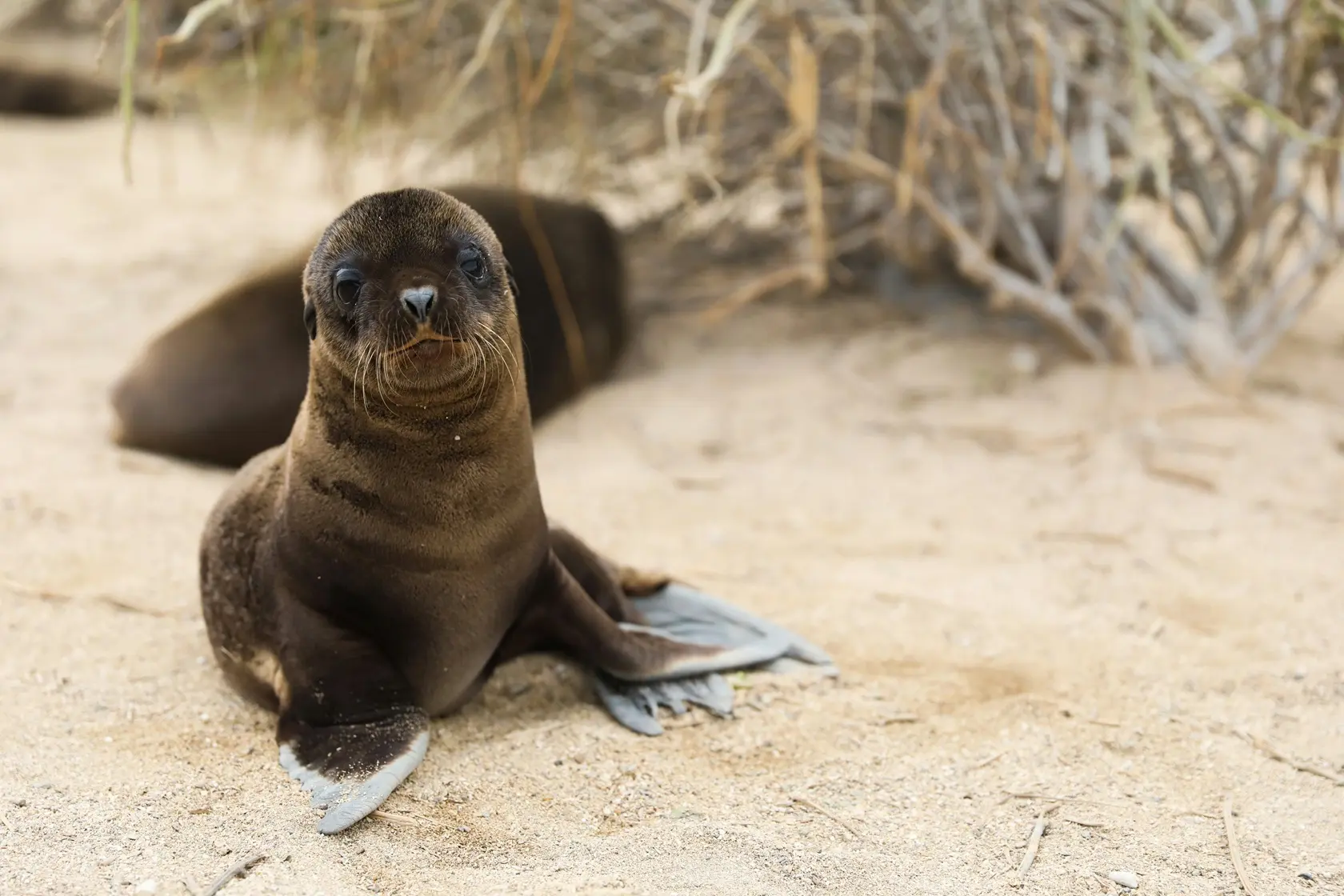
Physical Characteristics
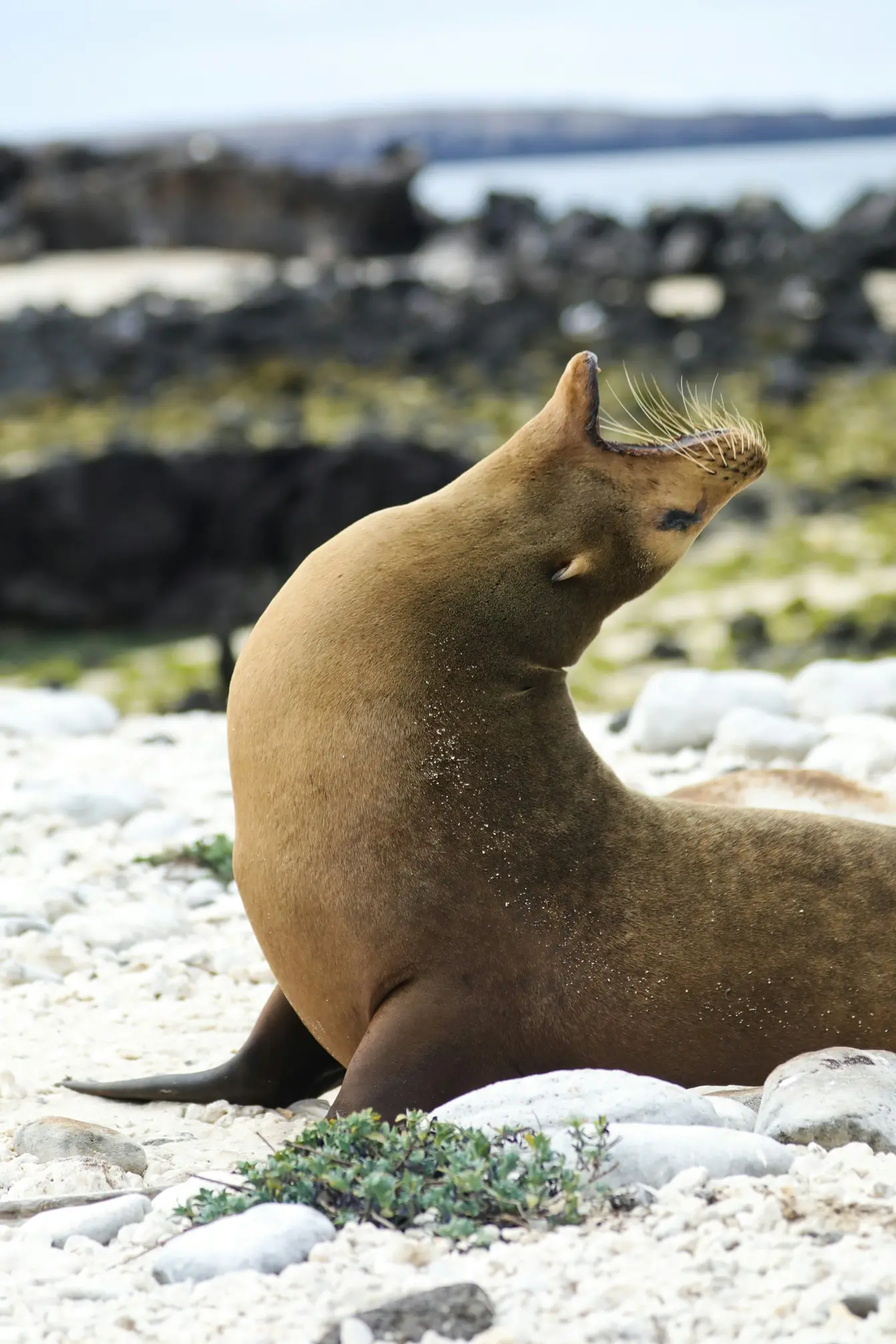
Stand two adult males next to each other from different species and most people wouldn’t clock the difference right away. Look closer and the muzzle gives it away — longer and noticeably more pointed than the blunt, bulldog-like snout of a California sea lion. Adult males also carry a bony bump on the forehead, a sagittal crest that thickens with age and testosterone, and it’s the fastest way to tell a mature bull from a female or a juvenile at a glance. Size does the rest of the sorting. Bulls typically run 2 to 2.3 meters long and weigh somewhere between 200 and 250 kilograms, though a dominant male in prime condition can carry more. Females stay considerably smaller — 1.5 to 1.7 meters and 50 to 100 kilograms — which means a big male can outweigh a female by a factor of three or four. Coat color runs from light tan to a grayish brown, with females and juveniles typically paler than the darker-coated bulls, and newborn pups arrive in a rich chestnut brown that lightens as they mature. The body itself is built for speed in water rather than bulk on land: smooth, torpedo-shaped, with a layer of blubber thinner than you’d expect for an animal that dives into cold upwellings. What actually sets pinnipeds like this one apart from true seals is in the hips. A sea lion can rotate its pelvic girdle and swing its rear flippers forward underneath its body, which lets it stand and even lope across rock — true seals can’t do this and have to haul themselves along on their bellies. On the jagged lava that passes for a beach in most of the Galápagos, that hip rotation is the difference between a clumsy scoot and a genuine sprint.Extraordinary Adaptations
Every Galápagos endemic seems to carry one adaptation built specifically for this archipelago and nowhere else, and for the sea lion it’s arguably the diving. Stomach-content studies and depth-tagging have recorded dives approaching 600 meters, with some individuals staying under for more than ten minutes at a stretch — a scientist tracking one female in 2013 followed her down close to 580 meters on a single dive. Most hunting happens far shallower, in the 30 to 40 meter range where lantern fish and small herring school, but the capacity to go deep when the shallow water comes up empty matters enormously during a bad year. Hunting itself only happens by daylight, as far as researchers have been able to tell — night dives haven’t turned up feeding behavior, which is unusual among marine predators and still not fully explained. What is understood is the metabolic trick that makes cold water bearable: a nursing mother’s metabolism slows once she’s back in cold water after a hunt, conserving heat and energy so she has enough left to nurse her pup through the night. Then there’s the land behavior, which looks almost more like a dog than a marine mammal. Pups learn to swim in sheltered coves within their first one to two weeks, shepherded by other juveniles as much as by their mothers, and adults doze on benches, docks, and boat ramps with the same unbothered posture they’d use on a beach. None of it reads as fear, because for this species, on this stretch of coastline, there’s rarely been anything worth fearing on land.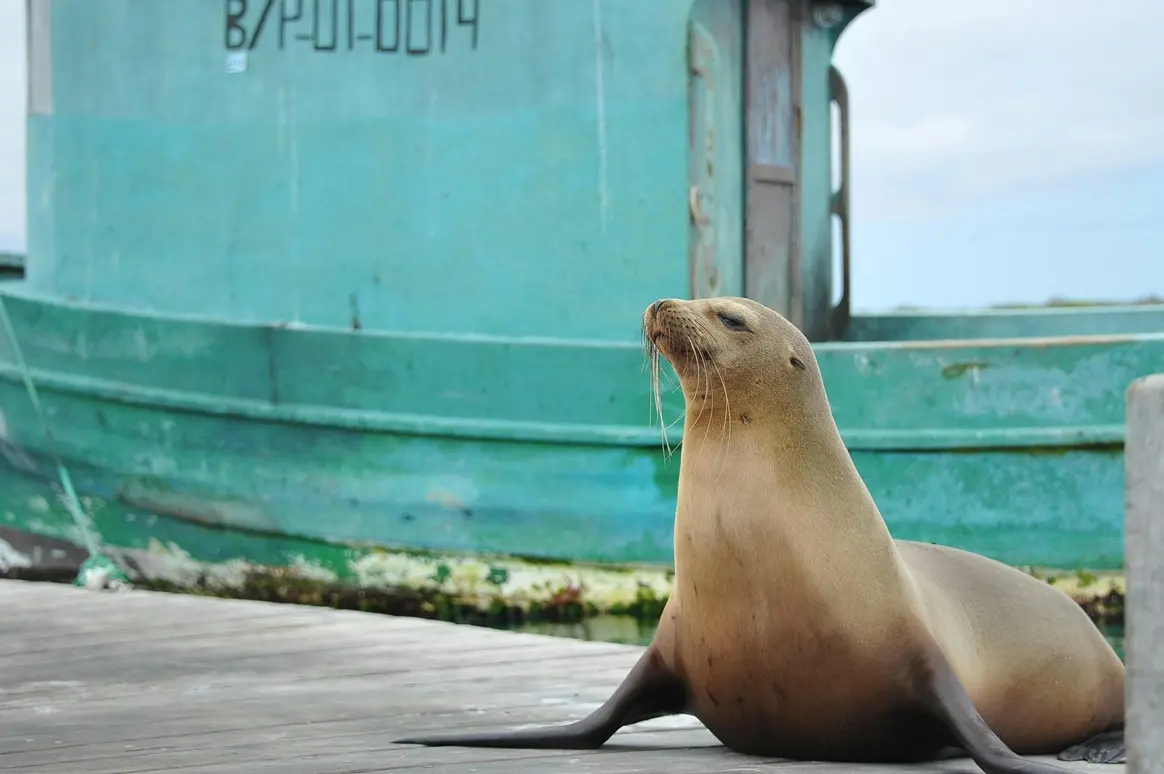
Distribution
Nearly every one of the sea lion’s breeding colonies sits inside the Galápagos archipelago itself, spread across virtually every island in the chain, which is part of why sightings feel so guaranteed on a Galápagos itinerary. Wanderers occasionally turn up much farther afield — a lone animal reached Isla de la Plata off mainland Ecuador back in 1986, others have been logged near Malpelo and Gorgona islands in Colombia, and there’s a confirmed sighting from Cocos Island, roughly 500 kilometers off Costa Rica. Panama’s Pacific coast sees occasional visitors too. None of these outposts function as breeding grounds, though; reproduction still happens almost exclusively inside Galápagos waters. There’s one exception worth knowing about, because it says something uncomfortable about where this species is headed. A colony of around 30 animals has taken up permanent residence on Foca Island, off the coast of Peru, sharing the rock with Humboldt penguins and South American sea lions. Researchers there have measured local sea surface temperatures climbing from roughly 17°C to 23°C over the past decade, and warmer water tends to draw in species built for it. It’s the first time an entire breeding-age group, rather than a scattering of lost individuals, has relocated outside the archipelago — and it lines up with warming trends already reshaping other parts of Galápagos marine life. Comparison Table: Where Galápagos Sea Lions Turn Up| Location | Population type | Notable trait |
|---|---|---|
| Galápagos archipelago | Core breeding population | Nearly all reproduction happens here; present on almost every island |
| Isla de la Plata, Ecuador | Occasional vagrants | First documented mainland sighting, 1986 |
| Malpelo & Gorgona, Colombia | Rare wanderers | No confirmed breeding recorded |
| Cocos Island, Costa Rica | Isolated sightings | Roughly 500 km from the archipelago |
| Foca Island, Peru | Established colony (~30 animals) | Linked to warming coastal waters; shares habitat with Humboldt penguins |
Behavior and Reproduction
During the May-to-January breeding season, bulls loudly defend harems of 5 to 25 females. This constant patrolling prevents them from eating, causing dominant males to burn through their fat reserves and lose their territory within a month to nearby rivals. Meanwhile, gestation lasts nearly a year, and nursing extends for 11 to 12 months, forging a mother-pup bond that can last up to three years—unusually long for marine mammals. To sustain this, mothers take short hunting trips and slow their metabolism at night to save energy. Unlike more structured species like Steller sea lions, Galapagos sea lion social groups remain loose and shifting, lacking the rigid hierarchy typical of the Otariidae family. Underwater, the same animal that looks lazy on a park bench turns genuinely playful — divers regularly describe individuals doing tight corkscrew turns, pushing their faces into a diver’s mask, and racing off only to loop back seconds later. Whether that play serves any real evolutionary purpose is still an open question; researchers who’ve tried to link social play to better hunting or fighting skills later in life haven’t found much evidence for it. The one consistent finding across those studies is that animals which play more tend to develop larger brains, which is a strange kind of consolation prize for a question that otherwise remains unanswered. Predation pressure comes almost entirely from the water. Galápagos sharks and orcas are the two confirmed predators, and scarred survivors carrying bite marks are common enough that researchers treat the threat as constant rather than rare. Sea lions aren’t entirely passive about it, either — adults and even pups have been seen mobbing a lone shark near shore to drive it off, a coordinated defense that shows up in few other pinniped species.Conservation Status
The Red List has carried this species as Endangered since 1996, and the threats stacking up against it are more varied than most people expect. El Niño events hit hardest and most directly: warmer water pushes the sardines and small fish this species depends on into deeper, cooler layers, which means longer dives, lower hunting success, and pups that don’t get fed enough during the exact window they need it most. A 2015 study on eye parasites tied to warmer water conditions found only 21 of 91 tracked pups survived, a mortality rate that gives a sense of how quickly a bad year can compound. Disease has played a role too — a Poxviridae outbreak added stress to populations already dealing with reduced food availability, and feral dogs on inhabited islands have been blamed for killing juvenile sea lions in a growing number of reports. Then there’s plastic. Roughly 45% of all plastic waste generated along the Pacific coast of South and Central America is mismanaged, translating into an estimated million tonnes leaking into the ocean every year, and sea lions that ingest it don’t tend to survive the encounter. None of this has stopped conservation groups from working the problem from multiple directions — monitoring pup survival rates season over season, running plastic-reduction partnerships across the eastern Pacific, and tracking population shifts like the Peru colony as an early signal of how the species might respond to continued warming. The population, last estimated between 20,000 and 50,000 animals, appears to have partially recovered from its worst years, though a species this closely tied to sea temperature will likely keep swinging with every future El Niño rather than settling into a stable number.